Wholesale Vitamin Suppliers for UK Businesses
The right wholesale range is the one that fits your route to market, not simply the one with the broadest catalogue. Wholesale vitamin suppliers in the UK may offer vitamins, minerals and other supplements as bulk stock, white-label products or products developed for a brand. Minimum order quantities and delivery thresholds are set by each supplier, so they depend on the product and ordering arrangement.
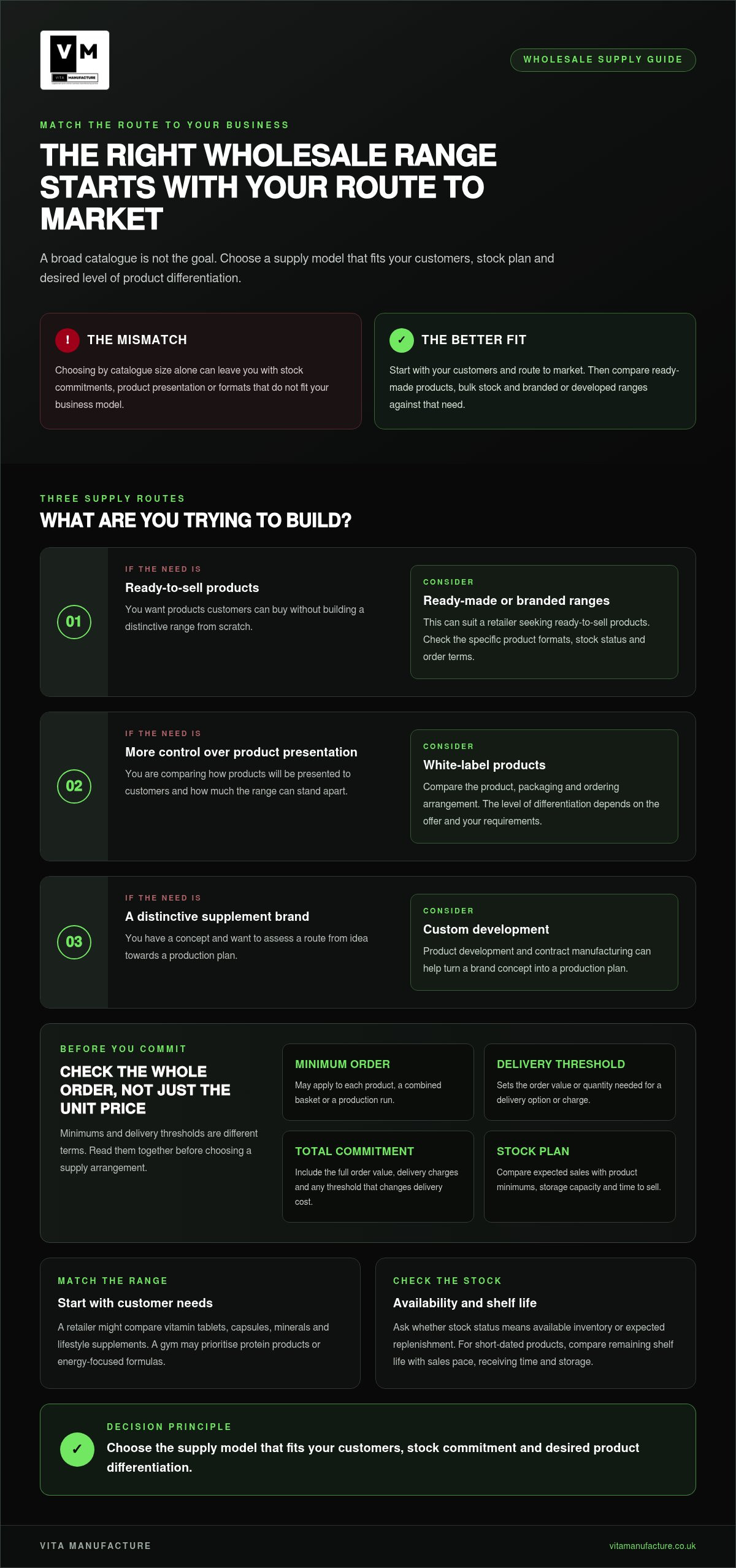
Look beyond the product list. Your choice affects how much stock you need to commit to, how products are presented to customers and whether the range suits your business model. A retailer seeking ready-to-sell products has different priorities from a founder building a distinctive supplement brand.
This article explains the main types of vitamins and supplements available wholesale, who each option may suit, and how minimum orders and delivery thresholds work. You’ll also learn what to consider when comparing supply models, so you can make a practical decision about the range and route to market that support your next stage of growth.
Table of Contents
Wholesale supplements and private-label products
Wholesale buying covers ready-made products, bulk ingredients and branded ranges. The right route depends on your customers, stock plan and desired level of product differentiation.
Product range and stock availability
Start by matching customer needs to product formats. A retailer might compare vitamin tablets, capsules, minerals and lifestyle supplements, whilst a gym may prioritise protein products or energy-focused formulas. Ask how stock status is displayed and whether it refers to available inventory or expected replenishment. Availability can vary by product and order size, so plan around the specific lines you intend to list.
Review short-dated products separately. Compare the remaining shelf life with your expected sales pace, receiving time and storage process before considering a discounted line. A lower purchase price has limited value if stock cannot sell before its use-by date. For online listings, include clear product names, ingredients, format, pack size and current availability. API integrations can help transfer catalogue and stock data into your systems, reducing repeated manual updates.
Prices and minimum orders
Compare supplier quotations in pounds sterling (£), using the same product format and pack size. A price for tablets cannot be compared fairly with a different-strength capsule or differently sized pack. Wholesale vitamin suppliers in the UK may set minimum orders by product, total basket or production arrangement. Identify which minimum applies, then calculate the stock commitment across the range you plan to carry.
Product prices depend on factors such as order volume, ingredients, format, packaging and whether the range is ready-made or privately labelled. Compare the full order value, not just the unit price. Include delivery charges and any threshold that changes the delivery cost. If a supplier offers a discount on short-dated stock, assess it separately from standard pricing and consider whether your sales cycle suits the remaining shelf life.
Quality checks and labelling requirements
Yes. UK sellers of food supplements must register as a Food Business Operator with their local authority. Review labels against the requirements that apply to the product and its presentation before sale. Check that product data, packaging artwork and online descriptions show consistent ingredient and pack information. Keep a record of the approved version for each product, especially when changing suppliers or packaging.
To assess quality evidence, request relevant certification details and product-testing documents, then match them to the supplier, product and batch. Check the certificate’s issuer, scope and validity dates; a certificate for one activity does not establish testing for every product. For a test report, compare its product or batch identifier with the stock being purchased and note which tests it covers. This creates a clear review trail for each line in your range.
Order minimums and delivery thresholds
Order terms shape cash flow, stock availability and how quickly products reach your business. Compare the full order commitment, not just the unit price, before choosing a supply arrangement.
How minimums and thresholds work
A minimum order can apply to each product, a combined basket or a production run. A delivery threshold is different: it sets the order value or quantity needed for a particular delivery option or charge. Read the terms together. A low product minimum may still require a larger basket to reach a delivery threshold, whilst a larger order could tie up cash in slower-moving stock.
Build a simple order plan around expected sales. For example, estimate demand for a multivitamin alongside other wellbeing products, then compare that forecast with the minimum for each line. Consider storage capacity and how long stock may take to sell. If minimums apply separately, adding an unfamiliar product may increase the commitment without improving the overall range.
UK delivery options and costs
UK delivery may be arranged as a single shipment to your premises, scheduled replenishment or direct fulfilment to customers. The method affects receiving, storage and order processing. Delivery costs can depend on the destination, parcel size, shipment method and whether the order meets a threshold. Compare the final delivered cost in pounds sterling (£), rather than treating the product price as the entire purchase cost.
Before setting a retail price, include delivery charges and any handling costs in your margin calculation. For example, a small top-up order may have a different delivery cost per unit from a consolidated shipment. Keep the calculation consistent across suppliers: use the same basket, destination and delivery method. That makes quotations easier to compare and helps identify which order pattern suits your sales cycle.
Recurring orders and fulfilment
Subscribe-and-save arrangements can schedule repeat orders, which may suit predictable demand for established lines. A recurring order still needs stock planning: review its frequency, product mix and cancellation or amendment terms against actual sales. A multivitamin that sells steadily may suit planned replenishment; a seasonal or trial product may not. Avoid letting an automatic schedule create surplus stock or restrict cash needed for other products.
Some wholesale arrangements include dropshipping or fulfilment, but these are not automatic parts of wholesale purchasing. Dropshipping generally means the supplier dispatches an order to your customer, whilst fulfilment can involve storing stock and processing orders. Confirm which party handles packing, delivery communication and returns. Those responsibilities affect the customer experience and your day-to-day workload.
For a distinct branded range, plan packaging and replenishment together. Supplement label graphic design can support clear product presentation, while a considered order plan helps align packaging decisions with stock requirements.
Vitamins and minerals
A focused range starts with the difference between vitamins and minerals. Vitamins are essential nutrients obtained from the diet, and the body cannot make them. Minerals are a separate product category, so plan listings and product information accordingly. Mintel reported that 38% of people in Britain regularly take vitamins, giving businesses a clear reason to understand this established category. That figure describes vitamin use, not demand for every individual product. Consider customer needs and format before choosing stock.
Specific nutrients can help define a range. Adults need 2.4 micrograms of vitamin B12 per day, and vitamin B12 is essential for vegans. A business serving vegan customers might therefore consider whether its selection includes a B12 supplement, alongside clear product information. Vitamin D is another distinct category: UK guidance recommends taking a supplement between October and March. These examples can inform range planning, but product descriptions should not turn nutrient facts into promises about individual outcomes.
Natural remedies and supplements can appear side by side in retail and online settings, but the categories are not interchangeable. A botanical or herbal product is not automatically a vitamin or mineral. Separate these product types in your catalogue, and describe each according to its ingredients and category. If a range uses terms such as “immune”, treat the wording as a descriptor, not proof of a particular effect. Clear product naming helps customers compare options without confusing ingredients with benefits.
Accurate nutrient information gives retailers a grounded way to explain product relevance. Vitamin D facilitates the absorption of calcium and phosphorus, whilst calcium and vitamin D both play a role in muscle function. These relationships can help organise product descriptions by nutrient, rather than relying on broad lifestyle language. Keep each explanation tied to the nutrient named on the product. For example, a vitamin D listing can describe its role in calcium and phosphorus absorption without implying that it prevents or treats a condition.
To build a practical range, list the customer groups and settings you serve, then map each product to a clear need. A shop serving vegan customers could assess B12; a broader wellbeing range might include vitamins and minerals with distinct, accurate descriptions. Review product format, ingredient details and catalogue wording together. This makes it easier to keep online filters, shelf categories and sales information consistent. When reviewing a potential range, separate nutrient facts from lifestyle positioning, and make sure each product’s information supports an informed choice.
Wholesale supplements for UK retailers, gyms and online stores
Choose products around your sales channel, not a generic catalogue. A high-street retailer, a gym and an online store need different stock plans, product information and customer journeys.
Retailers: organise shelves into clear categories, such as vitamins, minerals and sports nutrition. A pharmacy-style shop may prioritise everyday products, whilst a specialist health retailer could focus on particular customer lifestyles. Start with a defined range, then use sales records to identify which products merit replenishment. Keep pack formats and product descriptions easy to compare. If you sell several strengths or formats, label each clearly to reduce selection errors at the shelf and during stock counts.
Gyms: align the range with the setting and the questions members ask. Protein products, hydration formulas and products positioned for strength training may suit a fitness environment, but descriptions should accurately reflect ingredients and intended use. Separate nutrition products from services such as coaching, and avoid suggesting that a supplement guarantees muscle gain or improved performance. Start with a small group of relevant categories, then track member interest and repeat purchases before widening the range.
Online stores: product data does much of the work normally done by a sales assistant. Present ingredients, format, pack size, directions and stock status consistently across product pages. For example, a customer comparing two multivitamins needs clear information about each item, not broad claims about wellbeing. Use filters for categories such as vitamins, minerals and sports nutrition. Match catalogue updates to stock records, so an item shown as available can be fulfilled from inventory.
Each channel also changes how you plan inventory. A shop can review shelf space and weekly sales; a gym can compare product movement with membership activity; an online seller can analyse page views alongside completed orders. Use those signals to review slow-moving lines before placing another wholesale order. Keep seasonal products distinct from steady sellers, and avoid expanding the range simply because additional categories are available. A focused selection is easier to present and manage.
Branding is another decision. White-label products allow a business to sell products under its own brand, whilst private-label supplements support a branded range. Compare these routes with your capacity to manage packaging, product information and catalogue consistency. For an online launch, align product names and descriptions across packaging and web pages. For a gym counter, prioritise legible labels and a compact selection. The right choice depends on how prominently your business wants its own identity to appear.
Before ordering, write down three points: your target customer, the channel’s storage capacity and the products that fit its nutrition focus. Then compare supplier terms against those requirements. For example, a retailer with limited shelf space may favour a tighter range, while an online business may need broader category filters. This simple plan connects product choice to real operating conditions, rather than assumptions about what customers might buy.
Wholesale vitamin and supplement range
The best wholesale vitamin suppliers in the UK are those whose range, ordering terms and product information fit your business. Compare suppliers against the same shortlist, such as vitamins, minerals, sports nutrition and preferred delivery formats.
Range depth matters more than catalogue size alone. A focused selection might include vitamin D, vitamin B12, minerals and multivitamins, alongside supplements for specific customer groups. Compare tablets, capsules, powders and liquids by customer preference, storage needs and ease of listing. Check whether the range offers distinct products or several similar options competing for the same shelf space. That comparison helps you build a useful range instead of simply importing a broad catalogue.
Build a product matrix before assessing suppliers. For each line, record its category, format, intended customer, pack details and stock status. For example, a vegan-focused range could include B12, whilst a gym selection might prioritise sports nutrition. Keep product descriptions tied to ingredients and product information. Broad phrases about energy or wellbeing should not replace useful details customers need to compare products.
Stock continuity is another key measure. Review how availability is presented, how frequently catalogue information changes and what happens when an item is unavailable. A product shown as in stock can still create problems if replenishment disrupts your sales plan. Compare substitute options by ingredient, format and pack size rather than treating all products in one category as interchangeable. Capsules and tablets, for example, may suit different customer preferences.
Risks include unclear product data, inconsistent stock information, short-dated stock and order terms that do not fit your cash flow. Assess each risk against a real product and planned order. Match testing documents and certification details to the supplier and product, and check that batch references correspond with the stock being purchased. Compare labels, online descriptions and supplied product information for consistency before listing a product.
A practical supplier comparison can use three steps: define your target customers, shortlist the categories they need, then compare product details and order conditions. Record gaps as well as strengths. A supplier with fewer products may fit better if its range matches your needs and supports consistent product information. For branded ranges, decide whether white-label products or private-label supplements suit your desired level of differentiation and packaging control.
If you’re planning a distinctive branded range, explore private-label supplement development as a route from product concept to a market-ready range. Compare that approach with ready-made wholesale stock, using your customer preferences, range priorities and operating model to guide the decision.
There is no single best choice for every business. Prioritise suppliers whose products and formats fit your customers, whose stock and product information are consistent, and whose order terms suit your cash flow.
Vita Manufacture: New Product Development
Vita Manufacture is a natural next step if you want to move beyond ready-made wholesale stock and develop a supplement range around your business. Its New Product Development offering supports founders shaping a product concept, whilst Private Label Supplements and White Label Supplements provide routes to branded products. Contract Manufacturing is relevant when your business needs production for its range.
Bring your product concept, intended customers and preferred route to market into the discussion. This helps define whether development, a branded product or manufacturing is the right focus. For a project involving a medical device prototype, Vita Manufacture also offers Medical Device Product Prototype services.
Contact Vita Manufacture to discuss the next step for your product plans.
Shape your next stage of growth
Your next decision is whether to resell existing products or build a range with a stronger identity of its own. As you compare wholesale vitamin suppliers in the UK, consider how each route supports your long-term plans, from testing a market idea to developing products under your brand. A clear direction can help align your product strategy with the business you want to build.
Vita Manufacture offers New Product Development for businesses shaping a product concept, Contract Manufacturing for production, and Private Label Supplements for branded ranges. These options suit businesses moving beyond off-the-shelf sourcing towards a product proposition of their own. The right starting point depends on your concept, customers and intended route to market.
Ready to explore how your product idea could progress? Contact Vita Manufacture to discuss your plans. A focused next step can turn your ambition into a considered path forward.
Frequently Asked Questions
Which UK vitamin wholesalers supply retailers, pharmacies and online sellers?
The right supplier depends on whether you need resale stock or a branded product. Retailers, pharmacies and online sellers sourcing existing products should compare wholesale ranges and account terms against their customers’ needs. If you’re building your own range, Vita Manufacture offers Private Label Supplements, White Label Supplements and Contract Manufacturing. These services support businesses developing products under their own brand, rather than serving as a general retail wholesaler.
What are the minimum order quantities and wholesale prices for UK vitamin suppliers?
Minimum order quantities vary by product, formula and manufacturing process, so there isn’t one figure that applies across every range. Prices depend on factors such as product specifications, ingredients, format, packaging and order scale. For a useful comparison, define the product you need and the quantity you plan to purchase, then compare quotes in pounds sterling. For Vita Manufacture projects, pricing depends on the case and is provided after a quote request.
Which wholesale vitamin suppliers offer private label or white-label products?
Vita Manufacture offers both Private Label Supplements and White Label Supplements. These options suit businesses that want to sell supplements under their own brand, with the appropriate route shaped by the product concept and level of customisation required. For example, a founder with a distinct formulation concept may explore product development, whilst a business seeking a branded supplement can consider white-label products. Product claims and labelling must meet applicable UK requirements.
What are the delivery costs and lead times for UK vitamin wholesalers?
Delivery costs depend on the shipment arrangement, destination, order size and services involved, whilst lead times are determined per project. For example, a made-to-order product follows a different process from an existing product ready for dispatch. Vita Manufacture provides logistics and distribution as part of its business offerings. Include delivery requirements in your project or order brief so the fulfilment plan reflects your stock, packaging and destination needs.