Unflavoured Protein Powder: A Sourcing Guide
“Unflavoured” isn’t a complete ingredient list. Unflavoured protein powder has no added flavouring, but it may still contain an emulsifier such as lecithin. Check the label to see what is actually in the product, rather than relying on the front of the pack.
If you want a neutral base for drinks or recipes, unflavoured protein powder can be a flexible option. Unflavoured whey has a mild, slightly milky taste in water or milk. You can also stir it into warm oats after taking them off the heat.
This guide explains how to mix and serve unflavoured protein powder and how to assess its ingredients, including sweeteners, additives and other components. It also covers what to look for on the nutrition panel, so you can make an informed choice for your needs or product plans.
Table of Contents
Suggested serving and mixing instructions
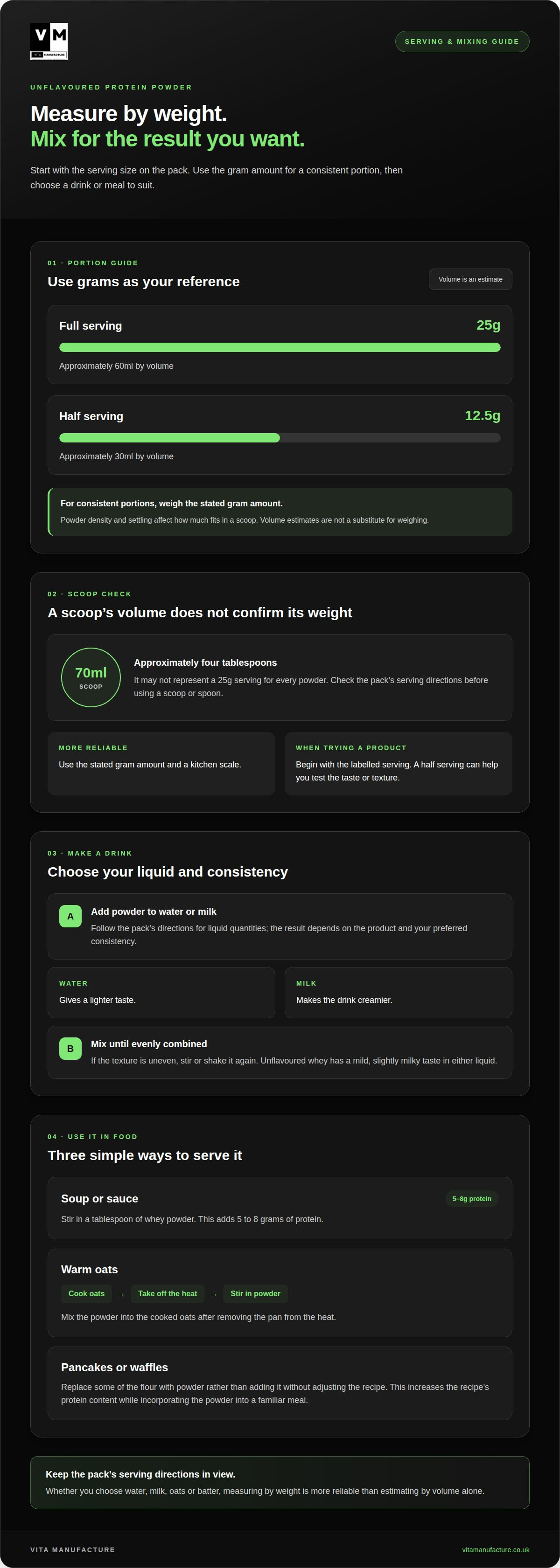
Start with the serving size on the product label, then measure it accurately. A 25g serving is approximately 60ml, while half a serving is around 12.5g or 30ml. These are volume estimates, not substitutes for weighing: powder density and settling can affect how much fits in a scoop. For consistent portions, use the stated gram amount and a kitchen scale rather than assuming every scoop holds the same weight.
A 70ml scoop is an approximate measure equal to around four tablespoons, but it may not represent a 25g serving for every powder. Check the pack’s serving directions before using a scoop or spoon. If you are trying a new product, begin with the labelled serving and adjust only in line with your intended daily intake. A half serving can be a practical way to test the taste or texture before preparing a full portion.
For a simple drink, add the powder to water or milk and mix until evenly combined. Water gives a lighter taste, while milk makes the drink creamier. Unflavoured whey has a mild, slightly milky taste in either liquid, without the sweetness or flavour of a flavoured blend. If the texture is uneven, stir or shake it again. Follow the pack’s directions for liquid quantities, since the result depends on the product and your preferred consistency.
Cooking offers other ways to use unflavoured protein powder. For warm oats, cook them first, take them off the heat, then stir in the powder. Adding it afterwards helps you mix it into the finished oats. For pancakes or waffles, replace some of the flour with powder rather than adding it without adjusting the recipe. This increases the recipe’s protein content while incorporating the powder into a familiar meal.
Soup or sauce: Stir in a tablespoon of whey powder. This adds 5 to 8 grams of protein.
Oats: Mix the powder into cooked oats after removing the pan from the heat.
Pancakes or waffles: Substitute some flour in the batter with powder.
These examples show how to use the serving size in drinks and meals. If you plan to use a product regularly, compare the gram serving on the label with its scoop guidance. Measuring a portion is more reliable than estimating by volume alone. Whether you choose water, milk, oats or batter, the powder’s mild taste leaves room for other ingredients to shape the result.
What is unflavoured protein powder?
Unflavoured protein powder has no added flavouring and can come from dairy or plant sources. The source and processing type affect its taste, ingredients and suitability.
Whey and plant-based options
Whey comes from milk and is available as concentrate or isolate. Pea and soy are plant-based alternatives, including for people who are lactose intolerant. The right source depends on dietary needs and how you plan to use the product. Check the ingredient list to identify the protein source, rather than relying on “unflavoured” alone.
Unflavoured whey has the same protein content, amino acid profile, leucine concentration and bioavailability as its flavoured equivalent. The absence of flavouring does not, by itself, mean the whey protein profile is different. Taste can vary by type: isolate is slightly more neutral, while concentrate has a creamier, more pronounced whey taste.
Whey concentrate and isolate
Concentrate and isolate are both forms of whey protein, but their tastes differ. Concentrate tends to have a creamier, more pronounced whey taste that may be noticeable in a drink or recipe. Isolate is slightly more neutral, so it may suit you when you want the protein source to have less influence on the finished flavour.
Neither description tells you everything about the finished product. Check the ingredients and nutrition panel to see what the powder contains and how much protein a serving provides. If you’re choosing between the two for a recipe, consider the intended flavour and texture. A more neutral taste may suit a lightly flavoured drink, while creamier whey may work well where dairy notes fit the recipe.
Unflavoured whey isolate ingredients
“Unflavoured” means there is no added flavouring, not necessarily that the formula contains just one ingredient. The ingredient list may include whey protein isolate and an emulsifier such as lecithin. The panel gives you a clearer picture than the front-of-pack wording, especially if you want to avoid particular additions.
Check each ingredient and distinguish the protein source from other components. Lecithin, for example, may be included as an emulsifier; its presence does not make the powder flavoured. Compare the list with your dietary preferences and intended use. A product containing whey is dairy-derived, whether or not it has added flavouring.
Safety and suitability
Suitability depends on the protein source and the person using it. People who are lactose intolerant can consider pea or soy protein, or whey isolate, which contains minimal lactose. This does not make every option suitable for every person, so check the ingredient details when dietary restrictions are involved.
Don’t treat “unflavoured” as a claim about safety or suitability. It describes flavouring, not the absence of all other ingredients. Read the full ingredient list and nutrition information, and consider whether the named source fits your needs. For a product concept, deciding on the protein source, ingredients and intended use early can make formulation choices clearer.
Avoiding sweeteners and additives
“Unflavoured” describes taste, but the ingredient list gives you the fuller picture. Unflavoured powders are often described as having no additives, sweeteners, flavourings, colourings or preservatives. Treat that description as a starting point and read the label of the specific product you’re considering. Formulas vary, and the front of a pack may not show every ingredient.
Start with the ingredients panel. Look for terms identifying sweeteners, flavourings, colourings and preservatives. If you want a powder without these additions, a short, clear ingredient list is easier to assess than a broad front-of-pack claim. Compare the full ingredient wording across products instead of assuming that two products labelled “unflavoured” have identical formulas.
Separate the protein source from ingredients added for other purposes. Whey protein, for example, identifies the base, while lecithin may be included as an emulsifier. An emulsifier is not a sweetener or flavouring, so its presence does not automatically give the powder a flavoured profile. Decide which ingredients you want to avoid, then compare each entry with your preferences.
Use a simple label-reading sequence:
Find the ingredients list. Don’t rely solely on words such as “plain” or “natural” on the front.
Identify the protein source. Note whether the product uses whey, pea or another protein.
Scan for additions. Look for any sweetener, flavouring, colouring or preservative stated in the list.
Review the nutrition panel. Compare sugars and protein per serving, then relate them to the ingredient information.
The nutrition panel adds context, but it does not replace the ingredients list. A serving’s sugar value, for example, describes the product’s sugars; it does not identify every ingredient or tell you whether flavouring was added. Use both panels together. If two labels list different ingredients, compare those differences directly rather than relying on their shared “unflavoured” description.
For a product concept, ingredient choices also shape how customers understand the formula from its label. A precise ingredient list can help distinguish the protein base from an emulsifier. In-house label graphic design can support a clear presentation, while the ingredient wording itself should accurately reflect the product. A clean-looking pack is no substitute for a complete, readable list.
The most useful test is straightforward: read every ingredient, identify its role, and compare the label with your requirements. This helps distinguish a simple formula from one that is merely unflavoured in taste.
Checking ingredients and product labels
Start with the ingredients list, then compare it with the nutrition panel. A genuinely unflavoured powder can list whey protein and no other ingredients apart from an emulsifier such as lecithin. That distinction matters: lecithin may support mixing, but it is not a sweetener or flavouring. Read the full list rather than relying on front-of-pack wording alone.
Next, compare protein figures using the same basis. One product example provides 19.6g of protein per 25g serving and 79g per 100g. Both figures help: the serving value shows what one portion contributes, whilst the per-100g value makes comparisons between products easier. Check that the serving size on the label matches the amount used for its nutrition figures.
Sugars and other nutrition values add useful context. In the same example, a 25g serving contains 1.1g of sugars, and the product contains 0.15g of cholesterol per 100g. Keep the units beside each number. Comparing 1.1g per serving directly with a per-100g figure would give a misleading impression.
For UK quality certifications and testing, look for a clearly named certification and understand its scope, alongside any product-specific test results. A certification label alone does not tell you which ingredients or contaminants were tested, so read any available results with the product information.
Testing details can be useful when they identify the substance tested and the reported result. For example, one product reports a lead test result below 0.0100 mg/kg and a BPA test result below 0.005 mg/kg. These are results for that product, not universal limits or results for every protein powder. Keep the test name, value and unit together when interpreting the claim.
Use this sequence to review a pack or product specification:
Identify the protein source. Note whether the ingredients name whey protein or another source.
Read every ingredient. Look for sweeteners, flavourings, colourings, preservatives or an emulsifier such as lecithin.
Compare nutrition figures. Check protein per serving and per 100g, then note sugars and their stated basis.
Review quality claims. Find the certification name and scope, and read product-specific testing with its units.
This approach turns label claims into comparable details. For example, a short ingredient list, protein values on both serving and per-100g bases, and clearly presented test results each answer a different question. Assess them together rather than treating one number or badge as proof of the whole product’s quality.
A 25g serving of the product provides 98.8 kcal, adding an energy measure to the protein, sugars and test details considered above.
Are unflavoured protein powders safe, and who should avoid them?
“Unflavoured” describes taste, not whether a product suits everyone. Suitability depends on the protein source, ingredients and your dietary needs. Unflavoured protein powder made with whey is still dairy-derived, even without added flavouring. Check the ingredient list to understand what the product contains, rather than treating its flavour description as an indication of allergens.
Lactose intolerance may affect your choice. Pea or soy protein are plant-based options, while whey isolate contains minimal lactose. These sources aren’t interchangeable for every diet: whey isolate is still a milk protein, whereas pea and soy are plant-based. If you’re choosing unflavoured protein powder to suit a dietary restriction, identify its source first and read the full ingredient information.
Consider the serving in the context of your overall diet. For people training regularly, 1.6-2.2g of protein per kilogram of bodyweight per day is a commonly used starting point for total daily protein. It is not a recommended amount to take from powder alone. Account for protein from meals and drinks as well, and use the product’s serving directions when preparing it.
Storage is another practical part of using a powder as directed. Keep the container sealed in a cool, dry place away from direct sunlight. Under those conditions, a product can stay fresh for up to 6 months after opening. Follow the storage instructions on its packaging, and keep the seal closed between uses.
Before choosing a product, consider these points together:
Dietary fit: Match the named protein source to your requirements.
Ingredients: Read the full list, including any emulsifiers or other components.
Serving: Consider powder as one part of your daily protein intake.
Storage: Keep the pack sealed and follow its stated directions.
For a supplement concept with carefully considered ingredients and product information, explore supplement product development.
Vita Manufacture
Vita Manufacture can help turn decisions about protein source, ingredients and labelling into a commercially considered supplement project. If you’re developing a product or expanding an existing range, Supplement Product Development, Custom Supplement Manufacturing and Private Label Supplements offer routes from concept towards production.
Clear ingredient choices and accurate product information are central to positioning an unflavoured formula. Vita Manufacture supports supplement development and manufacturing for founders and established brands. To move your product plans forward, outline your intended protein source, ingredient preferences and product goals.
To discuss your supplement project, contact Vita Manufacture.
Shape your next product decision
Turn your product idea into a clear brief by defining its audience, formula priorities and place in your range. For unflavoured protein powder, these decisions can shape how you develop and position the product. A considered concept also helps align the formula with your commercial direction.
Vita Manufacture supports supplement projects through Supplement Product Development, Custom Supplement Manufacturing and Private Label Supplements. If you’re planning an unflavoured protein powder, these services can help you move from a defined concept towards a product that fits your business plans. The right starting point depends on your development and production needs.
Bring your priorities together and take the next step at a pace that fits your plans. Contact Vita Manufacture to discuss your needs, and move your concept towards its next stage with confidence.
Frequently Asked Questions
What's the difference between whey protein and whey isolate?
Whey isolate is a more processed form of whey and has a slightly more neutral taste than whey concentrate. Concentrate has a creamier, more pronounced whey flavour. Both are dairy-derived, so neither is plant-based. For a recipe, consider how noticeable you want the whey taste to be. For dietary suitability, focus on the product’s stated ingredients and protein source.
How do whey, casein and plant-based unflavoured protein powders compare?
Whey and casein are milk proteins, while pea and soy are plant-based options. The source is key when considering dietary choices: whey and casein are unsuitable for someone avoiding dairy, while pea or soy may suit a vegan diet. Plant-based powders can differ in taste and composition, so compare the specific product’s ingredients and nutrition panel rather than assuming all sources are equivalent.
How can you check the ingredients and nutrition of unflavoured protein powder?
Read the ingredients list and nutrition panel together. Confirm the named protein source, note any additional ingredients, then compare protein and sugar values on the same basis, such as per serving. For example, don’t compare one product’s per-serving protein figure with another’s per-100g value. If you are assessing a product for a particular diet, use the ingredient details rather than relying on “unflavoured” as a description.
Does unflavoured protein powder taste or mix well in water, smoothies and cooking?
Unflavoured whey has a mild, slightly milky taste in water, without adding sweetness to a drink. In a smoothie, ingredients such as fruit can shape the overall taste. For cooking, stir whey into oats after taking them off the heat, or replace some flour in pancake batter. Follow the pack’s mixing directions, as liquid quantities and texture vary between products.
How do you choose an unflavoured protein powder for vegan, lactose-free or allergen-free diets?
For a vegan option, choose a plant-based source such as pea or soy, not whey or casein, which are milk proteins. Someone avoiding lactose may consider plant protein or whey isolate, which contains minimal lactose. For other allergies, read the full ingredient and allergen information on the specific pack. “Unflavoured” describes taste; it does not mean the product is allergen-free.
What UK quality certifications and testing should you look for in protein powder?
Look for reported testing results: the product’s lead test result is below 0.0100 mg/kg, and its BPA test result is below 0.005 mg/kg. No specific UK quality certifications are identified.
What are the best unflavoured protein powders in the UK?
Bulk Pure Whey Protein Powder, Unflavoured, is one option. Check its ingredients and nutrition panel to see whether the protein source and formula suit your needs.