Supplement manufacturing costs per unit explained
A supplement’s unit cost reflects the whole production run, not just its ingredients. Supplement manufacturing costs per unit depend on the formula, production labour, overhead, packaging and order volume. Larger runs can spread fixed costs across more units, while complex formulas or specialist packaging can increase the cost.
If you’re planning a private-label launch, you’ll naturally want a clear figure for budgeting. The more useful starting point is to understand what drives the unit price, so you can compare production options and make informed decisions about your product.
This guide explains how materials, labour, overhead, packaging and order volume affect costs, including how capsule production changes at different scales. You’ll see why products in similar bottles can have very different cost structures, and which decisions matter most when planning a commercially viable launch.
Table of Contents
How much does it cost to manufacture Private Label Supplements?
There is no single UK average that applies to every product: costs depend on the formula, dosage form, packaging and production volume. UK labels must clearly identify ingredients from animal sources, and health claims must use claims permitted under applicable UK rules.
Formula and Specification Choices
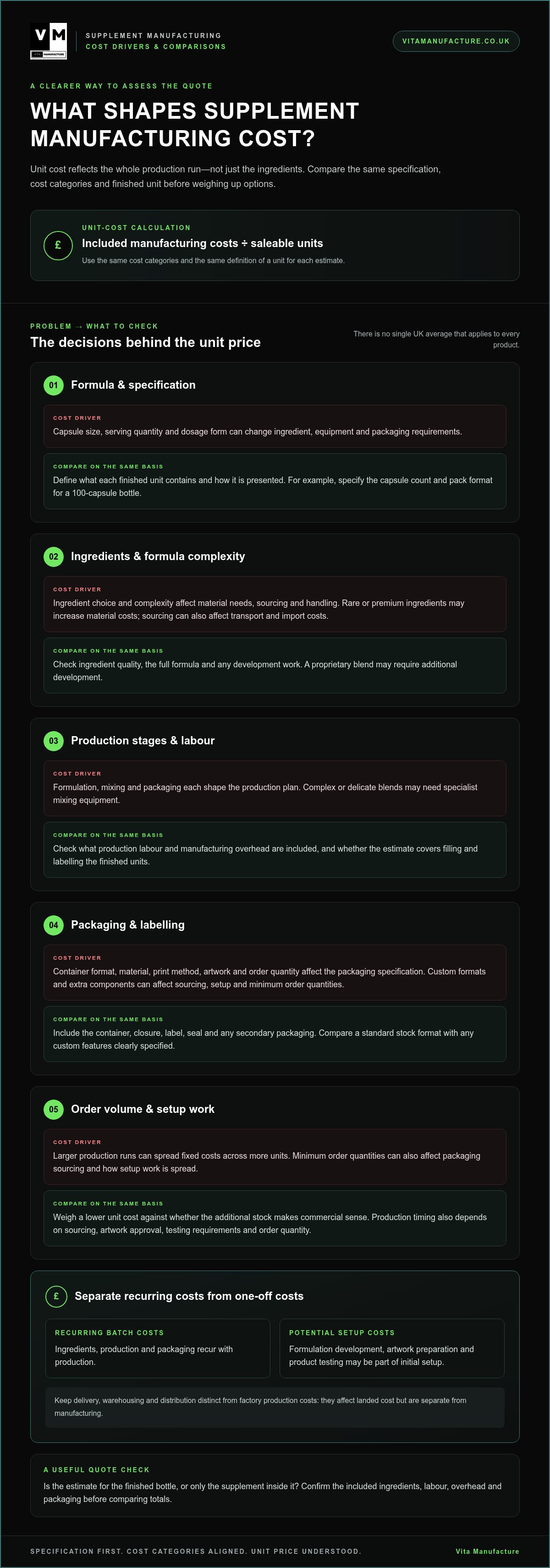
A product specification sets out what each finished unit must contain and how it must be presented. It matters because changing capsule size, serving quantity or dosage form can affect ingredients, equipment and packaging requirements. For example, a 100-capsule bottle needs a defined capsule count and pack format. Fixing these choices early makes manufacturing comparisons more meaningful.
Ingredient Selection and Formula Complexity
Ingredient selection determines the materials a formula needs, while its complexity affects how those materials are combined. Sourcing and handling requirements vary widely across categories—from adaptogens and probiotics to targeted canine formulas like supplements for mastiff puppy joint health. Rare or premium ingredients can increase material costs, while domestic or international sourcing can affect transport and import costs. A proprietary blend may also require additional development work.
Formulation, Mixing and Packaging Stages
Manufacturing moves through formulation, mixing and packaging, with each stage shaping the production plan. Formulation sets ingredient amounts and product specifications; mixing combines ingredients into a consistent batch; packaging fills and labels the finished units. Complex or delicate blends may need specialist mixing equipment, and the dosage form determines suitable production and filling processes.
Packaging also affects the product specification: capsules in a bottle follow a different filling route from gummies in a pouch. In the UK, permitted health claims and clear ingredient information are part of label planning, not just final artwork checks. Build these requirements into the specification before production begins.
Manufacturing Cost per Unit
Calculate unit cost by dividing total included manufacturing costs by the number of saleable units. Include direct ingredients, production labour, manufacturing overhead and packaging, while keeping one-off development expenses separate from recurring batch costs. For example, a formulation-development charge affects launch investment, while ingredients and bottle filling recur with production.
To compare supplement manufacturing costs per unit, use the same cost categories and unit definition for each estimate. Check whether the calculation covers the finished bottle or only the supplement inside it. Also distinguish factory production costs from delivery, warehousing and distribution, which affect landed cost but are separate from manufacturing.
Packaging and labelling costs
Packaging affects the finished product’s presentation, protection and production plan. For a private-label supplement, the container, closure, label artwork and print method all shape the specification. Custom formats involve decisions that standard stock packaging avoids, and each additional component can affect sourcing, production setup and minimum order quantities.
Packaging costs depend on the container format, material, print method, artwork and order quantity. A quote based on these requirements gives you a product-specific figure.
Packaging components and customisation
Start with a container suited to the product and its intended use. A stock bottle or jar provides a standard format; a custom container or specialist closure requires a more specific packaging plan. Include the label, seal and any secondary packaging in the specification, rather than comparing container costs alone. For example, a bottle with a custom closure has different sourcing and assembly requirements from a standard bottle with a basic label.
Label design involves more than choosing colours. The layout needs room for product identity, ingredients, directions and required regulatory information. Changes to serving details or ingredients can require artwork revisions, so finalising the formula before print setup helps avoid rework. Vita Manufacture’s in-house label graphic design connects visual choices with the product information required on pack.
Private label versus custom manufacturing
Private label typically adapts an existing formula, while custom manufacturing develops a product around a distinct specification. The difference affects more than ingredients: a custom formula may require development work, additional testing and bespoke packaging decisions. A private-label product using a standard formula may follow a more established production route, while custom blends can require closer coordination between formulation, label content and packaging.
First-batch planning should account for both recurring production items and setup work. Ingredients, packaging and filling recur with each batch; artwork preparation, formulation development and product testing may be part of initial setup. Testing needs depend on the product and its specification. Keeping these as separate cost categories clarifies launch planning and distinguishes one-off development expenses from ongoing unit costs.
Minimum order and production timing
Minimum order quantities can affect packaging sourcing and how setup work is spread across finished units. Custom print runs, specialist containers and bespoke closures may require coordinated purchasing before filling begins. A standard bottle with an approved label can follow a simpler sequence. The production timetable depends on component sourcing, artwork approval, testing requirements and order quantity, not packaging alone.
Map the sequence from approved artwork to component purchasing, filling and final labelling. This helps identify whether a late design change could hold up packaging or create unused printed stock. If your product needs coordinated formulation and pack development, supplement development planning can bring those decisions together as the specification takes shape.
Per-unit savings at higher production volumes
Larger runs can reduce unit costs by spreading fixed expenses across more finished products. The benefit depends on the formula, ingredients, testing and whether the additional stock suits expected demand.
Price Breaks at Higher Volumes
A price break is a lower unit rate offered for producing a larger batch. Compare quotes at two, five and ten times the proposed batch size to see how volume changes the calculation. Ingredient purchasing can also shift: bulk orders of 5,000 or more units can reduce per-unit ingredient costs by 25-40%. These savings apply to ingredients, not automatically to every cost category.
Once a formula is approved and production is optimised, per-unit costs may fall over time. Larger runs spread fixed costs across more units, but increase the total stock commitment. A lower unit rate is most useful when sales forecasts support the quantity and the product remains suitable for sale.
Tracking Production Costs
Track each product separately, then divide its batch costs by the number of saleable units. Record raw materials, labour, overhead, packaging and testing as distinct categories. This makes it easier to see whether a change in unit cost comes from ingredient purchasing, production volume or another part of the process.
For multiple products, keep separate cost records even when they share a production run. A capsule and a powder can use different ingredients, packaging and processes, so combining them can obscure each product’s true cost. Compare like with like: use the same batch size, pack format and cost inclusions when reviewing quotes.
Include testing in the batch calculation, not as an afterthought. Since testing is associated with the product, its per-unit impact changes with the number of units sharing the cost. Keep testing separate from recurring ingredient and packaging costs when comparing repeat production.
For example, if a capsule formula uses the same specification across two proposed volumes, compare the raw materials, labour, overhead, testing and packaging for each run. Then divide each total by the saleable units. This shows whether a lower unit cost reflects genuine volume efficiencies or simply excludes a cost included in the other estimate.
Review the figures after each production run. Compare actual ingredient use, finished quantity and testing expenses with the planned batch. If the number of saleable units differs, recalculate unit cost using the finished quantity rather than the planned order. This keeps forecasts grounded and highlights which production assumptions need updating.
Direct materials, labour and manufacturing overhead
A supplement’s manufacturing cost combines the materials used in the product with production labour and factory overhead. Separating these expenses shows which inputs drive unit cost and how larger runs affect their allocation.
Direct Material Costs
Direct materials are the ingredients and packaging components used to make each finished product. Raw materials typically account for 40-60% of supplement manufacturing cost, whilst ingredients account for 30-50% of cost of goods sold. These figures use different cost bases, so compare them only with matching categories. For brands choosing premium ingredients, organic, non-GMO or clinically dosed actives can add 15-30% to ingredient costs.
Ingredient choice shapes material costs before production begins. A formula using collagen peptides, adaptogens or probiotics can have different sourcing needs from a simpler blend. Premium or rare ingredients can increase expenses, while domestic or international sourcing affects transport and import costs. Calculate the quantity of each ingredient needed for the batch, then include bottles, closures and labels to understand direct material requirements.
Manufacturing Labour per Unit
Manufacturing labour covers the work required to prepare, process and pack a batch. The figure combines these two categories, so it should not be read as labour alone. Production format, handling needs and the work involved in filling bottles all influence the labour allocation.
When interpreting a quote, distinguish direct labour from shared factory expenses. Direct labour relates to tasks performed on a particular batch; shared production support may be allocated across multiple products. Capsule and gummy runs can involve different handling and equipment demands. The same unit volume is therefore an imperfect basis for comparing labour unless the product specifications also match.
Manufacturing Overhead per Unit
Manufacturing overhead includes factory expenses that support production but cannot be traced to a single ingredient or bottle. Equipment, facility use and production support are allocated across the units made. A larger batch can spread these fixed expenses across more bottles, reducing their share per unit. Lower output or downtime has the opposite effect because overhead is divided across fewer finished products.
Keep the allocation method consistent when comparing products. For example, compare two capsule batches using the same overhead categories and saleable-unit count. If one calculation excludes factory costs, its unit price does not represent the same manufacturing scope. Separating ingredients, labour and overhead helps show whether differences come from a premium formula, production process or factory allocation.
For a practical cost breakdown, calculate each category separately: total direct materials, add production labour, then include allocated overhead. Divide the combined manufacturing total by the saleable units. This prevents bottle or ingredient expenses from being mistaken for the full production cost and gives brands a clearer basis for comparing batch plans.
Capsule manufacturing costs at different order volumes
Capsule production costs depend on batch size, formula and pack specification. Gummies and softgels generally cost more to manufacture than standard capsules or tablets, while powder costs vary with ingredients and packaging.
Minimum order quantities for capsules or tablets can vary between manufacturers. Manufacturers may offer test runs of 1,000-2,000 units, but the unit cost increases. Some manufacturers commonly require 100,000-200,000 capsules, so distinguish capsule count from finished-bottle quantity when comparing minimums.
Larger minimum orders can make production more competitive per unit because fixed costs are spread across more finished products. However, the total order commitment also rises. A smaller test run may suit early market validation, while a larger batch may suit brands with established demand and storage plans. MOQs vary by product, formula and manufacturing process.
Compare capsule volumes on equal terms
Use the same capsule count, formula, bottle format and testing scope when comparing production quotes. A standard 60-count capsule product at a 1,500-bottle run differs from one made at 10,000 or 25,000 bottles: the batch size changes how fixed costs are allocated. Compare the quoted total and unit basis, not just the headline unit rate.
Bulk purchasing at 5,000 or more supplement units reduces per-unit ingredient costs by 25-40%. That saving applies to ingredient costs, not necessarily the whole manufacturing total. At higher production volumes, per-unit costs typically drop 30-50% once the formula is approved and production is optimised, in year 2 and beyond.
Capsules and tablets also differ from gummies and liquids in minimums. Typical minimum order quantities for gummies or liquids are 10,000-20,000 units. Their larger minimums can create a different stock commitment, even as greater volume helps distribute fixed costs. Compare a format’s minimum against realistic sales demand before selecting it.
Read quotes beyond the unit figure
Consider quality control and testing alongside production volume. Testing can include identity checks, microbial testing, heavy metal screening and label compliance review. These requirements affect the overall production plan, so compare quotes with the same testing and packaging scope.
For a clear comparison, record the batch quantity, saleable bottle count, formula, packaging, testing and included production work. Divide the total included manufacturing costs by saleable units, then compare like-for-like estimates. This prevents a lower unit figure from seeming more competitive simply because it excludes a relevant cost.
Planning a capsule launch? Discuss your capsule manufacturing requirements and align the product specification with your intended production volume.
Vita Manufacture: New Product Development
Vita Manufacture’s New Product Development can turn a supplement concept into a defined product specification. It is a natural next step when you’re weighing formula choices, packaging requirements and production volumes, or when an existing private-label option does not fit your product vision.
For a new formula, development connects ingredient and specification decisions with the practical requirements of manufacturing. If your product is ready for production, Vita Manufacture’s Contract Manufacturing service provides a route from an agreed specification to a production plan. The right starting point depends on how developed your formula is and what needs resolving before manufacture.
Share your product goals and current specification with Vita Manufacture to discuss the next step, or visit Vita Manufacture online.
Turn your product plan into a clear next step
Use your cost model as a decision-making tool, not simply a target to minimise. The right specification should support your product’s identity, quality requirements and commercial direction. A clear view of your priorities helps you shape a launch plan around the product you intend to build.
If you’re still developing your concept, Vita Manufacture’s New Product Development service can help progress the product specification. If you’re ready for production, Contract Manufacturing and Private Label Supplements provide different routes to market. Set out your product idea, preferred format and production goals, then discuss how they fit together with Vita Manufacture.
Understanding supplement manufacturing costs per unit gives you a stronger foundation for making those decisions. Contact Vita Manufacture about your project and take the next step towards bringing your supplement concept to market.
Frequently Asked Questions
Do costs go down when you reorder?
Keeping the approved formula and packaging specification unchanged avoids repeating some initial development and setup work. Once a formula is approved and production is optimised, per-unit costs typically drop 30-50% in year 2 and beyond. A repeat run can still involve new batch testing, ingredient purchasing and packaging, so compare its full production scope with the original order before planning your margin.
How do I read a manufacturing quote properly?
Check the quote’s unit definition, batch quantity and included work before comparing headline figures. Confirm whether it covers packaging, testing, tooling and the master batch record, then separate delivery or storage expenses. Two quotes with the same unit price can differ substantially in landed cost once these items are included. Build a like-for-like comparison using the same product specification.
What is the typical cost per bottle?
Treat this as a broad manufacturing reference, not a universal finished-bottle price: the formula, pack format and included production work change the calculation. A bottle cost can also include packaging, testing or delivery, so identify the elements covered before using the figure in your retail margin model.
What can you control before you ever ask for a quote?
Prepare a clear product brief before requesting a production estimate. Define the intended dosage form, serving quantity, ingredients, target pack format and preferred batch volume. Note any premium ingredient requirements and whether you want a standard or custom formula. For example, a capsule brief that specifies the capsule count and bottle format gives manufacturers a clearer basis for estimating materials, production steps and packaging needs.
Why do two quotes for the same formula come back so different?
Quotes can differ because they include different production tasks, packaging specifications or testing scopes, even when the formula is the same. One estimate might cover finished, labelled bottles, while another prices bulk product alone. Tooling, batch documentation and delivery can also affect the landed total. Compare each line item and the number of saleable units rather than assuming the lowest quoted unit figure represents the same finished product.
How do ingredients, potency and formulation complexity affect supplement production costs?
Ingredient choice and serving strength determine how much raw material each unit needs. A higher-potency specification can require more active ingredient per serving, whilst a blend with several actives adds sourcing and mixing considerations. Premium ingredients, including organic, non-GMO or clinically dosed actives, add 15-30% to ingredient costs. Custom blends can also need additional development, so finalise the target serving and ingredient list before comparing production estimates.
What are typical UK costs for supplement packaging, labels and bottling per unit?
These figures cover different packaging and design elements, so don’t add them together without checking what each estimate includes.
How do batch size and production volume change the cost per supplement unit?
Larger batches spread fixed production expenses across more finished units, reducing the amount allocated to each one. However, the total order commitment and stock to manage also increase. Include inventory handling in your financial plan, so you assess a lower factory unit cost alongside the costs of holding and distributing stock.