Starflower Oil in Supplements: Formulation Guide
A capsule’s oil weight tells you less than its fatty-acid profile. Starflower oil is valued in supplements for its gamma-linolenic acid (GLA), an omega-6 fatty acid. The amount of oil in a capsule doesn’t reveal how much GLA it provides, so compare both figures when assessing starflower oil supplements.
It’s understandable to focus on what starflower oil may do, especially when supplements are promoted for specific health concerns. Effects aren’t guaranteed, so it helps to distinguish the fatty acids the oil supplies from claims about how you might feel.
This guide explains how GLA and linoleic acid relate to supplement formulations, what to compare on capsule labels, and how dietary sources fit in. It also covers why capsule strength alone can mislead, which product-quality details to consider, and when to seek professional advice before taking a supplement.
Table of Contents
Dosage and capsule composition
Capsule directions and fatty-acid amounts are more informative than oil weight alone. There is no UK or EU recommended daily allowance or upper safe limit for starflower oil.
Suggested supplement dosage
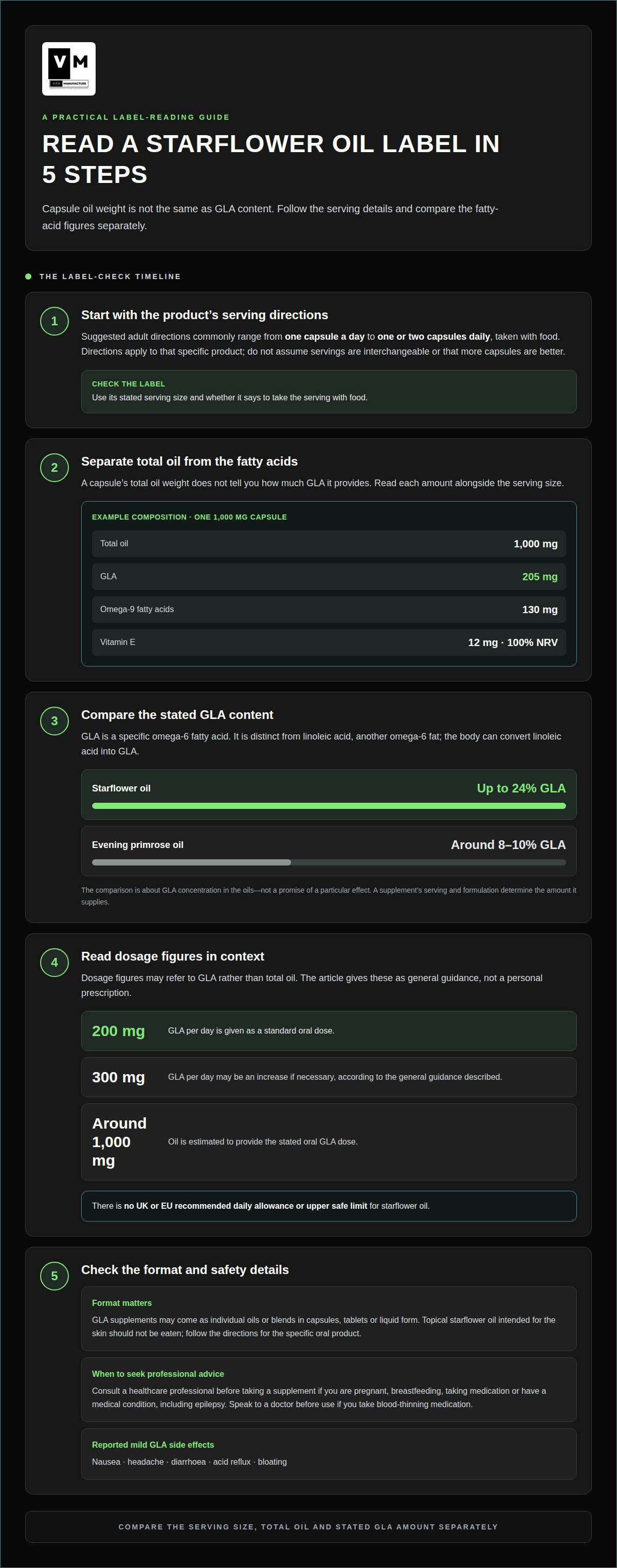
Suggested adult directions commonly range from one capsule a day to one or two capsules daily, taken with food. The label gives the serving for that specific supplement, so directions aren’t interchangeable. Follow the stated amount rather than assuming more capsules are better. A healthcare professional may recommend a different approach for your circumstances.
Dosage figures can also describe GLA, not total oil. Around 200 mg of GLA per day is given as a standard oral dose, with an increase to 300 mg per day if necessary. Around 1,000 mg of oil is estimated to provide the stated oral GLA dose. These figures describe general guidance, not a personal prescription for rheumatoid arthritis or breast symptoms.
Dosage and forms of use
GLA supplements come as individual oils or blends in capsules, tablets or liquid form. The format affects how the serving is described: a capsule may list its total oil weight, while a liquid serving may be measured differently. Compare the directions and stated GLA amount, rather than treating one capsule or spoonful as a universal dose.
Topical liquid is used differently from an oral supplement. Liquid starflower oil intended for application to the skin should not be eaten. Take oral formats according to their own label directions, including whether to take the serving with a meal. For example, a direction to take one capsule daily with food applies to that specific product.
Consider a 1,000 mg capsule: it can contain 205 mg of GLA and 130 mg of omega-9 fatty acids. A product may also provide 12 mg of vitamin E, equivalent to 100% of the NRV. The total oil weight alone therefore doesn’t show how much GLA or other listed nutrients the serving supplies. Read each amount alongside the stated serving size.
Before taking a supplement, consult a healthcare professional if you’re pregnant, breastfeeding, taking medication or have a medical condition, including epilepsy. Speak to a doctor before use if you take blood-thinning medication. Reported mild GLA side effects include nausea, headache, diarrhoea, acid reflux and bloating. These considerations matter even when the label gives a straightforward daily serving.
Gamma-linolenic acid and linoleic acid
Starflower oil can contain up to 24% gamma-linolenic acid (GLA), an omega-6 fatty acid. Understanding how GLA differs from linoleic acid helps you interpret an oil’s composition without treating all omega-6 fats as equivalent.
Gamma-linolenic acid content
GLA content describes the share of the oil made up by this specific fatty acid, rather than the total oil amount. Starflower oil contains up to 24% GLA, while evening primrose oil typically contains around 8-10%. The comparison helps explain why oil sources can differ in concentration, but it doesn’t establish which supplement is suitable for a particular condition.
What gamma-linolenic acid is
GLA is an omega-6 fatty acid found mainly in plant-seed oils, including evening primrose, starflower, blackcurrant and hemp. It’s distinct from linoleic acid, another omega-6 fatty acid found in the diet. The body can convert linoleic acid into GLA, so the two names refer to related fats, not identical ingredients.
This distinction matters when reading a product label. A supplement may state its source oil and total oil quantity, but that doesn’t necessarily reveal its GLA percentage. Look for the GLA amount separately and consider it alongside the serving size. This makes comparisons clearer than relying on the source name alone.
Starflower, also known as borage, is a plant-seed source of GLA. Its oil is described as having around twice the GLA level of evening primrose oil. This refers to the oils’ concentration, not a promise of twice the effect. The amount supplied by a supplement still depends on its formulation and serving.
Linoleic acid provides useful context for the broader fatty-acid profile. It’s an essential omega-6 fat obtained through food, while GLA is a particular omega-6 found in oils such as blackcurrant and hemp. Grouping both under “omega-6” can obscure their different identities. A clear label separates the oil source, total oil and stated GLA content.
For a formulation, the practical task is to make those distinctions legible. Avoid presenting total oil weight as though it were the GLA amount; show each figure against its serving basis. Clear supplement label design can help readers understand the fatty-acid content without confusing GLA with linoleic acid.
Potential effects on menopause symptoms
Starflower oil supplies gamma-linolenic acid (GLA), but its potential effects on menopause symptoms are distinct from established treatment. As a supplement, it isn’t regulated or approved in the same way as a medicine. Supplement status alone does not prove a medicinal effect.
Menopause commonly affects women in their late 40s and 50s. Evening primrose oil and other GLA sources may need regular use for up to four months before potential benefits are felt. That timeframe is not proof of effectiveness for every symptom or person. Track the symptom you hope to address and discuss persistent or disruptive changes with a healthcare professional.
Inflammation is one proposed pathway behind GLA’s possible effects. A review of 22 studies on herbal treatments for rheumatoid arthritis found moderate evidence that oils containing GLA could relieve symptoms. A separate study of GLA supplements included 56 participants and lasted six months. These findings concern rheumatoid arthritis, not menopause, so they don’t establish that GLA relieves hot flushes or other menopausal symptoms.
Other research has examined different concerns. A placebo-controlled study gave fatty acids including GLA to 120 women with premenstrual syndrome symptoms over six months. This is evidence relating to PMS, not menopause. Results for one group of symptoms cannot establish the effects of a supplement on another condition.
Reported GLA side effects include nausea, headache, diarrhoea, acid reflux and bloating. Starflower oil may also cause bloating, nausea or soft stools in some people. Stop taking it and seek appropriate medical advice if you experience a concerning reaction.
Take extra care if you use anticoagulants, have a bleeding disorder, liver or gastrointestinal issues, or plan surgery. People with a seizure disorder such as epilepsy are advised not to take GLA. Consult a GP before starting a supplement if you take medication or have an underlying condition. Pregnancy is another important precaution: GLA is advised against during pregnancy, and pregnant or breastfeeding people should speak to a doctor before use.
Product guidance also advises consulting a healthcare professional before use while breastfeeding, taking medication or managing a medical condition, including epilepsy. Follow the product’s directions, and don’t treat a supplement as a substitute for prescribed care. Use topical liquid only as directed; liquid intended for the skin should not be eaten.
Choosing a starflower oil supplement
Starflower oil can provide more GLA than evening primrose oil: it contains up to 24%, compared with around 8-10% in evening primrose oil. Fish oil is a different oil source, so compare the fatty acids stated on each label rather than treating these supplements as interchangeable.
Start with the ingredient panel. Look for the oil source, stated GLA content and serving basis. The total oil amount alone doesn’t show the proportion of GLA. Clear labelling makes it easier to compare products using equivalent information, rather than relying on front-of-pack claims or the source name.
Processing and packaging also affect what a label can tell you. Cold-pressed oil tends to preserve more beneficial compounds. Softgels can reduce exposure to oxygen in the air and help extend the life of active compounds. These are useful considerations, but they don’t replace evidence of product testing or a clearly stated fatty-acid profile.
Prioritise testing for pyrrolizidine alkaloids (PAs), toxic compounds naturally found in borage plants. The stated safe guideline is no more than 1 µg of PAs per adult per day. Third-party testing for purity, potency and safety can provide additional quality information. Read the testing claims alongside the actual ingredient details, rather than treating one quality statement as proof of every aspect.
Herbal supplements aren’t tested and regulated in the same way as medicines, and ingredient purity and quality can’t be guaranteed. Transparent composition and testing are therefore important when comparing products. A supplement label should not be taken as evidence that the product treats arthritis or another medical condition.
Use the label as a practical comparison tool:
Identify the oil source and the stated amount of GLA.
Check whether PA testing and third-party quality testing are described.
Consider whether cold pressing and softgel packaging suit your priorities.
Review the directions and warnings before taking the supplement.
Finally, consider your own circumstances. Bloating and nausea are among the reported mild side effects of GLA. If you take medication, have a health condition or are concerned about possible interactions, speak to your doctor before use. Assess both what the product contains and whether it is appropriate for you.
For a specific product, check that its starflower oil has been tested for PAs, rather than relying only on a general quality statement. The starflower oil used in the product is certified to contain less than 1µg of pyrrolizidine alkaloids per kg of oil. Also check whether the supplement is third-party tested for purity, potency and safety; these are quality details to verify when comparing products.
Dietary sources of starflower oil and GLA
GLA comes from particular plant-seed oils, including starflower, evening primrose, blackcurrant and hemp. These are dietary sources of the fatty acid, but they’re not interchangeable with ordinary foods containing other omega-6 fats. The useful distinction is between consuming an oil as an ingredient and taking a supplement with a stated GLA amount.
Linoleic acid is another omega-6 fatty acid found in the diet. The body can convert it into GLA, but the two remain different fatty acids. So, a diet that includes sources of linoleic acid isn’t automatically equivalent to taking an oil that naturally contains GLA. The oil’s source and composition determine what fatty acids it supplies.
Starflower oil is pressed from starflower seeds, also known as borage. It is used as a source of GLA in supplements, whose labels can state the composition and serving. A general dietary source, by contrast, may not provide a stated GLA quantity. The form of consumption matters when estimating intake.
For a practical comparison, distinguish the source from the format:
Plant-seed oils: Starflower, evening primrose, blackcurrant and hemp oils are sources of GLA.
Whole foods: Foods may supply linoleic acid, which the body can convert into GLA.
Supplements: Capsules, tablets or liquids can state the GLA content per serving.
This distinction also helps interpret studies. Research involving a GLA supplement examines a defined oil product, not every food containing omega-6 fatty acids. Evidence about premenstrual syndrome or another health concern should therefore be read in the context of the specific source and form studied. It cannot automatically establish the same effects from a different dietary source.
Food choices and supplements can serve different purposes. A varied diet can include several plant oils, while a supplement provides a measured serving of a particular oil. If you’re considering a supplement alongside dietary changes, take your medication and health conditions into account, and discuss use with a healthcare professional where appropriate.
For supplement brands, the source and serving information should be easy to understand on pack. A clear label can distinguish the oil amount from its GLA content and help customers interpret the product accurately. Develop clear supplement label design that presents the composition in a reader-friendly way.
Vita Manufacture
Vita Manufacture can help turn a supplement concept involving starflower oil into a product plan. If you’re weighing the GLA profile, dosage format and label information, Supplement Product Development can support formulation decisions, while regulatory guidance helps shape development. The right route depends on whether you’re creating a new supplement or expanding an established brand’s range.
Private Label Supplements and Custom Supplement Manufacturing can support brands seeking a clear route from product concept to manufacture. Clear ingredient and serving information can help customers understand what a capsule contains without overstating potential effects. This is a practical next step once your research has clarified formulation priorities and you’re ready to develop the product commercially.
To discuss your supplement plans, contact Vita Manufacture.
Turn your formulation into a clear next step
A supplement concept becomes more actionable when its composition, intended audience and customer-facing explanation align. For a product involving starflower oil, decide the ingredient’s role in the formulation and how its GLA content will be presented. That gives development a clear direction without relying on broad claims about possible effects.
Vita Manufacture supports brands through Supplement Product Development, Custom Supplement Manufacturing and Private Label Supplements. These services can help move your formulation decisions towards a product suited to your commercial plans, with the route shaped around your project.
If you’re ready to explore that next step, contact Vita Manufacture about your formulation. A considered plan can turn ingredient knowledge into a stronger foundation for your supplement range.
Frequently Asked Questions
What does starflower oil do?
It provides gamma-linolenic acid (GLA), an omega-6 fatty acid found in some plant-seed oils. People take supplements hoping to support particular health concerns, but evidence differs by condition and does not establish a guaranteed effect. For example, research on GLA and rheumatoid arthritis does not show that it treats unrelated symptoms. Treat supplement use as a separate decision from prescribed care.
How do evening primrose and starflower oils work?
Both oils provide GLA, but their fatty-acid profiles differ. Starflower oil can contain up to 24% GLA, whilst evening primrose oil typically contains around 8-10%. The body’s handling of dietary fatty acids does not prove that either oil will relieve a particular symptom. These are routes for obtaining or producing a fatty acid, not proof that either oil will relieve a particular symptom.
How effective is GLA?
Effectiveness depends on the condition studied and the outcome measured. A review of 22 studies on herbal treatments for rheumatoid arthritis found moderate evidence that oils containing GLA could relieve symptoms. A study involving 56 participants lasted six months, but those findings don’t establish results for other conditions. Research on premenstrual syndrome also involved fatty acids including GLA, so it can’t isolate GLA’s effect.
What is starflower oil and what is it used for?
Starflower oil is pressed from the seeds of starflower, also known as borage, and is used as a source of GLA in supplements. Products may come as capsules, tablets or liquids, including blends. This differs from topical oil: liquid intended for application to the skin shouldn’t be eaten. Check the product’s stated purpose and directions, as the format determines how it should be used.
What are the proven benefits of starflower oil?
No specific benefit should be treated as proven for every user or condition. Research has examined GLA-containing oils in areas such as rheumatoid arthritis, but findings for one condition don’t demonstrate benefits for another. A study of skin concerns reported visible improvement in over half of participants, but that result alone doesn’t establish a reliable effect for eczema or other skin conditions.
Does starflower oil help with eczema, PMS or menopause symptoms?
Evidence varies, and these uses shouldn’t be presented as established treatments. A study of skin concerns reported visible improvement in over half of participants, while a placebo-controlled study gave fatty acids including GLA to 120 women with PMS symptoms over six months. Menopause-related effects may take regular use for up to four months to emerge, but that timeframe doesn’t establish that symptoms will improve.
How much starflower oil should adults take, and how much GLA does it contain?
Adult product directions commonly range from one capsule daily to one or two capsules per day with food, so follow the specific label. A 1,000 mg capsule may contain 205 mg of GLA; oil weight alone doesn’t show the GLA amount. Around 200 mg of GLA per day is given as a standard oral dose, with an increase to 300 mg if necessary.
What are the side effects and risks of taking starflower oil?
Reported effects include nausea, headache, diarrhoea, acid reflux, bloating and soft stools. Avoid GLA during pregnancy, and seek medical advice before use if you’re breastfeeding, taking medication or managing a health condition. People with epilepsy or another seizure disorder are advised not to take GLA. Blood-thinning medication, bleeding disorders and planned surgery also call for particular caution and medical advice.