NMN Compound: Formulation & Compliance Guide for Brands
NMN is not a proven way to reverse ageing. Human studies have found increases in blood NAD+ after supplementation, but that finding alone does not show that ageing can be reversed. For brands considering an NMN compound, the UK regulatory position also remains unresolved.
The interest is understandable: NMN is studied for its potential role in cellular health and metabolism, while brands must make careful decisions about safety, formulation and sourcing. This guide explains what the evidence says about NMN and ageing, outlines safety considerations and sets out what to weigh when sourcing NMN in bulk for the UK market.
Table of Contents
Potential effects on cellular health and metabolism
Nicotinamide adenine dinucleotide (NAD+) supports energy metabolism, DNA repair and cellular signalling. NMN is a precursor to NAD+, so researchers are investigating whether supplementation can raise NAD+ levels and influence metabolic function. This biological role makes NMN relevant to longevity research, but it does not establish that supplements extend lifespan or prevent age-related disease.
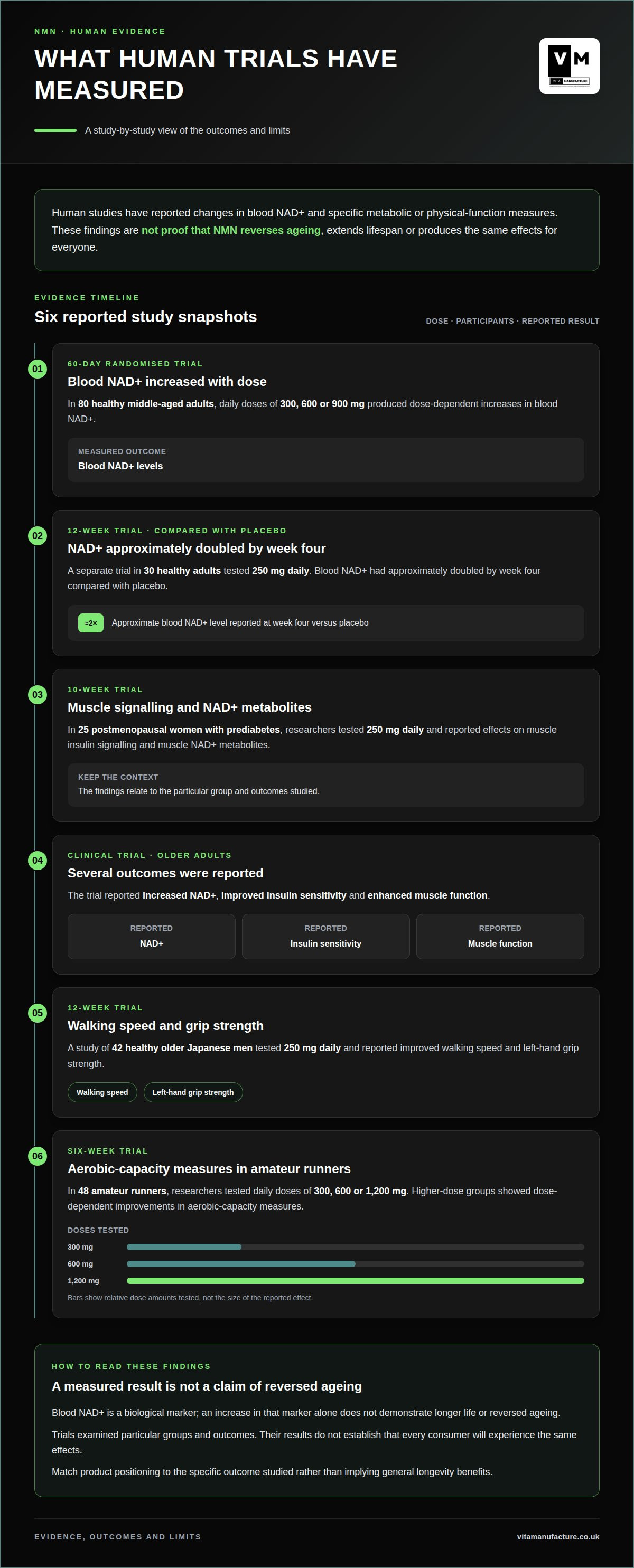
Human trials offer specific findings, with important limits. In a 60-day randomised trial of 80 healthy middle-aged adults, 300, 600 or 900 mg of NMN per day produced dose-dependent increases in blood NAD+. A separate trial tested 250 mg daily for 12 weeks in 30 healthy adults and found blood NAD+ had approximately doubled by week four compared with placebo. These results concern a blood marker, not proof of longer life or a broad improvement in health.
Metabolic health is another area of interest. A trial involving 25 postmenopausal women with prediabetes tested 250 mg daily for 10 weeks and reported effects on muscle insulin signalling and muscle NAD+ metabolites. A clinical trial in older adults also found increased NAD+, improved insulin sensitivity and enhanced muscle function. These results may be relevant when formulating supplements for a metabolic-health audience, but the studies examined particular groups and outcomes. They don’t show that every consumer will experience the same effects.
For a different goal, the evidence may look different. A study of 42 healthy older Japanese men tested 250 mg daily for 12 weeks and reported improved walking speed and left-hand grip strength. In a six-week trial of 48 amateur runners, researchers tested 300, 600 or 1,200 mg per day; higher-dose groups showed dose-dependent improvements in aerobic-capacity measures. Neither example establishes that NMN improves performance or physical function across all populations. Match any product positioning to the specific outcome studied, rather than using a result to imply general longevity benefits.
To assess quality, look for a batch certificate as evidence of independent testing. A purity claim alone does not demonstrate batch-level testing. UK rules require equal care: the regulatory position for NMN remains unresolved, so there is no settled, simple answer that applies to every supplement purchase or import route. For brands, intended use, product classification and route to market are key considerations. Retail prices also vary with formulation, capsule strength, pack size and testing; there is no single typical price per dose across products.
Potential side effects and safety considerations
Nicotinamide mononucleotide (NMN) is involved in pathways that produce NAD+, a coenzyme used in cellular energy processes. Its biological role explains the scientific interest, but does not establish that supplementation is suitable for everyone. Human safety research remains relatively short-term, so study duration and participant group matter when interpreting results.
A dedicated safety trial tested 1,250 mg of NMN per day for four weeks in 20 healthy adults. It reported no serious adverse events during that period. A separate single-dose study tested 100, 250 and 500 mg in 10 healthy Japanese men. These findings describe specific exposures and participants; they don’t establish safety for every dose, health condition or longer period of use.
Other trials broaden the evidence, but not indefinitely. Human research has reported daily doses up to 1,200 mg as safe to consume. Doses of 2,000 mg daily were taken for up to 14 days without adverse effects. A randomised trial also studied 108 older Japanese adults taking 250 mg daily for 12 weeks, comparing morning and afternoon dosing. Such studies help describe short-term use, rather than the effects of lifelong supplementation.
Reported symptoms deserve attention. A small study in 2021 noted mild effects among NMN users, including abdominal pain, diarrhoea, gas and upper respiratory health issues. These examples give consumers and brands concrete outcomes to consider when discussing tolerability. “Generally well tolerated” shouldn’t be presented as “no side effects”, particularly where a product contains additional active ingredients.
These trials do not establish NMN’s safety alongside medicines or other supplements, as they studied particular doses and groups. Anyone taking medicines, managing a disease or combining supplements should discuss the intended use with a healthcare professional, taking their health status and the full ingredient list into account.
Personal suitability also matters. The safety guidance advises people under 18 years of age, and those who are pregnant or nursing, to avoid NMN supplementation. For adults considering use, it recommends starting with a lower dose and consulting a healthcare professional about an appropriate intake. That discussion can account for health conditions, medicines and other ingredients, rather than treating a research dose as an individual recommendation.
For brands, responsible formulation means treating safety as part of the product decision. Dose, ingredient combinations and consumer-facing explanations all affect how people understand a supplement. A private label supplement formulation can be developed with clear attention to ingredient purpose and accurate product presentation.
Can NMN reverse ageing?
The human evidence discussed here does not show that NMN reverses ageing. NMN is a precursor to nicotinamide adenine dinucleotide, or NAD+, a molecule involved in hundreds of essential biological processes. This connection makes it relevant to research on cellular function and age-related changes, but a mechanism is not proof of a clinical outcome. Raising a biological marker cannot, by itself, demonstrate longer life or reversed ageing.
NMN is converted into NAD+ through a comparatively direct pathway. After absorption, cells can use NMN to produce NAD+. That is why researchers study NMN as a precursor, not as a treatment that directly repairs age-related damage. The distinction matters: a precursor supplies material for a process, while its effects depend on how the body uses it and which outcomes a study measures.
Nicotinamide is a related NAD+ precursor, but follows a different route. The body converts nicotinamide into NAD+ through several biochemical steps, while NMN is closer to NAD+ in the pathway. This difference may affect how researchers compare the compounds, but does not establish that one is more effective for longevity. A comparison needs to consider measured outcomes, participants, dose and duration, not pathway diagrams alone.
NAD+ supports cellular energy metabolism, DNA repair and signalling. These functions help explain interest in possible effects on physical function, metabolic health and responses to biological stress. They do not prove that NMN improves cognitive function, prevents disease or extends lifespan. Each claim requires direct human evidence for that outcome. A rise in NAD+ levels provides evidence about a biomarker, not a substitute for results on cognition, disease risk or lifespan.
For brands, the responsible interpretation is precise. Describe NMN as an NAD+ precursor and distinguish that role from claims about reversing ageing. Studies may examine specific groups and outcomes, such as insulin sensitivity or muscle function, but those findings do not automatically apply to every consumer or support broader longevity claims. Product language should reflect the evidence for the specific formulation and intended use. A sound scientific rationale can guide formulation, but it cannot turn a promising mechanism into proof of an anti-ageing effect.
How Does NMN Work to Combat Ageing?
NMN is a nucleotide the body uses to make NAD+, which supports cellular energy and DNA repair. This biological pathway explains why researchers study NMN supplementation, but does not establish an anti-ageing dose. Human trials have tested different amounts for specific periods and outcomes. A dose that raises NAD+ in one study cannot automatically be considered the right amount for every healthy adult.
Research doses vary. Trials have tested daily amounts from 250 mg to 1,000 mg, while common supplement guidance describes 250 to 500 mg per day. These figures describe studied or suggested amounts, not a universal prescription. Study design, participant health and duration affect how a result should be interpreted. For product development, distinguishing a research dose from a consumer recommendation helps keep formulation decisions and product language precise.
Age-based guidance also needs careful framing. Some consumer recommendations suggest starting with 250 mg daily for people under 35, and 500 mg daily for adults aged 35 and above. Those age bands are suggestions, not evidence of a clinically established dosing rule. Age alone doesn’t capture health status, medicines, diet or other factors relevant to supplementation. Don’t present these amounts as proven requirements for people in either age group.
Some guidance suggests increasing the daily amount after one or two weeks. This should not be presented as a necessary escalation schedule: research does not establish that everyone should increase their intake. A careful discussion of dosage considers intended use, amount per serving and study context. Human trials have tested set doses over defined periods, rather than proving that progressively higher intake improves outcomes.
Timing is another formulation consideration. Morning use is often suggested, but there is no universally agreed best time. A study involving 108 older Japanese adults compared morning and afternoon use at 250 mg daily for 12 weeks. This helps illustrate that timing can be studied directly, but it doesn’t make one schedule a general rule for all consumers or formulations.
For a brand, the practical decision is to align serving size and communication with the evidence being referenced. A label should clearly state the amount per serving and avoid implying that a nucleotide precursor guarantees cellular energy, DNA repair or longevity. Keep the distinction between a studied dose and a recommended intake clear. This gives consumers a more accurate basis for understanding what NMN supplementation is intended to provide.
Bulk NMN sourcing
Bulk sourcing is a formulation decision, not simply a price-per-kilogram calculation. NMN’s identity, quality evidence and physical handling can affect production planning and the finished supplement. Start by defining the intended product format, serving size and target market. For example, a powder for capsule filling raises different production questions from an ingredient intended for another delivery format.
Make batch-level documentation central to the assessment. A batch certificate is recommended as evidence of independent testing for an NMN product. It should identify the material and batch, show which tests were performed and present the results clearly. This gives a development team a basis for assessing whether the supplied ingredient matches the specification used in formulation. A general purity statement without batch context is less useful for that decision.
Consider how the ingredient will behave during manufacturing. Solubility, handling characteristics and compatibility with other ingredients can influence blending, filling and finished-product consistency. For example, combining NMN with other active ingredients creates a different formulation brief from a single-ingredient capsule. These details affect production design and should not be inferred from a supplier’s broad description of the ingredient.
Regulatory planning also belongs in the sourcing decision. Regulatory requirements can affect product classification and intended route to market, so brands should assess them before committing to a commercial formulation. A supplier’s ability to provide material does not, by itself, settle whether a finished product can be marketed for a particular use. Build regulatory assessment into the project timeline alongside specification and manufacturing feasibility.
Keep product claims aligned with the evidence. NMN is studied as a precursor involved in pathways that support NAD+ production and cellular energy. Those mechanisms do not establish that a finished supplement will improve energy, reverse an age-related decline or produce a particular health outcome. When evaluating bulk material, separate evidence about ingredient identity and quality from evidence about human effects. They answer different questions.
A clear sourcing brief connects ingredient selection with later production decisions. Set out the intended formulation, required batch documentation, planned testing evidence and product format. Then assess how each decision affects consistency, quality review and the finished label. This makes the supply decision more commercially useful than choosing on volume alone and gives formulation teams clearer criteria for progressing from a raw molecule to a consumer-ready supplement.
For support aligning ingredient requirements with formulation and production, explore ingredient and bulk sourcing support.
Vita Manufacture
Vita Manufacture can help turn an NMN product concept into a defined development and manufacturing brief. If you are assessing ingredient sourcing, formulation options and how a product could progress towards production, its New Product Development and Contract Manufacturing services provide relevant next steps. Private Label Supplements and White Label Supplements may also suit brands choosing between a tailored formula and an established product format.
Bring together your intended audience, proposed formulation, product format and evidence behind planned claims. These details help shape development decisions and keep the product brief connected to its commercial purpose. Because the UK regulatory position for NMN remains unresolved, include regulatory considerations in your planning before moving towards market.
Contact Vita Manufacture to discuss your NMN product plans.
Turn your NMN concept into a clear product plan
Turn your research and sourcing priorities into a focused development brief. Define the audience, product format and intended role of the ingredient, then align these choices with the quality evidence and claims you plan to communicate. This gives your team a practical basis for assessing whether an NMN compound concept is coherent, from ingredient selection through to finished-product positioning.
Keep the brief adaptable. As formulation and production requirements become clearer, refine the product concept without losing sight of its evidence base or commercial purpose. Consider how the selected NMN compound fits your formulation strategy and how the finished product will be positioned. Vita Manufacture supports brands through New Product Development, Contract Manufacturing and Private Label Supplements.
If you’re ready to discuss your sourcing or development plans, contact Vita Manufacture about NMN sourcing. A well-defined brief is a strong starting point for building a product with clarity and purpose.
Frequently Asked Questions
Nicotinamide Mononucleotide: Is the NMN Molecule the Answer to Longevity and Vitality?
No. NMN is a subject of longevity research, but describing it as the answer to longer life or vitality goes beyond the human evidence. Consumers and brands should distinguish a biological rationale from a demonstrated outcome. A claim about vitality also needs a clearly defined measure, such as a particular physical function, rather than a broad promise that could mean different things to different people.
What is NMN Complex?
“NMN Complex” is a product-style name, not a standard formula with a fixed ingredient list. A complex may combine NMN with other ingredients, so the name alone does not tell you what a product contains or how much of each ingredient it provides. For example, two products using that term may have different formulas. Review the full ingredient declaration and amount per serving before comparing them.
Where to find NMN?
For a brand developing an NMN supplement, sourcing should begin with a defined specification and batch-level documentation. A batch certificate provides evidence of independent testing for the relevant material. Consider the intended product format and route to market alongside identity and quality records. In the UK, the regulatory position remains unresolved, so sourcing decisions should form part of a wider product and regulatory assessment.
What is NMN (nicotinamide mononucleotide) and how does it work in the body?
NMN is a molecule the body can use to produce NAD+, a coenzyme involved in cellular processes. Researchers examine whether supplementation changes NAD+ levels and whether measured outcomes change alongside them. These are separate questions: a change in a biomarker is not itself evidence of a particular benefit. For example, a study measuring blood NAD+ answers a different question from one measuring physical function.
What are the claimed health benefits of NMN, and which are supported by human studies?
Claims commonly focus on metabolism, insulin sensitivity, muscle function and exercise capacity. Human studies have reported findings in some of these areas, including changes in insulin-related measures and physical performance outcomes in particular participant groups. This does not establish benefits for every consumer or prove longevity effects. Assess each claim separately: identify the population, measured outcome and study duration before drawing conclusions for a product or audience.
What does clinical research say about NMN dosage and how long it takes to have an effect?
Human trials have tested different daily amounts and durations, so there is no single research schedule that applies to every person or product. One trial reported a blood NAD+ increase by week four; other studies assessed outcomes across periods such as 10 or 12 weeks. The outcome matters: a biomarker change and a change in physical function are distinct measures, not interchangeable signs of an effect.
What are the side effects and potential risks of taking NMN supplements?
Reported mild effects include abdominal pain, diarrhoea, gas and upper respiratory health issues. Short-term studies cannot describe every possible response or establish the effects of long-term use. Medicine use and combined supplements matter too: available findings do not establish that NMN is compatible with every medicine or ingredient. Anyone considering it alongside treatment should discuss the full ingredient list and intended use with a healthcare professional.
How does NMN compare with NR (nicotinamide riboside) and other NAD+ supplements?
NMN and NR are different ingredients discussed in relation to NAD+ pathways, and their names alone do not establish which is preferable. Compare the actual formulation, serving amount, human outcomes studied and testing documentation rather than assuming equivalent doses or effects. Nicotinamide follows a different conversion route to NAD+ from NMN. In any comparison, separate pathway information from evidence about outcomes that matter to the intended consumer.