Midlife Cholesterol: Formulation Guide for Brands
Updated: Oct 23
A supplement concept built around one LDL figure can miss the bigger picture. For brands, understanding the cholesterol numbers you need to know in midlife and supplement hacks for brands means looking beyond a single result and resisting the appeal of quick-fix claims.
Consumers often focus on cholesterol readings, but LDL-C, HDL-C, triglycerides and non-HDL cholesterol each describe a different part of the picture. Their significance depends on personal risk factors and clinical context, not simply a number that can be turned into a product promise. The challenge is to translate that complexity into a clear, commercially viable concept without overstating what a supplement can do.
This guide explains the key lipid markers and why individual risk matters, then sets out a responsible route from consumer need to evidence-led formulation. It covers ingredient rationale, product briefs and positioning for UK market review, with the aim of helping you build a credible proposition grounded in science, clear communication and practical manufacturing decisions.
Table of Contents
Why midlife cholesterol numbers matter to supplement brands
Midlife can be a useful moment to take stock of cardiovascular risk, but it isn’t a diagnosis or a ready-made product opportunity. A cholesterol result is one piece of information about blood fats. Cholesterol is a lipid the body needs, carried through the blood in particles called lipoproteins. For a concise foundation, see this cholesterol overview.
A lipid panel is a blood test that measures fats in the blood, including cholesterol and triglycerides, to help inform an assessment of cardiovascular health. For brands, explaining what the test can and can’t tell someone is as important as discussing the figures. Consumer education should build understanding, not drift into personal medical advice or imply that a supplement can diagnose, treat or replace clinical care.
What does a cholesterol result actually describe?
A result describes measured blood lipids at the time of testing. On its own, it doesn’t provide a complete forecast of someone’s chance of developing cardiovascular disease. NHS guidance places cholesterol within a wider health picture: healthcare professionals may consider factors such as age, blood pressure, smoking and medical history when assessing personal risk.
This distinction matters for product communication. Population-level guidance can help people understand broad reference points, but it isn’t an individual target or treatment plan. Avoid turning a single reading into a verdict about someone’s health. Encourage readers concerned about their results to discuss them with a healthcare professional, who can interpret them in context.
Why midlife is relevant to heart-health product planning
For some people, midlife brings greater attention to routine health checks, long-term wellbeing or family health history. For others, cholesterol may not be a current concern. This age group is not a single consumer profile, so a responsible concept starts with a defined need rather than the assumption that everyone in midlife wants to manage cholesterol.
That calls for audience research as well as scientific discipline. A brand might explore whether its intended customers need clearer explanations of lipid results, practical support for healthy routines or a broader daily regimen — an area where brands like Nuradiant focus on age-specific nutrition for adults over 50. These are different needs, and each points to a different brief. None should be framed as a promise to change a test result or address a medical condition.
The commercial opportunity is strongest when education and product design reinforce each other. Brands that clearly explain the limits of cholesterol testing can help consumers make informed decisions and build trust. The phrase cholesterol numbers you need to know in midlife and supplement hacks for brands should lead to better questions, not shortcuts: who is the product for, what evidence supports the concept, and how can its role be communicated responsibly? Those questions create a useful foundation for evaluating the individual markers.
Which cholesterol numbers matter, and how should brands explain them?
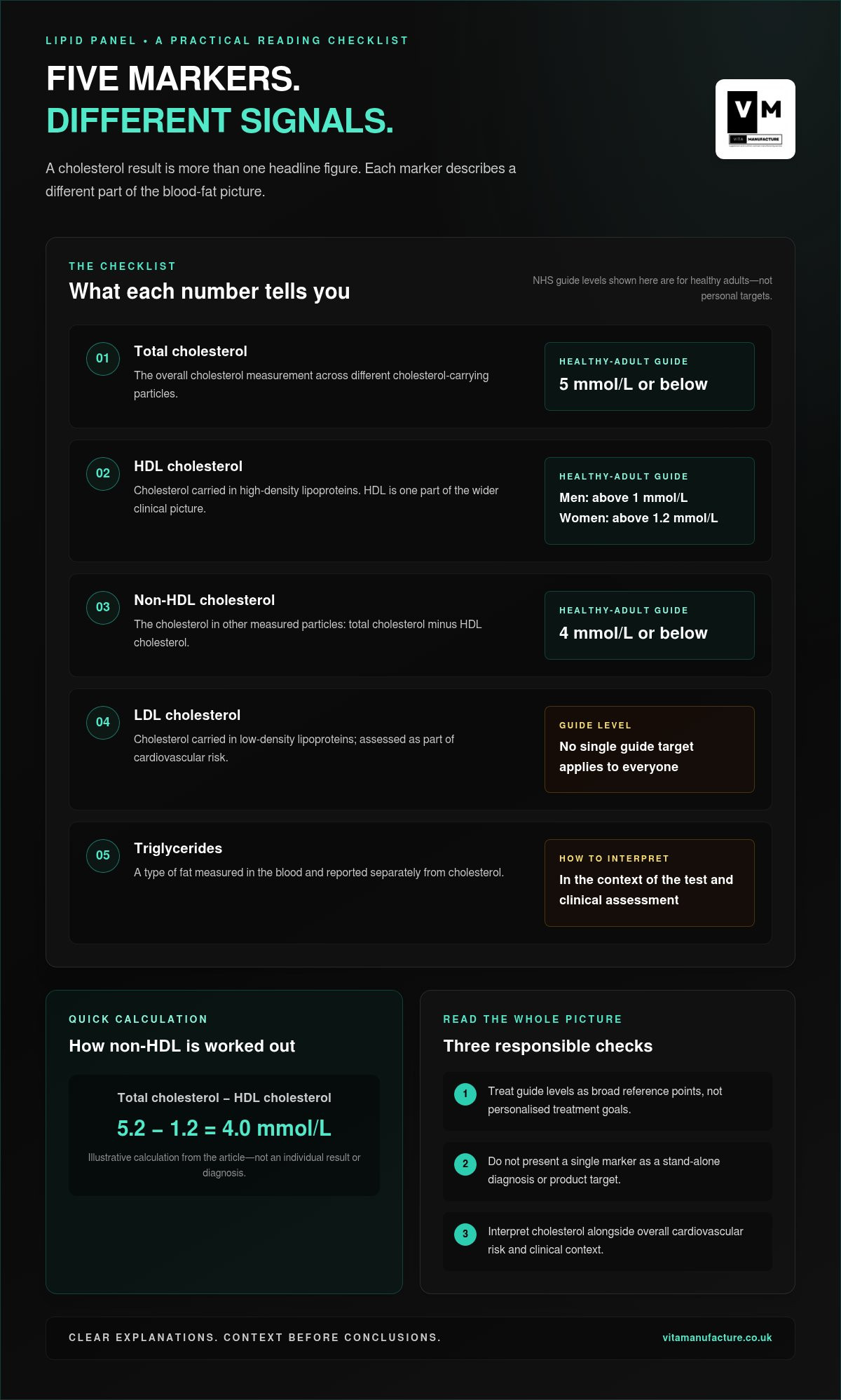
A useful explanation starts with the full lipid panel, not a single headline figure. Each marker describes a different aspect of blood fats, and none should be presented as a stand-alone diagnosis or product target. For UK consumer-facing content, use mmol/L and identify guide levels as broad guidance for healthy adults, not personalised treatment goals.
A cholesterol result should be interpreted alongside a person’s overall cardiovascular risk, not in isolation. This principle helps brands explain the numbers accurately without implying that one reading tells the whole story.
Total cholesterol, HDL and non-HDL in plain English
Total cholesterol is the overall amount measured across different cholesterol-carrying particles. HDL and non-HDL provide additional detail: HDL refers to cholesterol carried in high-density lipoproteins, while non-HDL captures cholesterol in the other measured particles. Calling HDL simply “good” and non-HDL simply “bad” can obscure the wider clinical picture.
The NHS gives healthy-adult guide levels for total cholesterol, HDL and non-HDL. These are reference points for explanation, not personal assessments.
The non-HDL calculation is straightforward: total cholesterol minus HDL cholesterol equals non-HDL cholesterol. For example, if total cholesterol is 5.2 mmol/L and HDL is 1.2 mmol/L, non-HDL is 4.0 mmol/L. This illustrates the calculation only, not an individual result or diagnosis.
LDL and triglycerides: why context matters
LDL is clinically relevant, but there isn’t one universal LDL target suitable for every person. Clinicians interpret LDL and triglycerides alongside factors such as medical history and overall cardiovascular risk when considering care and treatment. A guide level isn’t a prescription, and brands should avoid presenting a population reference as a promise to change laboratory results.
For consumer communication, define each marker plainly, name the NHS as the source of its healthy-adult guide levels, and distinguish those guides from individual clinical decisions. The cholesterol numbers you need to know in midlife and supplement hacks for brands are most useful when they support clear education, not self-diagnosis. A carefully scoped supplement product brief can carry that clarity into development by keeping the audience need distinct from a medical treatment claim.
Do cholesterol supplements work, or are brands chasing a shortcut?
A supplement isn’t a substitute for prescribed treatment or clinical care. People with raised cholesterol or cardiovascular concerns should follow advice from their healthcare professional, rather than stopping or changing medication based on a product message. For brands, the useful question is not whether a supplement “works” in the abstract. Ask what evidence supports a specific ingredient, dose and finished product, and what can responsibly be said about it.
Four evidence levels are easy to blur: a plausible biological mechanism, research in people, studies of the actual finished product, and claims that are permitted for use in the UK. A mechanism may suggest how an ingredient could act, but it doesn’t prove a meaningful effect in people. Evidence for one ingredient also doesn’t automatically validate a different dose, combination or format.
Evidence for an ingredient is not the same as evidence for a finished product. That distinction should shape both the formulation brief and the language consumers see.
How to assess evidence behind a cholesterol supplement concept
Start with the study, not its headline. Check whether it involved people, how the participants compare with the intended audience, and the dose and duration tested. Consider the study design, quality and limitations before drawing conclusions. A small or preliminary finding may help generate a research question, but it shouldn’t be presented as proof of a consumer outcome.
Then compare the research with the proposed product. Is the ingredient in the same form? Does the formulation deliver a comparable amount? Was the tested product a single ingredient or a blend? If the evidence concerns a different preparation or delivery format, acknowledge the gap rather than glossing over it. These checks help distinguish a promising concept from a substantiated product proposition.
Why supplement claims need careful boundaries
In the UK, health and nutrition claims for foods and supplements need careful review against current rules and applicable authorised claims, including any conditions attached to their use. Wording matters: a claim that a product treats high cholesterol, prevents disease or replaces prescribed medicine risks presenting a supplement as a medicine. Avoid implying that consumers should change or delay clinical care.
Responsible development also includes considering safety, suitability and possible interactions. A supplement’s audience may include people with diagnosed conditions or taking medicines, so avoid broad assurances that it is suitable for everyone. Keep individual advice with appropriately qualified healthcare professionals, and make sure consumer information doesn’t encourage self-treatment.
For brands exploring cholesterol numbers you need to know in midlife and supplement hacks for brands, the commercial opportunity lies in disciplined translation: move from a clearly defined consumer need to evidence that matches the proposed formula, then review every claim for accuracy and UK suitability. Include regulatory guidance in the development process alongside formulation decisions, so a credible idea can progress towards a manufacturable product without outrunning its evidence.
How can brands turn cholesterol evidence into a responsible product brief?
A strong brief turns evidence into decisions, not promises. It should define who the product is for, what consumer need it addresses and what the formula can realistically deliver. Keep that need distinct from a medical condition or a promise to change cholesterol test results. This discipline aligns scientific rationale, consumer communication and commercial feasibility from the outset.
Use this workflow to move from an initial idea towards a development-ready concept. The custom supplement formulation checklist can help structure the questions your team needs to resolve.
Build the brief around evidence and a defined audience
Describe the intended audience through relevant needs and behaviours, rather than treating all midlife consumers as medically alike. Then map each proposed ingredient and consumer-facing statement to its evidence and claims review. Record safety considerations, intended exclusions and questions that need expert assessment. A clear evidence trail makes it easier to challenge assumptions before they become part of the formula, label or marketing plan.
Define the consumer need. State who the concept is designed for and the wellbeing need it aims to address. Avoid defining the audience as people with high cholesterol unless the product and its claims are appropriately supported for that purpose.
Review the evidence. For every proposed ingredient, document the relevant human research, ingredient form, dose, population and limitations. Separate scientific rationale from evidence for the proposed finished product, and note where further assessment is needed.
Set the claims boundaries. Draft possible consumer-facing language, then review it against current UK requirements and applicable authorised claims. Remove wording that implies diagnosis, treatment, disease prevention or replacement of prescribed medicines.
Check formulation and commercial feasibility before launch
Evidence alone doesn’t make a product viable. Translate the brief into ingredient specifications, a suitable dosage form and practical manufacturing requirements. Consider compatibility, stability, quality controls and packaging together, since a change to one element may affect the final product plan. The supplement formulation development guide offers a broader framework for connecting these decisions.
Test the formulation concept. Consider whether the ingredients can be sourced to the required specifications and combined in the intended format. Assess serving size, ingredient compatibility and manufacturing practicality before settling the brief.
Plan for quality and stability. Identify the information needed to assess product stability and the quality controls relevant to the formulation. Include packaging requirements in this plan rather than leaving them until launch preparation.
Resolve remaining uncertainties. Use pilot work or market research when it can answer a specific question, such as whether the intended format suits the target audience or whether the concept is understood as intended. Record what each activity is meant to establish.
Ready to move from a substantiated idea to a practical development brief? Explore supplement product development with Vita Manufacture, bringing formulation, regulatory guidance, manufacturing and logistics into one joined-up process.
How Vita Manufacture can support a midlife heart-health supplement concept
Clinical expertise and substantiated evidence must lead the concept. Once a brand has defined its audience, reviewed its rationale and set responsible claims boundaries, the next challenge is turning that work into a product that can be developed and manufactured. Vita Manufacture supports brands with formulation, regulatory guidance, manufacturing and logistics, connecting decisions made at the brief stage with practical development planning.
This joined-up approach helps teams consider the intended formula, dosage form, ingredient specifications and consumer communication as related parts of one project. For wider context on evaluating a development partner, explore the UK supplement manufacturer guide.
From product concept to a manufacturable supplement
A well-defined brief gives the development process a clear starting point: who the product is for, what need it addresses, which evidence informs the concept and what claims are within scope. Those decisions guide formulation choices and help identify practical questions about sourcing, format and manufacturing requirements early, before the product direction is set.
Product development and manufacturing are connected. A proposed formula needs to be considered for its rationale and for how its ingredients and chosen format can be translated into a manufacturable supplement. Vita Manufacture’s new product development, custom formulation and contract manufacturing support helps brands work through that transition. The company is ISO 22000:2018-certified. This is a food safety management certification, not evidence that a particular supplement is effective or suitable for a medical purpose.
A joined-up development partner for growing brands
Regulatory guidance forms part of Vita Manufacture’s development support, helping brands consider claims in relation to their intended market. This matters for UK-facing projects, where wording needs appropriate review and should not imply that a supplement treats a condition or replaces clinical care. Regulatory guidance supports responsible product planning; it doesn’t replace clinical judgement or the brand’s responsibility for its communications.
Manufacturing and logistics support connect product decisions with the steps needed to bring a concept through development. A transparent customer portal provides another part of the end-to-end support, helping clients follow project information. Vita Manufacture serves clients worldwide from the United Kingdom.
The cholesterol numbers you need to know in midlife and supplement hacks for brands are most valuable when they inform clear, evidence-led decisions, not a shortcut to a health promise. If you have a substantiated concept and a defined audience, discuss your supplement concept and explore a practical next step with Vita Manufacture.
Make your next product decision evidence-led
Turn a substantiated idea into a focused development plan. Use the cholesterol numbers you need to know in midlife and supplement hacks for brands as a prompt to ask sharper questions about the audience, product purpose and evidence behind each decision. Then move forward with a brief that is clear enough to assess and refine.
Vita Manufacture is an ISO 22000:2018-certified UK contract manufacturer, with support spanning formulation, regulatory guidance, manufacturing and logistics. Certification relates to food safety management, not proof that a finished product delivers a particular health outcome. Keep that distinction in view from the start of product planning.
Have a concept ready to develop?Discuss your supplement concept with Vita Manufacture and explore a practical next step for your brief.
Frequently Asked Questions
Do I need to fast before a cholesterol test in the UK?
Usually, you don’t need to fast before a routine cholesterol test in the UK. Follow the instructions from the GP surgery or clinic arranging it, as they’ll tell you if your particular test requires preparation. If you’ve already eaten, don’t cancel or delay the appointment without checking. Mention any medicines or supplements you take, as this information may help a clinician interpret the result in context.
Are cholesterol levels different for men and women in midlife?
Some reference guidance differs by sex. For example, NHS healthy-adult guidance gives different HDL guide levels for men and women. These are broad guides, not personal targets, and don’t mean everyone in either group has the same risk. A clinician may interpret results alongside factors such as health history and blood pressure. When comparing results, check that units and marker definitions match before drawing conclusions.
Can menopause affect cholesterol levels?
Cholesterol readings can change around menopause, although the pattern and extent vary between individuals. A result during this transition shouldn’t automatically be attributed to menopause or treated as a diagnosis. If a test shows a change, discuss it with a healthcare professional, particularly if you have other risk factors or take regular medicines. They can advise whether follow-up testing or a broader risk assessment is appropriate for your circumstances.
Can supplements lower LDL cholesterol?
Some supplement ingredients have been studied for their potential effects on LDL, but evidence varies by ingredient, dose and formulation. It doesn’t establish that every finished product will have the same effect. For brands considering cholesterol numbers you need to know in midlife and supplement hacks for brands, the distinction matters: don’t present a possible ingredient effect as a guaranteed result. Consumers should discuss cholesterol concerns and treatment choices with a healthcare professional.
Can I stop taking statins if I start a supplement?
No. Don’t stop, reduce or replace a prescribed statin with a supplement unless the clinician responsible for your care advises you to. Stopping treatment without guidance may affect your individual care plan. If you’re experiencing side effects or want to add a supplement, speak to your prescriber or pharmacist first. Share the product’s ingredient list so they can assess possible interactions and advise on a safe approach.
How often should adults have their cholesterol checked?
There isn’t one testing interval that suits every adult. In England, eligible adults aged 40 to 74 are invited for an NHS Health Check every five years, which includes a cardiovascular risk assessment; other UK nations have their own arrangements. A clinician may recommend a different schedule based on previous results, existing conditions, medicines or personal risk. If you’re unsure when to test again, ask your GP practice for advice.
Developing an evidence-led supplement concept?Discuss your supplement concept with Vita Manufacture and take the next step towards a focused product brief.