Magnesium L-Threonate: Guide for Supplement Brands
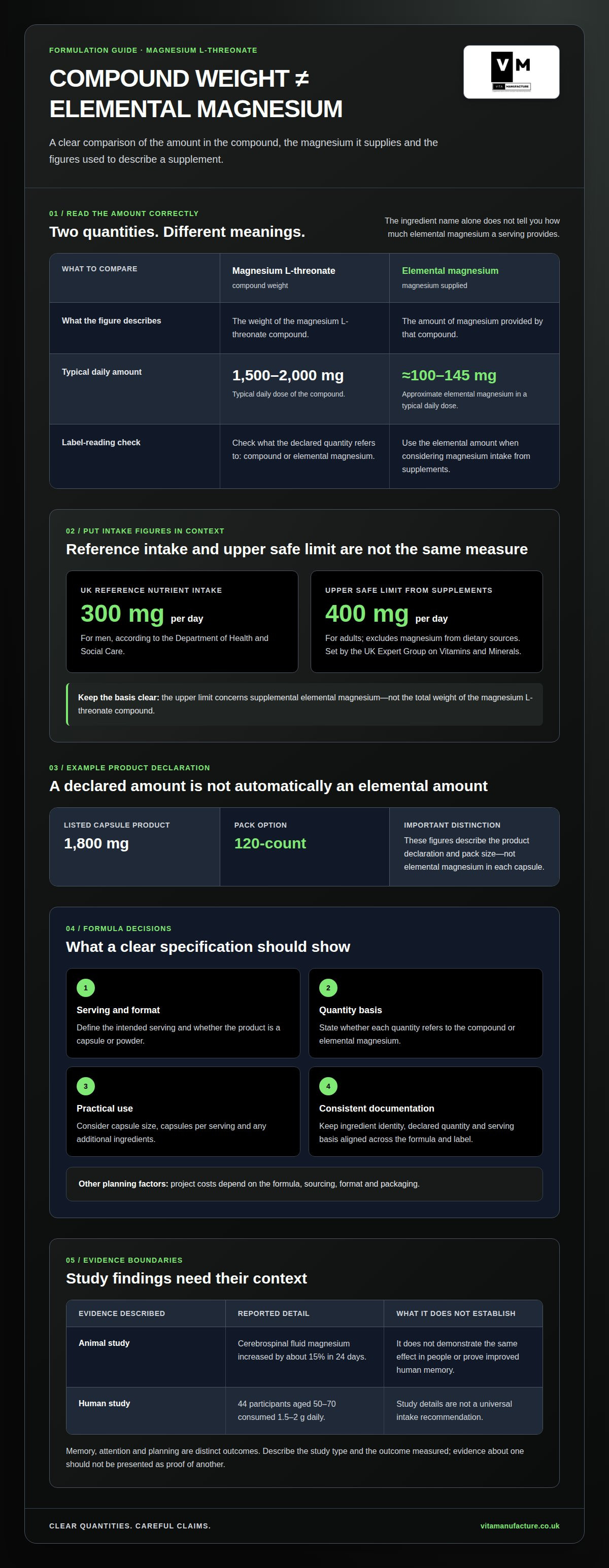
Magnesium L-threonate is a form of magnesium used in food supplements, and its compound weight differs from its elemental magnesium content. A typical daily dose provides approximately 100-145 mg of elemental magnesium. That distinction matters when you’re assessing a formula or planning a product label.
Magnesium L-threonate attracts interest for its potential cognitive effects, but the ingredient’s name alone does not explain how a finished supplement is formulated or what evidence supports its claims. Clear composition details help show what each serving provides.
This guide explains what magnesium L-threonate is, how it can be formulated, how to interpret its elemental magnesium content, and what research says about potential effects on memory, attention and learning. Use this information to assess the ingredient and its role in a supplement concept.
Table of Contents
What Is Magnesium L-Threonate?
Magnesium L-threonate combines magnesium with L-threonic acid, a compound associated with vitamin C metabolism. Research interest centres on whether this form affects magnesium availability in the brain and how that may relate to cognitive function.
Executive function and cognitive performance
Executive function refers to mental skills used to plan, focus, remember instructions and manage tasks. These skills are involved in everyday activities, such as organising a workday or following a multi-step discussion.
For supplement brands, “cognitive performance” needs a precise definition. Memory, attention and planning are distinct outcomes, not interchangeable labels for one effect. A formula positioned around focus, for example, should not imply proven improvements in every executive function. The proposed role of the ingredient in cognitive health remains a research question, not a guarantee of an everyday result.
The UK Reference Nutrient Intake for magnesium is 300 mg per day for men. That broad nutritional role does not, by itself, establish a specific cognitive benefit from this form.
Memory and cognitive health research
Research on magnesium L-threonate and memory examines whether changes in brain magnesium relate to measured cognitive outcomes. A biological measure may support a proposed mechanism, but it does not automatically show better recall or learning.
In an animal study, magnesium L-threonate increased cerebrospinal fluid magnesium by about 15% in 24 days. This finding concerns animals and a brain-related measure. It does not demonstrate the same effect in people or establish improved human memory.
A cited human study involved 44 participants aged 50 to 70, who consumed 1.5 to 2 grams daily. These details describe the study population and intake, rather than a universal recommendation. For a nutrition or medical discussion, keep the participant group separate from broader claims about cognitive health.
When describing research on magnesium L-threonate, specify whether it involved animals, human participants or a particular cognitive test. A result on memory recall, for example, is not proof of improved attention.
Comparing magnesium forms
Magnesium L-threonate, glycinate, citrate and oxide are different forms of magnesium, each paired with a different compound. Their names alone do not show that they provide equal amounts of elemental magnesium or have the same evidence for cognitive outcomes.
Do not apply research on magnesium L-threonate’s brain-related measures to glycinate, citrate or oxide without supporting evidence. Compare the stated form and elemental magnesium contribution of each product, then assess claims against the outcomes actually studied. This gives brands a clearer basis for explaining how formulas differ.
Magnesium L-threonate supplement formulation
A viable formula starts with a defined serving, not just an ingredient name. For magnesium L-threonate, the specification should distinguish the compound amount from the elemental magnesium amount. That distinction shapes how the serving is described and how consumers compare products. It also helps keep composition clear on the label and in supporting information.
Format is another formulation decision. Capsules and powders present different serving experiences, while the chosen format affects how the ingredient quantity is communicated. A listed capsule product, for example, declares 1,800 mg and comes in a 120-count option. Those figures describe the product declaration and pack size, not the elemental magnesium in each capsule.
Building a clear formulation
Start by defining the intended serving and dosage format, then calculate each ingredient’s contribution. For magnesium L-threonate, state whether each quantity refers to the compound or to elemental magnesium. This makes the formula easier to interpret and prevents readers from comparing unlike figures.
Next, consider practical use. Capsule size, the number of capsules per serving and additional ingredients all shape the finished product. If a label declares 1,800 mg, the serving information should make clear what that figure represents. Clear wording helps consumers understand the formulation without inferring a different amount.
Quality and UK purchasing context
Quality starts with a precise raw-material specification. Record the ingredient identity, declared quantity and serving basis, and keep those details consistent across the formula and label. For a finished magnesium L-threonate supplement, this documentation supports accurate composition information and aligned product descriptions.
In the UK, magnesium L-threonate is classified as a food supplement, not a medicine. Product positioning should reflect this distinction. Describe the composition and intended role without presenting the product as a medical treatment. Describe studies of cognitive outcomes in line with what they measured, without extending the findings into broader promises.
Intake limits and costs
The UK Expert Group on Vitamins and Minerals sets the upper safe limit for total magnesium intake from supplements for adults at 400 mg per day, excluding dietary sources. This limit concerns supplemental magnesium, not the total weight of the compound. Formulation decisions should therefore account for elemental magnesium from all supplement ingredients.
Project costs depend on factors such as the formula, sourcing, format and packaging. For brands developing a magnesium L-threonate concept, private label supplement development can bring formulation decisions and product planning together.
Magnesium amount and EU reference intake
A typical daily dose of magnesium L-threonate is 1,500-2,000 mg, providing approximately 100-145 mg of elemental magnesium. The compound weight and elemental amount describe different things, so they shouldn’t be compared as equivalent figures.
Reference values and intake recommendations
A Reference Nutrient Intake (RNI) is a benchmark for the amount of a nutrient intended to meet the needs of most people in a group. It helps put a supplement’s contribution in context, rather than serving as a target for one specific form of magnesium.
According to the Department of Health and Social Care, the UK Reference Nutrient Intake for magnesium is 300 mg per day for men. According to the Department of Health and Social Care, the UK Reference Nutrient Intake for magnesium is 270 mg per day for women. These values refer to magnesium intake, not to the weight of magnesium L-threonate.
Magnesium is an essential mineral involved in many processes, and intake can come from both food and supplements. A serving that provides 100-145 mg of elemental magnesium contributes to total intake; it isn’t the same as supplying the full RNI. A person’s overall intake therefore depends on the rest of their diet and any other magnesium supplements they use.
“EU Reference Intake” and the UK RNI are different label and nutrition concepts. An EU Reference Intake basis of 8,400 kJ or 2,000 kcal describes the energy intake used for an average adult on some labels. It does not give a magnesium target, and it should not be mistaken for the UK RNI.
Dosage and elemental magnesium
The amount commonly used for magnesium L-threonate is 1,500-2,000 mg per day, supplying approximately 100-145 mg of elemental magnesium. This distinction matters because the compound contains magnesium alongside L-threonic acid. Its full weight is not the quantity of the mineral itself.
There is no recommended daily allowance for magnesium L-threonate as a distinct compound. The UK reference values concern magnesium, so comparing a product with them means using its elemental magnesium amount. For example, a label’s 1,800 mg compound declaration should not be read as 1,800 mg of elemental magnesium.
For a clear comparison, identify the serving size, the stated compound amount and the elemental magnesium provided. Then consider that contribution alongside dietary intake and other supplements. This separates the form of magnesium from the amount of mineral delivered, giving readers a more useful way to understand product composition.
Potential effects on memory, attention and learning
Human research on magnesium L-threonate and cognition includes a study using Magtein® and measures related to cognitive performance. To interpret the results, distinguish the measured outcome from broader claims about everyday memory, attention or learning.
The evidence described here does not establish benefits for sleep or anxiety. A cited study reported a change in a brain-age measure, which is not the same as demonstrating improved sleep, reduced anxiety or better performance across every cognitive task.
A randomised, double-blind, placebo-controlled study of Magtein® involved 100 adults. By the end of the cited study, participants receiving magnesium L-threonate improved by 9 years of brain age. That reported result relates to the study’s brain-age measure; it should not be translated into a claim that participants became younger or gained nine years of memory capacity.
Memory, attention and learning are distinct outcomes. A memory task might assess recall, while an attention task could measure the ability to maintain focus. Learning concerns acquiring information or skills. Evidence for one measure does not automatically establish effects on the others or on executive functions such as planning.
For brands, this distinction shapes how potential benefits and uses are presented. Identify the outcome actually examined rather than promising broad improvements based on a single result. For example, describe a finding involving a brain-age measure as such, not as proof of better concentration, recall and learning.
Magtein® is a named ingredient used in the cited human study. The study design, participant group, comparator and measured outcome are central to interpreting its relevance. A placebo-controlled comparison can help assess whether observed differences relate to the formula tested, while the participant profile shows who took part. Neither detail alone establishes that every product using the ingredient has identical effects.
Potency also calls for precise wording. The study finding does not, by itself, establish a universally effective dose or show that a higher amount produces greater cognitive effects. A finished formula’s declared serving, elemental magnesium contribution and ingredient identity are separate composition details. Keep them distinct from clinical outcomes when describing a product.
For supplement brands, use evidence-led communication: name the cognitive measure, explain the study context and avoid extending a result to sleep or anxiety without supporting evidence. This helps readers understand what a formula is intended to address and what the research actually measured.
Magnesium L-threonate product composition
Product composition is more than the headline milligram figure. A useful specification connects the ingredient name, declared amount, serving size and pack count, so each figure has a clear meaning. A label showing the weight of a magnesium compound does not automatically show how much elemental magnesium a serving provides.
Consider the difference between two listed capsule options: both declare 1,800 mg, but one comes in a 120-count pack and the other in a 180-count pack. The pack count alone doesn’t tell you the serving size or the amount per capsule. Those details determine how a consumer interprets the product and how accurately brands can compare different forms of magnesium.
A listed gummy product illustrates another composition choice: it comes in a 90-count pack and is labelled as containing 2,000 mg. The number of gummies, serving instructions and meaning of the milligram declaration need to be read together. Without that context, a shopper could mistake a pack-level quantity for a daily serving, or compare it directly with a capsule’s serving amount.
For adults assessing magnesium levels, the key distinction remains compound weight versus elemental magnesium. A typical daily dose of this form provides approximately 100-145 mg of elemental magnesium, although product declarations may foreground the larger compound figure. A composition-led comparison therefore asks what the stated amount refers to, how many units make a serving and how much elemental mineral that serving contributes.
Clinical research and product composition answer different questions. A study may investigate a particular ingredient and formula, while the label describes the finished supplement consumers receive. For example, a result associated with Magtein® is not proof that every product labelled magnesium L-threonate has the same composition or effect. Ingredient identity, amount and serving context all matter.
For a clear product concept, present the composition in a consistent order: identify the magnesium form, state the amount and serving basis, then show the pack count and directions. This makes comparisons easier and helps prevent compound weight from being mistaken for elemental magnesium. It also gives product positioning a firmer foundation than a headline number alone.
If you’re developing a formula around these composition decisions, shape your supplement product concept with those details in view.
Vita Manufacture
Vita Manufacture can help turn a magnesium L-threonate concept into a clearly defined supplement product. If you are weighing ingredient composition, serving format and how to communicate elemental magnesium, Supplement Product Development can help shape the concept. Private Label Supplements and Custom Supplement Manufacturing offer routes to market.
The right starting point depends on your plans: you might be developing a new formula or building a brand around an established product concept. Clear decisions about composition and positioning give the project a stronger foundation.
Contact Vita Manufacture to discuss your magnesium supplement plans and the next step for your product concept.
Shape the next stage of your supplement concept
A strong product concept brings together a clear rationale, a considered formula and a customer-facing explanation grounded in the evidence. As you develop a magnesium L-threonate product, treat composition and communication as connected decisions. Describe the ingredient in a way that reflects what the finished formula contains and what the research actually measured.
Your next step may be refining an early idea or preparing a defined product for manufacture. Vita Manufacture supports this progression through Supplement Product Development, Custom Supplement Manufacturing and Private Label Supplements, helping align your product direction with the work needed to move it forward.
Consider which part of the process needs attention first: shaping the formulation, planning production or establishing the product’s position. A focused conversation can help turn these decisions into a clearer development path.
Discuss your formulation with Vita Manufacture and take the next step towards a well-defined supplement concept.
Frequently Asked Questions
What is magnesium L-threonate and how does it work?
Magnesium L-threonate combines magnesium with L-threonic acid, a compound associated with vitamin C metabolism. Researchers have examined whether this form can influence magnesium levels in the brain. An animal study found increased cerebrospinal fluid magnesium after supplementation, but that mechanism alone does not establish a cognitive benefit in people. Distinguish a proposed biological pathway from demonstrated effects on memory or other everyday functions.
What clinical studies have tested magnesium L-threonate in humans, and what were their results?
Human research includes a study of 44 participants aged 50 to 70 who consumed 1.5 to 2 grams daily, and a randomised, double-blind, placebo-controlled Magtein® study involving 100 adults. The latter reported a 9-year improvement in a brain-age measure by the study’s end. That measure isn’t equivalent to gaining years of memory ability; interpret each finding according to the outcome actually assessed.
What are the side effects and risks of magnesium L-threonate?
Magnesium supplements can interact with medicines, including some antibiotics, bisphosphonates, diuretics and proton pump inhibitors. The UK Expert Group on Vitamins and Minerals sets an upper safe limit for total magnesium intake from supplements for adults at 400 mg per day, excluding dietary sources. Very high magnesium intake, commonly from magnesium-containing laxatives or antacids, can cause toxicity. Consider total supplemental intake, not just one product.
Who should avoid magnesium L-threonate, including people with kidney disease or those taking medicines?
People with kidney disease should discuss magnesium supplements with a healthcare professional before use, because their health circumstances may affect whether supplementation is suitable. The same applies to people taking medicines that can interact with magnesium, including levothyroxine, antibiotics, bisphosphonates, diuretics or proton pump inhibitors. Timing can matter: magnesium should be taken at least 4 hours apart from levothyroxine. A healthcare professional can consider the medicine and individual circumstances.
Is magnesium L-threonate approved or regulated as a supplement in the UK?
In the UK, magnesium L-threonate is classified as a food supplement, not a medicine. This classification is not medicine approval or proof that a product treats a health condition. For brands, the distinction matters when presenting a product: describe its composition accurately and avoid turning research findings into claims of medical treatment or guaranteed cognitive effects.
How much does magnesium L-threonate cost in the UK, and which products are available?
Available examples include capsules and gummies: listed capsule products include 120-count and 180-count packs, while a listed gummy option comes in a 90-count pack. Pack size alone doesn’t show how much elemental magnesium a serving provides. Compare serving directions and the amount stated on the label, rather than relying only on the pack count.
How can you check the quality and safety of a magnesium L-threonate supplement?
Start with the label: identify the exact magnesium form, the stated amount, the serving size and the elemental magnesium provided per serving. Check that the directions explain how many units make a serving, such as capsules or gummies. Then assess whether product descriptions keep composition separate from cognitive claims. A clear label helps you compare products consistently and avoid mistaking compound weight for the amount of magnesium itself.