How to Budget for Launching a Supplement Product in the UK
But a launch budget is only part of the decision: a product can be ready to sell and still be priced too low to support the business. Your retail price needs to cover manufacturing and the costs of bringing the product to market.
Before committing your budget, review manufacturing, compliance, registration and VAT. This guide explains how these costs can affect your launch and how manufacturing cost can provide a practical starting point for setting a retail price.
A focused product range and a clear view of operating costs can help you plan a commercially viable launch, rather than treating the first production run as the entire investment.
Table of Contents
How much does it cost to start a supplement company?
Your budget depends on the product, production quantity, compliance work and launch activity.
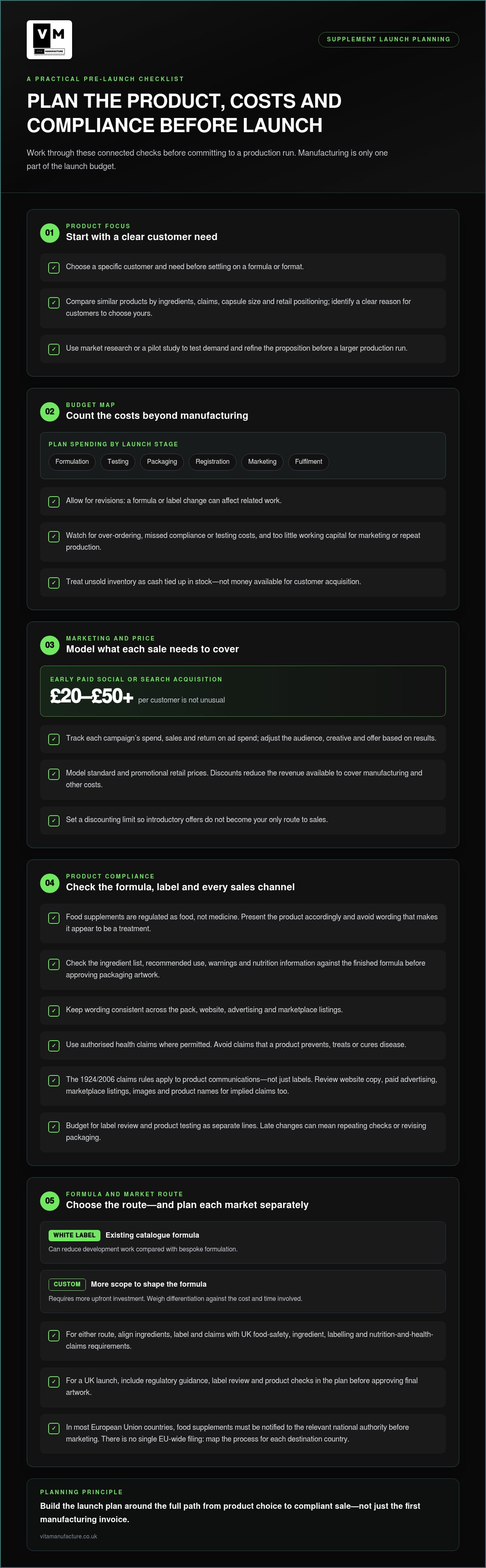
Research the market and identify a nicheChoose a specific customer and need before deciding on a formula or format. Compare similar products by ingredients, claims, capsule size and retail positioning, then identify a clear reason for customers to choose yours, such as a distinct audience or format. Use market research or a pilot study to test demand and refine the proposition before committing to a larger production run.
Assess financial risks and hidden costsMap every cost from development through the first sale, not just the manufacturing invoice. Risks include ordering more stock than demand supports, overlooking compliance and testing, and leaving too little working capital for marketing or repeat production.List planned spending by launch stage: formulation, testing, packaging, registration, marketing and fulfilment. Set aside an allowance for revisions, since a formula or label change can affect related work. Treat unsold inventory as cash tied up in stock, not money available for customer acquisition.
Set a marketing and customer acquisition budget. Early paid social or search customer acquisition costs of £20-£50 or more per customer are not unusual. Track each campaign’s spend, sales and return on ad spend, then adjust the audience, creative and offer based on results.Plan promotions alongside your retail price. A discount can encourage first purchases, but it also reduces the revenue available to cover manufacturing and other costs. Model both standard and promotional prices before launch, and set a discounting limit so introductory offers don’t become your only route to sales.
Check notification requirements for each market. Food supplements must be notified to the relevant national authority before marketing in most European Union countries. Treat this as a destination-market task, rather than assuming one notification covers every country. Before budgeting an international launch, map each target country’s process and schedule the required work before promotion or sales begin.For a UK launch, include regulatory guidance and label review in your plan, alongside the formula and claims. These tasks can affect packaging and marketing materials, so allocate time and budget before approving final artwork. This helps avoid last-minute costs from compliance-related changes.
UK food supplement compliance and label claims
Compliance affects your formula, packaging and every sales channel. Build it into product development instead of treating label checks as a final artwork task.
Plan packaging and labellingPrepare product information before approving packaging artwork. Check the ingredient list, recommended use, warnings and nutrition information against the finished formula. Keep wording consistent across the pack, website, advertising and marketplace listings. Since changes to ingredients or claims can affect several materials, coordinate their review before ordering printed packaging.Food supplements are regulated as food, not medicine. Present them accordingly and avoid wording that could make the product appear to be a treatment.
Review every claim before publishing it. UK supplement sellers may use authorised health claims, but must avoid claims that products prevent, treat or cure disease. The 1924/2006 claims rules apply to product communications, not just the label. Review website copy, paid advertising and marketplace listings alongside packaging, including implied claims created by images or product names.For each proposed claim, check that its wording matches the product and is permitted. Don’t assume a statement used by an established brand is suitable for your formula. A claims review can flag wording to change before finalising artwork or promotional material.
Choose a formula route with compliance work in mind. White label products use existing catalogue formulas. This can reduce development work compared with bespoke formulation. Custom development offers more scope to shape the formula, but requires more upfront investment. In either case, the ingredients, label and claims need to align with UK food-safety, ingredient, labelling and nutrition-and-health-claims requirements.Compare the value of differentiation with the cost and time involved in developing a new formula. A white-label product may suit a focused first launch; a bespoke formula may better support a distinct product proposition. Make this decision before building packaging and sales materials around the product.
Budget for label review and product testingThese are separate budget lines, so match each test to the product and evidence required.Review the final formula and artwork together. Late changes can mean repeating checks or revising packaging, adding costs beyond the original review. Include testing and label approval in your launch schedule, not just your production budget.
Plan registration for each sales market. Food supplement notification requirements vary by market. In most European Union countries, supplements must be notified to the relevant national authority before marketing. Notifications are made country by country, with no single EU-wide filing. If your sales plan includes EU markets, list each destination and allow for its separate notification process.For a UK launch, organise label review, product checks and sales copy as connected tasks. Supplement label graphic design can bring artwork layout and regulatory text together as you prepare packaging.
Manufacturing costs and minimum order quantities
Manufacturing is often a major initial investment for a supplement brand. Build your budget around the formula, production quantity, packaging and operating model.
Estimate manufacturing and ingredient costsList the ingredients, product format and packaging you need, then compare how each affects the production plan. Capsules, tablets, gummies and liquids use different processes and order quantities. Premium ingredients, including collagen peptides, adaptogens and probiotics, can increase unit costs. A manufacturer can help you understand how formula complexity and batch size shape the production estimate.Decide whether an established formula or custom development better fits your product strategy. White-label formulas can require less development investment because the formula already exists; a bespoke formula involves more upfront work. Keep testing, stability work and packaging in separate budget lines so manufacturing doesn’t consume the entire launch fund.
Plan inventory and minimum order quantitiesMatch your first order to a realistic sales plan. Typical minimum order quantities for capsule or tablet supplements are 5,000-10,000 units; gummies or liquids commonly require 10,000-20,000 units. Smaller test runs of 1,000-2,000 units may be available, but increase the cost per unit.Check quantities by format, not just by product name. White-label supplement minimum order quantities are typically around 25 kg of finished product, whilst a private-label pre-formulated blend typically starts at around 75 kg. A 75 kg run yields 500 pouches of 150 g each. Avoid treating every unit as immediately saleable: stock ties up working capital until customers buy it.
Choose a production model before budgeting premises. Compare outsourced contract manufacturing with in-house production. An in-house model requires suitable premises, equipment and fit-out, while outsourced production shifts the budget towards product development, manufacturing and stock. Include storage in your inventory plan, especially if the order quantity exceeds expected early sales.These figures relate to a shop setup, not a universal manufacturing budget. Use them only if your business plan includes retail premises and equipment.
Budget for packaging and repeat production. Choose packaging that suits your launch quantity. Digital pouch printing is usually the best option for runs of fewer than 5,000 pouches. A contract packing slot can take 12 weeks, so schedule artwork approval, production and stock arrival around your launch date.Plan for repeat production as well as the first order. Sales may exhaust stock, while an oversized batch can tie up cash in inventory. Set a reorder point using your actual sales pace and the manufacturer’s production schedule, rather than assuming the first batch will last indefinitely.
Include brand and ecommerce essentials. List the work needed for packaging artwork, product photography, website content and checkout before launch. Connect the website budget to the number of products, formats and sales channels you plan to support.Keep the launch range focused. Each additional SKU can bring a separate formula, packaging and stock commitment. Starting with a limited range gives you a defined inventory plan and lets early sales data guide future product development.
Business registration and VAT considerations
Budget for business setup, food-business registration, VAT and delivery before trading.
Set up the businessChoose a business structure, then include its formation and ongoing administration in your launch budget. A sole trader can register for free, while digital incorporation with Companies House costs £50. A confirmation statement costs £34. Record these costs separately from product development, packaging and branding, so your setup budget remains visible.An online-first or home-based model can avoid premises costs, but still needs funds for stock, storage, website operations and fulfilment. Compare these expenses with your expected order quantities. Keep business and personal transactions separate in your records, and plan how to track sales, invoices and product-related expenses from launch.
Register the food businessRegister as a Food Business Operator with your local authority before trading. Food businesses in Great Britain must register at least 28 days before trading. Include this timing in your launch schedule, especially if product delivery, label approval and website preparation are happening in parallel.Use the business address consistently across your records and customer-facing materials. From 1 January 2024, food products sold in Great Britain must provide a UK address for the food business operator that consumers can contact. Factor that requirement into packaging and online product information before artwork is finalised.
Build VAT and import costs into your cash-flow plan. The UK VAT registration threshold cited for business planning is £90,000 in sales, according to HM Revenue & Customs. Consider how VAT registration could affect cash flow, pricing and bookkeeping as your sales grow. Model your product costs and selling price with VAT treatment in mind, rather than treating VAT as an afterthought.For imported supplements, budget for applicable import duties and VAT as separate cost lines. The amount depends on factors such as product classification, origin and shipping arrangements. Record these details for each shipment, then include any charges in your landed product cost before setting retail prices.
Calculate fulfilment costs by unit. Multiply the relevant unit cost by your planned order quantity to understand the potential cash requirement. Include storage and dispatch in your pricing model, whether you handle stock at home or use a third-party fulfilment service.Keep a simple launch checklist: register the business, complete food-business registration, prepare compliant product information, organise stock and plan VAT records. Review the sequence against your expected trading date, allowing the required 28 days for local-authority registration. This helps prevent an administrative task from delaying a planned launch.
Setting a target retail price and manufacturing cost
Work backwards from costs, then test the result against customer demand. A clear target helps you assess whether the product can support a viable supplement brand.
Choose a realistic retail price. Start with the price you believe customers will accept for the product’s format, ingredients and positioning. Compare similar products and pack sizes, but don’t treat competitors’ prices as proof of demand. Use customer research and early sales data to assess whether your proposed price fits the market.
Apply a cost split as an initial planning tool. One example allocates 30% of the sale price to manufacturing. At a retail price of £30 per unit, the target manufacturing cost is £9. This is a budgeting framework, not a guarantee of profitability: it helps you spot when production costs leave too little room for other expenses.
Allow for overheads and profit. In the same 30/30/40 model, 40% of the sale price is allocated to overheads and profit. For a £30 product, that represents £12. The remaining portion must accommodate other operating costs in the model. Map each cost to a category, rather than assuming the full difference between retail and manufacturing is profit.
Calculate the full unit cost. Add ingredients, manufacturing, packaging, testing, fulfilment and shipping. Include discounts and launch promotions in your calculations, since a reduced selling price changes how much remains to cover each cost.
Stress-test the price against order quantities. Minimum order quantities and unit costs shape how much stock you must fund before sales begin. Compare smaller and larger production runs, considering both per-unit cost and cash tied up in inventory. If your demand forecast cannot absorb the planned quantity, revise the order or launch range before setting the final retail price.
Account for material and certification choices. Packaging materials affect per-unit costs, and premium options can change your pricing model. Include certification only where it supports your product strategy, and calculate its effect across the expected production quantity.
Review the calculation before production. Revisit your target when ingredients, packaging, order volumes or fulfilment arrangements change. A contract manufacturing estimate can help you assess how production choices affect unit costs before finalising a retail price.
Vita Manufacture: New Product Development
Vita Manufacture’s Supplement Product Development service can help turn a supplement concept into a defined product and production plan. It’s a useful next step when you’ve identified your target market but need to settle decisions about the formula, format and manufacturing approach.
For a product based on an existing formula, Private Label Supplements or White Label Supplements may suit your launch model. If you’re developing a distinct formulation, Supplement Product Development provides a route to shape the product before production. Custom Supplement Manufacturing is relevant when you’re ready to produce your supplement for your brand.
Bring your product concept, intended audience and preferred retail positioning into the conversation. These decisions help shape development and manufacturing around your commercial goals.
To discuss your supplement project, contact Vita Manufacture.
Turn your launch plan into a commercially sound product
Planning the cost to launch a supplement product in the UK means deciding what your first product needs to prove. Set clear measures for customer response, repeat demand and the cash needed for your next production decision. This gives you a practical basis for refining the range as you learn, rather than expanding before the proposition is established.
Vita Manufacture offers Supplement Product Development for founders shaping a new concept, Custom Supplement Manufacturing for production, and Private Label Supplements for brands using existing products. Consider which route best matches your formula, market position and readiness to progress. A focused discussion can help turn those priorities into a clearer development and manufacturing brief.
Contact Vita Manufacture about your launch to discuss your supplement project. With a considered plan and the right production approach, you can take the next step with greater commercial clarity.
Frequently Asked Questions
Can I start a supplement brand with one product?
Yes, launching a single product can be a practical way to test your proposition before expanding. The cost to launch a supplement product in the UK depends partly on whether you choose an existing formula or develop a bespoke one. Define the intended customer, product positioning and sales channel first. Then consider whether one SKU can support a clear brand identity and leave room to respond to customer feedback.
What are the UK costs to formulate and develop a new supplement product?
Development costs depend on whether you adapt an established formula or create a new one. Bespoke work can involve ingredient selection, formulation, pilot work, regulatory review and testing, so separate these activities in your budget. The number of ingredients and the chosen format also affect the work required. For a project-specific price, costs depend on the formula, materials and manufacturing requirements, and are given after a quote request.
How much does UK supplement manufacturing cost per unit and minimum order quantity?
Unit costs and minimum order quantities depend on the formula, ingredients, format, packaging and manufacturing process. A capsule and a liquid, for example, have different production requirements. Estimate the total production commitment as well as the unit cost, since a lower unit cost can involve funding more stock upfront. Include packaging and the planned production quantity in your cost calculation.
What are the costs of supplement packaging, label design and printing in the UK?
Packaging costs depend on the material, container or pouch, print method, order quantity and design requirements. Digital printing can suit shorter pouch runs, whilst larger runs may make other print methods more appropriate. Separate the packaging itself from artwork, regulatory text and printing. This makes it easier to compare options and assess how a packaging change affects both unit economics and the product’s presentation.
How much does UK supplement testing, stability testing and quality assurance cost?
Testing budgets depend on the product and evidence required, so identify each test before approving the final formula. Nutritional analysis, microbiological checks and stability work serve different purposes and shouldn’t be treated as interchangeable expenses. Define the testing scope and include it in the product plan. If selling through Amazon, check its requirements for dietary supplements, including third-party laboratory testing.
What UK food business registration, product notification and compliance costs apply to supplements?
Plan for local-authority food-business registration, product checks and any market-specific notification. In Great Britain, register the food business before trading; if selling into the European Union, food supplement notifications are handled country by country. The work involved depends on your sales markets and product. Budget for accurate product information and any separate notification process, rather than assuming one filing covers every destination.
What UK rules govern supplement ingredients, health claims, labelling and advertising?
UK food supplements must meet relevant food, labelling and nutrition and health claims rules. Only authorised health claims may be used, and marketing must not present a supplement as a medicine or suggest it treats, prevents or cures disease. Review packaging, websites, adverts and marketplace listings together. Check ingredients too: a food ingredient not consumed significantly before 15 May 1997 may be novel and require FSA authorisation before sale.
What are the costs to launch a supplement website and sell through UK marketplaces or retailers?
Website and sales-channel costs depend on the store’s design, product content, payment setup, marketplace requirements and fulfilment model. Prepare product information, compliant claims and clear images for each listing. Amazon requires dietary supplements sold in its store to undergo reputable third-party laboratory testing. For retailers, build a separate channel budget covering the materials, stock planning and operational arrangements needed to serve their ordering requirements.