Formulating with L-Magnesium: Brand Guide
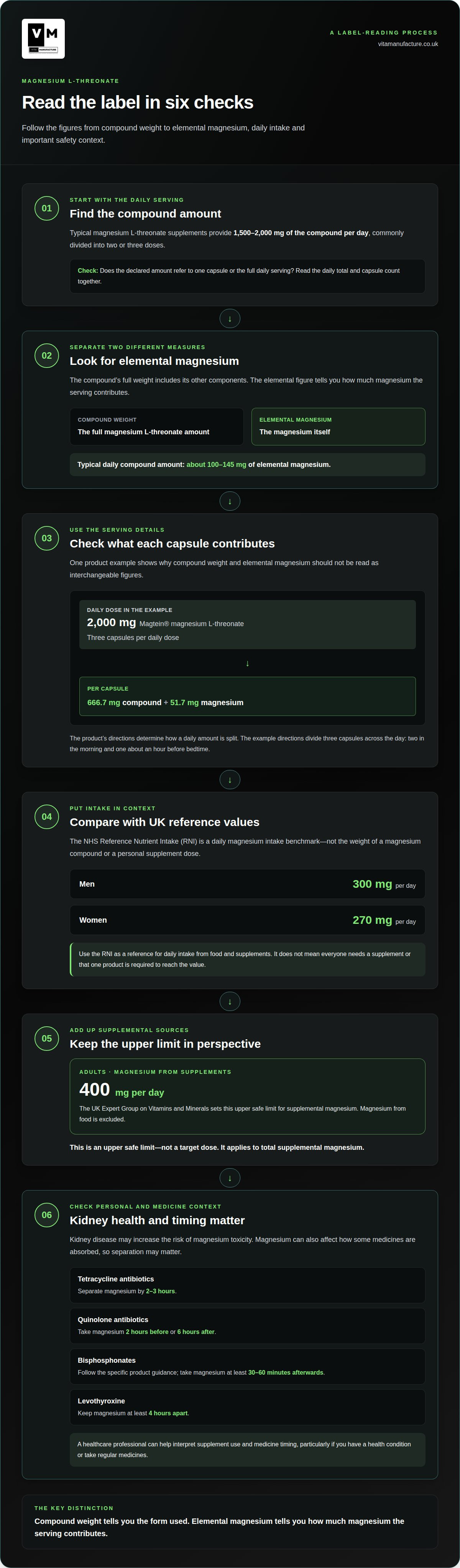
The milligram figure on a magnesium L-threonate label isn’t the whole story. L-magnesium in this context means magnesium paired with L-threonate; a typical daily supplement provides 1,500-2,000 mg of the compound, equivalent to about 100-145 mg of elemental magnesium. That distinction matters when you’re assessing what a formulation actually contributes.
It’s also understandable to look to supplements when you’re concerned about magnesium intake, but food sources and personal deficiency risk deserve attention too. In the UK, the NHS Reference Nutrient Intake is 300 mg per day for men and 270 mg per day for women, referring to magnesium intake rather than the weight of a magnesium compound. This guide explains what magnesium L-threonate is, how UK intake guidance relates to food and deficiency risk, and how to read elemental magnesium content. You’ll have a clearer basis for understanding a formulation and the role its stated dose plays.
Table of Contents
What Is Magnesium L-Threonate?
Magnesium L-threonate combines magnesium with L-threonic acid to form a compound used in dietary supplements. When reading a serving, distinguish the compound’s total weight from the amount of elemental magnesium it provides.
Typical Dosage and Directions
Typical magnesium L-threonate supplements provide 1,500-2,000 mg per day, commonly divided into two or three doses. A product’s serving directions determine how that amount is split, so the daily total and capsule count should be read together.
One example provides 2,000 mg of Magtein® magnesium L-threonate in a daily dose of three capsules. Each capsule contains 666.7 mg of the compound and 51.7 mg of magnesium. These figures describe different quantities, not competing measures.
Follow the directions on the specific product rather than treating a typical range as personal advice. One product example gives a three-capsule serving, divided across the day: two capsules in the morning and one about an hour before bedtime.
Side Effects and Toxicity
The amount of elemental magnesium matters when considering total intake from supplements. The UK Expert Group on Vitamins and Minerals sets an upper safe limit of 400 mg per day from supplements for adults, excluding magnesium from food. This is not a target dose, and it applies to total supplemental magnesium.
People with kidney disease may face a greater risk of magnesium toxicity because impaired kidney function can affect how the body handles excess magnesium. Speak with a healthcare professional before taking a supplement, particularly if you have a health condition or take regular medicines.
Do magnesium supplements interact with medicines? Yes. Magnesium can affect how some medicines are absorbed, so timing matters. Separate it from tetracycline antibiotics by 2-3 hours, and take it 2 hours before or 6 hours after quinolone antibiotics.
For bisphosphonates, follow the specific product guidance and take magnesium at least 30-60 minutes afterwards. Keep magnesium at least 4 hours apart from levothyroxine. A pharmacist or clinician can help interpret timing where several medicines are involved.
Benefits and Supporting Evidence
Magnesium L-threonate is often discussed in relation to cognitive function, but a proposed benefit is not the same as established clinical evidence. A reported study using Magtein® doses of 1.5 to 2.0 g ran over three months, while a separate reported result recorded a placebo group’s overall cognitive score increasing by 5.6 points after six weeks.
Interpret those results in context: the comparison group’s change matters, as do the study design, participants and measures. One reported product claim describes cognitive-function effects as noticeable after six weeks of supplementation, but this timing is not a guaranteed outcome for every user.
Scientific discussions also include animal research, which cannot by itself demonstrate the same effects in people. Check whether evidence comes from human clinical studies, what outcomes were measured and how long supplementation lasted. These distinctions help separate promising findings from conclusions that the evidence supports.
Comparison with Other Magnesium Forms
How does magnesium L-threonate compare with magnesium glycinate and citrate? These are different forms, with different compound weights and elemental magnesium amounts. Compare the elemental figure on each label, not compound weight alone. The facts presented here do not establish that one form is superior for everyone.
Magnesium citrate has been examined in a small study involving 14 male participants, but that detail does not provide a direct comparison with L-threonate or glycinate. A fair comparison considers the intended use, elemental content per serving, directions and strength of relevant human evidence.
When developing a product, name the magnesium form clearly and state its amount in a way readers can interpret. A label that distinguishes compound weight from elemental magnesium makes serving information more useful. Neither L-threonate nor another supplement should replace medical assessment or treatment when needed.
UK magnesium reference nutrient intakes
UK reference values help put magnesium intake into context, but they aren’t a personal prescription. According to the NHS, the UK Reference Nutrient Intake for magnesium is 300 mg per day for men. According to the NHS, the UK Reference Nutrient Intake for magnesium is 270 mg per day for women. These figures describe daily intake, not the amount of a magnesium compound in a capsule.
A Reference Nutrient Intake, or RNI, is a benchmark for the amount of a nutrient that meets the needs of nearly all healthy people in a group. It provides a useful reference when reviewing intake from food and supplements. It does not mean that everyone needs a supplement or that a specific product is required to reach that value.
Pay attention to the units. Milligrams of elemental magnesium describe the magnesium itself, while a compound’s full weight includes its other components. This distinction matters when reading a label: the compound amount and elemental amount answer different questions. The first describes the form used; the second shows how much magnesium the serving contributes towards daily intake.
Use the RNI as a comparison point, not a stand-alone assessment of magnesium levels. A label’s reference intake percentage can show how a serving relates to a labelling reference, but it does not establish an individual’s nutritional status. Reaching an RNI through one capsule also does not show that someone has an optimal intake for their circumstances.
For a practical review, take these steps:
Identify the serving. Read whether the declared amount applies to one capsule or the full daily serving.
Find elemental magnesium. Use that value, rather than compound weight, to understand the magnesium contribution.
Consider the whole diet. Food and supplements both contribute to total intake, so assess them together rather than in isolation.
Keep the purpose clear. An RNI is a nutritional reference, not evidence that a product improves memory or cognitive function.
Magnesium is involved in many processes in the body, but that alone does not show that higher intake improves a particular outcome. A reference value supports consistent interpretation; claims about memory or cognitive function require relevant evidence of their own. Treat these as separate questions when assessing a supplement or planning nutrition information.
For supplement brands, clear label design can help readers distinguish a serving amount from an intake reference. In-house label graphic design can support that communication by presenting product information in a more readable structure.
Dietary sources and magnesium deficiency risk
Food is a practical starting point for improving magnesium intake. For people with magnesium deficiency, obtaining magnesium from whole foods is the best initial strategy. Consider the overall pattern of meals rather than treating one food or supplement as a complete solution.
Useful food sources include leafy green vegetables, pulses, nuts, seeds and wholegrains. Examples include spinach, lentils, almonds, pumpkin seeds and oats. Including several of these foods across meals can make magnesium a regular part of everyday nutrition. Porridge with seeds or lentils alongside vegetables shows how food choices can contribute without relying on a capsule.
Preparation and variety matter. Build meals around different plant foods, such as beans with wholegrain rice or leafy vegetables with nuts. These combinations offer a straightforward way to broaden the diet. No single food needs to provide all your magnesium; the range of foods eaten over time matters more than focusing on one item.
Diet alone may not meet everyone’s needs. One market estimate says up to two-thirds of people in the Western world do not meet their magnesium needs through diet alone. This is a broad population estimate, not an assessment of an individual’s magnesium levels. It cannot show whether a particular person has a deficiency or identify its cause.
Dietary patterns can help identify where intake might be low. Someone who rarely eats pulses, nuts, seeds, wholegrains or leafy greens, for example, has fewer of these food sources in their usual meals. This can guide a review of nutrition, but it is not a diagnosis. If deficiency is a concern, a healthcare professional can assess symptoms, medical history and relevant clinical information.
When considering supplements, distinguish food intake from supplemental intake. A different form of magnesium may have a different compound weight, but it does not replace the value of a varied diet. Supplements should not replace medical care and are not automatically suitable for everyone. Consult a healthcare professional before taking one, especially if you have a health condition or take medicines.
For a practical food-first review, note which sources are already part of your meals, then look for opportunities to add variety. Oats and seeds at breakfast, beans at lunch, or vegetables with dinner are concrete options. This helps make dietary choices visible without assuming food alone will resolve a diagnosed deficiency.
Elemental magnesium content
Elemental content tells you how much magnesium a compound supplies. Magnesium salts and complexes contain other components, so the compound’s full weight is not the same as its magnesium contribution. This distinction helps you interpret serving information and compare products consistently.
Consider a capsule labelled as containing 666.7 mg of magnesium L-threonate. That figure describes the compound, while its elemental magnesium content is 51.7 mg per capsule. The latter is the useful figure when assessing how much magnesium the serving provides. A higher compound weight alone doesn’t mean a product supplies more elemental magnesium.
Labels may show these amounts in different places, such as a supplement facts panel or serving table. Read the serving size first, then check whether each amount applies per capsule or to the full serving. If a daily serving contains several capsules, the total serving value helps avoid confusing it with a single-capsule figure.
Use this simple reading sequence:
Find the serving size. Establish how many capsules make up the stated serving.
Locate elemental magnesium. Distinguish the mineral amount from the weight of the complete compound.
Check the basis. Confirm whether the figure is per capsule or per serving.
Compare like with like. Use elemental magnesium amounts when comparing forms such as citrate and L-threonate.
This distinction matters across magnesium forms. A citrate product and an L-threonate product can have different compound weights and elemental yields, so comparing their total compound figures alone can be misleading. Studies may also report the amount of a specific compound. Check whether a stated amount refers to compound weight or elemental magnesium.
Magnesium is involved in over 300 enzymatic reactions in the body, including processes associated with the nervous system, and the UK Reference Nutrient Intake for men is 300 mg per day. That biological role doesn’t make compound weight a measure of effect. Nor does a label’s elemental figure establish that someone has low magnesium levels or needs supplementation. It describes product composition, not an individual assessment.
For a clear formulation, present the compound name, amount per capsule, serving size and elemental content distinctly. Showing both the L-threonate amount and its magnesium contribution, for example, helps readers understand what the capsule contains. Label each figure clearly so readers do not mistake compound weight for the amount of the mineral.
When comparing a product with a reference intake, use its elemental magnesium amount and keep the serving basis consistent. A per-capsule figure cannot be compared directly with a daily-serving figure unless you account for the capsule count. This simple label-reading step makes product information easier to interpret and supports informed decisions.
What are the benefits and evidence for magnesium L-threonate?
Magnesium L-threonate is often discussed in relation to cognitive function, including memory. Separate proposed benefits from what a study actually measures. A product claim, a biological explanation and a clinical finding are different kinds of evidence. Keeping them distinct helps readers assess what a supplement can reasonably claim.
Read evidence in context. For any human clinical study, identify the participants, supplement dose, duration and cognitive tests used. A change in one test does not automatically establish a broad improvement in memory or everyday function. Also consider whether the study compared supplementation with a placebo and reported results for both groups.
Magtein® research has included a study lasting three months, using doses from 1.5 to 2.0 g. Its duration and dose help define what the study examined, but they don’t establish the right regimen for every person. A separate reported result found a change in the placebo group’s overall cognitive score after six weeks. That comparison matters: outcomes in the supplement group must be assessed alongside changes that occurred without the active ingredient.
Animal research can help explore possible mechanisms, but it cannot establish that people will experience the same outcome. Human evidence is more directly relevant to consumer claims. When reviewing a claim, ask what outcome was measured, whether it involved cognitive performance or another measure, and whether the findings apply to the population described. The word “cognitive” alone does not explain a study’s scope.
Magnesium has established roles in the body, but those roles do not prove that supplementation improves a specific outcome. For people without low magnesium levels, the information discussed here does not establish a measurable benefit from taking a magnesium supplement. This distinction is central: evidence about correcting low intake does not automatically support claims of enhanced memory in people whose levels are already adequate.
For a balanced evaluation, separate the evidence into three questions:
What was tested? Identify the supplement, dose and specific outcome.
Who took part? Consider whether the study participants match the group addressed by the claim.
What changed? Compare results with the placebo group and note the study duration.
This evidence-led approach also supports responsible product communication. Present the ingredient and serving information clearly, and keep cognitive claims aligned with the evidence available. Develop clear supplement label design to help customers distinguish product facts from claims about outcomes.
Vita Manufacture
Vita Manufacture can help you turn an understanding of magnesium L-threonate into a supplement concept with clear ingredient and label information. Its New Product Development and Contract Manufacturing services support brands planning a formulation and production pathway, while Private Label Supplements offer another route for businesses building a supplement range.
This is a natural next step if you’re considering how to explain compound weight, elemental magnesium and serving directions clearly to customers. A considered formulation and readable product information can make these distinctions easier to understand without overstating the evidence.
If you’re planning a magnesium supplement and want to discuss how your concept could take shape, contact Vita Manufacture.
Shape your next formulation decision
Taking an L-magnesium concept forward starts with a clear product brief, not simply an ingredient choice. Define the intended audience, product purpose and format, then decide how the evidence will inform the product’s positioning. These decisions give development a practical direction and help keep the concept aligned with your brand’s goals.
It’s also useful to consider how the product will fit within your wider range. A distinct role, well-defined customer and consistent product story can guide decisions from early formulation through to launch planning. That forward view helps turn technical considerations into a proposition your team can assess and refine.
Vita Manufacture can support brands developing supplement concepts and planning a route towards production. If you’re ready to discuss how your idea could progress, contact Vita Manufacture about formulation.
Start with a clear brief and give your next product decision room to grow.
Frequently Asked Questions
Should you take a magnesium supplement?
Not everyone needs a magnesium supplement. Start by considering your usual diet and whether a healthcare professional has identified a reason to supplement. For people without low magnesium levels, the information discussed here does not establish a measurable benefit from taking a supplement. If you’re considering one because of a health concern, discuss your circumstances, medicines and overall intake with a healthcare professional before starting.
What is L-magnesium, and what does the L stand for?
“L-magnesium” is an informal way to refer to magnesium L-threonate, not a separate type of magnesium mineral. The “L” describes the form of the threonate component in the compound’s name. Magnesium is paired with L-threonate; the letter does not describe a special kind of elemental magnesium. Look for the full ingredient name on product information to identify the magnesium compound.
What are the different forms of magnesium supplements, such as magnesium L-threonate?
Supplement forms include magnesium L-threonate, magnesium citrate and magnesium glycinate. Each is a different compound, so compare the elemental magnesium amount and serving directions rather than relying on the compound name alone. A label may show both the full compound weight and the magnesium it provides. These details help you interpret the product, but do not establish which form is right for you.
How much magnesium should adults take daily in the UK?
The NHS Reference Nutrient Intake is 300 mg per day for men and 270 mg per day for women. These are daily reference values for magnesium intake, not instructions to take that amount as a supplement. Food contributes to total intake too. When reading a supplement label, distinguish the elemental magnesium amount from the full weight of the compound, and consider the serving size alongside your diet.
What are the side effects and risks of magnesium supplements?
Excess magnesium from supplements can pose a toxicity risk, particularly for people with kidney disease. The UK Expert Group on Vitamins and Minerals sets an upper safe limit of 400 mg per day from supplements for adults, excluding dietary magnesium. Supplements may also affect how some medicines are absorbed, including certain antibiotics and levothyroxine. Discuss your medicines and supplement plans with a healthcare professional or pharmacist.
Who should avoid magnesium supplements or check with a doctor first?
People with kidney disease, those who are pregnant or breastfeeding, people taking medicines, and anyone under medical supervision should consult a healthcare professional before using a magnesium supplement. This does not mean everyone in these groups must avoid magnesium; health conditions, medicines and total intake affect the decision. If a clinician or pharmacist advises a particular timing or amount, follow that guidance and the product directions.