Formulating with Benfotiamine: Key Brand Benefits
The key distinction is that thiamine is vitamin B1, while benfotiamine is a lab-made form the body converts into thiamine. Thiamine supports energy metabolism, including sugar breakdown, and has roles in nerve communication and immune-system activity. Understanding how benfotiamine relates to thiamine helps explain why researchers are examining its potential effects on advanced glycation end products (AGEs), compounds formed through reactions involving sugars and proteins.
It’s worth looking beyond headlines about absorption or potential benefits: the mechanism matters, as does the strength of the evidence. This article explains how thiamine works, how benfotiamine is absorbed and converted, and how it may influence advanced glycation end product (AGE) formation through transketolase and other pathways. It also puts reported findings in context, distinguishing early research from established health claims. This provides a clearer foundation for assessing benfotiamine and its relevance to supplement formulation.
Table of Contents
Effects on advanced glycation end products
Advanced glycation end products (AGEs) form when sugars react with proteins or fats. Their formation, and the effects of thiamine-related compounds, are areas of research into metabolic stress.
Reported findings include lower AGE levels, alongside proposed antioxidant and anti-inflammatory activity. Benfotiamine has been studied for these effects, but human evidence remains limited and should be interpreted carefully.
Antioxidant and anti-inflammatory effects
Antioxidant effects involve limiting oxidative damage, while anti-inflammatory effects relate to processes that contribute to inflammation. Benfotiamine has been studied for both, as well as for its effects on AGEs, but these proposed mechanisms do not demonstrate clinical improvement on their own.
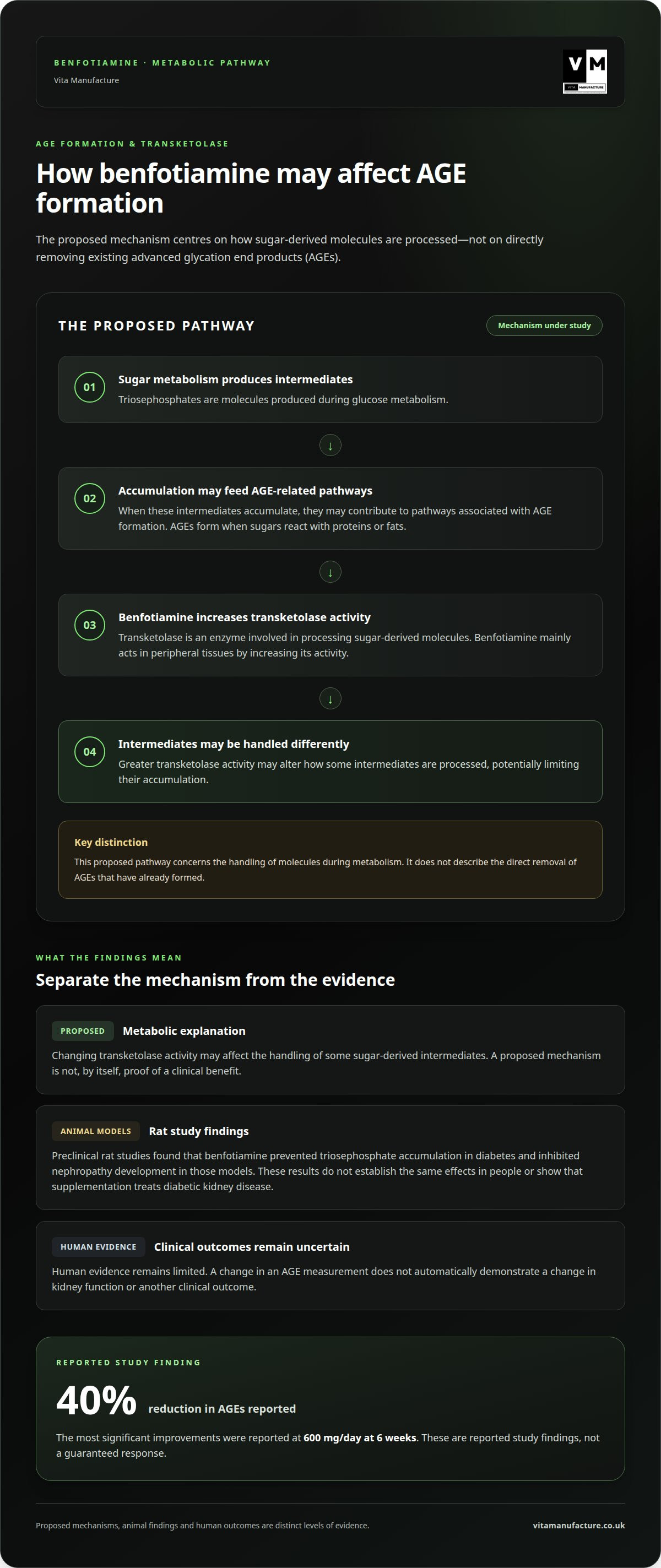
One reported finding is a 40% reduction in advanced glycation end products, with the most significant improvements reported at 600 mg/day at 6 weeks. These figures describe reported study findings, not a guaranteed response for patients. The proposed effects may involve changes in metabolic activity, rather than a single antioxidant action.
Neuroprotective effects in animal models
Neuroprotection means limiting damage to nerve cells or supporting their function. Animal research can point to possible biological mechanisms, but findings in rats do not establish benefits in people.
Preclinical rat studies found that benfotiamine prevented triosephosphate accumulation in diabetes and inhibited nephropathy development in those models. This is a kidney finding, not direct evidence of neuroprotection. Human findings on nerve-related outcomes are mixed, and some studies found no nerve benefit. The animal results therefore do not prove that benfotiamine improves nerve health.
Evidence for benefits and uses
Evidence for benefits is the body of clinical findings supporting a health effect in people. A 2021 review described two clinical trials with positive results for diabetic polyneuropathy, but research on diabetic nerve damage has also produced mixed results.
What benefits does the evidence support? Studies have reported effects on AGEs and explored potential benefits in diabetic polyneuropathy, but more evidence is needed to support health claims. Current clinical evidence does not establish prevention or treatment of diabetes-related heart failure, kidney disease or eye damage.
What conditions has it been studied for, and how strong is the evidence? Research has examined diabetic polyneuropathy and other metabolic effects. Evidence on nerve outcomes remains mixed, with some trials reporting no benefit. Findings in one area do not establish effectiveness for every condition studied.
Does benfotiamine interact with medicines or other supplements? People taking medicines or herbs to lower blood pressure or blood glucose should exercise caution, because conversion to thiamine may lower blood pressure or blood glucose. A combination of benfotiamine, pyridoxine and cyanocobalamin was associated with nausea, dizziness, stomach ache and weight gain in around 8% of participants.
Side effects are unwanted effects reported during use. Clinical-trial reports describe mostly mild gastrointestinal issues and skin reactions; people prone to allergies may develop a rash. Benfotiamine was well tolerated in most human studies, with no serious adverse events reported, but its long-term side effects remain unclear.
A 24-month double-blind, randomised, placebo-controlled trial studied long-term oral benfotiamine supplementation and peripheral nerve function in people with type 1 diabetes; supplements are often sold in capsules containing 150-300 mg.
AGE formation and transketolase
Advanced glycation end products (AGEs) form when sugars react with proteins or fats. In diabetes, glucose-derived intermediates can contribute to their formation, making these reactions relevant to metabolic disease research. Transketolase is an enzyme involved in processing sugar-derived molecules. Benfotiamine mainly acts in peripheral tissues by increasing its activity, linking the ingredient to a specific metabolic pathway rather than to a general antioxidant effect alone.
One proposed sequence starts with triosephosphates, molecules produced during glucose metabolism. When these intermediates accumulate, they may contribute to pathways associated with AGE formation. Increased transketolase activity may alter how some intermediates are handled, potentially limiting their accumulation. This helps explain interest in benfotiamine: the proposed mechanism concerns how molecules move through metabolism, not the direct removal of existing AGEs. That distinction is important when describing the ingredient’s biological rationale.
Preclinical rat studies found that benfotiamine prevented triosephosphate accumulation in diabetes and inhibited nephropathy development in those models. These findings connect the enzyme mechanism with a kidney outcome in animals. They do not establish that the same effect occurs in people or that supplementation treats diabetic kidney disease. The model provides a reason to investigate the pathway further, while human studies are needed to assess relevant clinical outcomes.
AGE formation is only part of the picture. Benfotiamine may affect AGE-related activity as well as pathways that do not depend on AGEs. A change in transketolase activity therefore cannot, on its own, explain every reported effect. An AGE measurement and a kidney-function outcome are different endpoints; a change in one does not automatically demonstrate a change in the other. Product communications should distinguish proposed mechanisms, animal-model findings and demonstrated human outcomes.
For formulation decisions, describe the chain precisely: the ingredient is associated with increased transketolase activity in peripheral tissues; animal models showed reduced triosephosphate accumulation; and the resulting clinical significance needs to be assessed separately. This wording keeps the science accessible without converting a biological rationale into a treatment claim. Clear explanations also help customers understand why a mechanism is not the same as proof of a health benefit. In-house label graphic design can help present ingredient information clearly.
Absorption and bioavailability
Bioavailability describes how much of a substance is absorbed and becomes available to the body. Compared with water-soluble thiamine salts, benfotiamine is absorbed up to 3.6 times more, and is associated with a 120-fold greater increase in metabolically active thiamine diphosphate levels. These comparisons describe absorption and measured levels, not a proven clinical improvement.
How does it compare with thiamine, vitamin B1? Thiamine is the vitamin the body needs, while benfotiamine is a fat-soluble form converted into thiamine. Studies report higher thiamine levels in muscle, brain, liver and kidney after benfotiamine than after water-soluble forms.
The conversion involves distinct steps. In the intestinal mucosa, ecto-alkaline phosphatases remove a phosphate group, producing S-benzoylthiamine. Thioesterases in the liver then hydrolyse this compound to thiamine. This sequence explains how benfotiamine is transformed before contributing to the body’s thiamine pool.
Thiamine diphosphate is the metabolically active form measured in the comparison with water-soluble thiamine. The reported 120-fold greater increase refers to levels of this form, not a 120-fold increase in every tissue or health outcome. Likewise, the absorption figure of up to 3.6 times compares benfotiamine with water-soluble forms; it should not be read as a dose equivalence.
A pilot study administered 350 mg after meals to 13 patients with type 2 diabetes. That example describes a study protocol, not a general dosing instruction or proof of a benefit. The number of participants and the specific population also matter when interpreting what the study can show.
Higher bioavailability may be relevant to formulation discussions, but the amount absorbed alone cannot establish a reduction in neuropathy. Clinical effects depend on more than measured thiamine levels, and absorption comparisons do not establish which dose or schedule is suitable for an individual. A biochemical comparison is also distinct from clinical use: bioavailability findings alone do not determine interactions or how the ingredient should be used.
For brands, the practical distinction is between ingredient conversion, measured vitamin levels and patient outcomes. Keeping these claims separate supports precise communication: present absorption findings as comparative data, describe the intestinal and liver steps as the conversion pathway, and discuss clinical benefits only in line with evidence for the relevant outcome.
The pathway describes a staged chemical conversion: ecto-alkaline phosphatases in the intestinal mucosa dephosphorylate benfotiamine to S-benzoylthiamine, which thioesterases in the liver then hydrolyse to thiamine. These steps involve specific transformations and locations; they are not interchangeable. S-benzoylthiamine is the intermediate in this sequence, and thiamine is produced by the subsequent hydrolysis. In other words, the pathway describes a change in chemical form, with an identified intermediate between benfotiamine and thiamine. Describe the route in its stated order, retaining both enzyme names and tissue locations. This precision separates the conversion sequence from broader claims about absorption, tissue levels or clinical effects, which the pathway alone does not establish.
Advanced glycation end products and benfotiamine's mechanisms
Advanced glycation end products (AGEs) form when sugars react with proteins or fats. Proposed mechanisms for benfotiamine include effects on AGE formation and on pathways that do not depend on AGEs.
AGE formation begins when glucose reacts with biological molecules, creating modified compounds that may accumulate in tissues. One proposed mechanism involves transketolase, an enzyme whose activity benfotiamine increases in peripheral tissues. This may redirect glucose-derived intermediates and reduce their contribution to AGE-related pathways. The mechanism is relevant to metabolic research, but it does not establish a clinical outcome on its own.
AGE-dependent activity describes effects linked to the formation or handling of these compounds. Benfotiamine is reported to modulate AGEs, while also acting through pathways that do not depend on them. This distinction matters: changes in AGE levels cannot explain every effect under investigation, and AGE modulation alone does not prove improvement in a disease.
Clinical evidence is distinct from biological mechanisms. Research into diabetic peripheral neuropathy has produced mixed results, and some studies found no nerve benefit. Benfotiamine has also been studied in relation to Alzheimer’s disease, but no large, well-designed studies have evaluated it as a treatment for the disease. These examples show why proposed glucose-related mechanisms should not be presented as established treatment benefits.
Is benfotiamine available in the UK, and is it prescription-only? It is generally available over the counter rather than as a prescription-only product. Availability does not establish that it is suitable for every person or condition.
There is no single adult dosage that applies to every purpose. Clinical studies have used 200-600 mg per day; a chapter recommends 150-300 mg twice daily specifically for diabetic peripheral neuropathy. A clinical trial tested 300 mg twice daily. These are study amounts, not a universal personal recommendation.
Dosage describes the amount taken, while treatment refers to use for a health condition. Keeping the concepts separate supports accurate product communication: distinguish a study protocol from general use, and describe proposed mechanisms without implying a proven clinical result. When developing a supplement concept, align decisions about the ingredient’s role and intended audience with the evidence relevant to the formulation.
What is benfotiamine and how does it work?
Benfotiamine is a lab-made form of vitamin B1 that the body converts into thiamine. Thiamine is involved in energy metabolism, the breakdown of sugars and carbon skeletons, neuronal communication, and immune-system activation. The distinction is useful: one name describes the supplied compound, whilst the other describes the vitamin produced after conversion.
Thiamine is a water-soluble vitamin needed for several processes that help cells use nutrients. Its roles connect food-derived molecules with energy production and other cellular activity. For example, thiamine supports the breakdown of sugars, linking its function to glucose metabolism. It also contributes to neuronal communication, so its relevance extends beyond energy pathways. For those exploring targeted dietary support for digestive, immune, and nervous system health, healthygut.com provides science-backed supplements formulated around these core functions.
Metabolism is the set of chemical processes that transform substances in the body. Here, thiamine supports enzymes involved in processing sugar-derived molecules, which can enter different pathways. Their route matters because some intermediates are associated with advanced glycation end product formation, while others serve different metabolic functions.
Transketolase is an enzyme involved in processing sugar-derived intermediates. Benfotiamine mainly acts in peripheral tissues by increasing transketolase activity. In theory, this may redirect some intermediates through a different metabolic route. The proposed sequence is conversion into thiamine, increased enzyme activity, then altered processing of those molecules. This describes a mechanism, not a demonstrated clinical outcome.
Advanced glycation end products are compounds formed through reactions involving sugars and proteins or fats. Their formation is one pathway studied in relation to metabolic stress. Benfotiamine may modulate AGE-related activity, but it may also act through pathways that do not depend on AGEs. A single mechanism therefore cannot explain every biological effect under investigation.
Mechanistic findings and clinical benefits answer different questions. A biological pathway can suggest how a compound might act, while clinical trials assess outcomes in people. Research into diabetic nerve damage has produced mixed results, and some studies found no nerve benefit. Evidence for preventing or treating diabetes-related heart, kidney or eye complications remains unclear.
For a supplement concept, keep the ingredient identity, proposed mechanism and evidence for outcomes distinct. This gives readers a clearer account of what the formulation contains and what research has examined. If you’re developing a product, explore in-house label graphic design to communicate ingredient information clearly.
Vita Manufacture: New Product Development
Vita Manufacture supports brands through New Product Development, helping turn an ingredient concept into a defined supplement proposition. For a project involving benfotiamine, this can include shaping the product concept and deciding how the ingredient fits its intended purpose, while keeping proposed mechanisms distinct from established clinical outcomes.
New founders can use product development to shape an initial concept, while established brands can explore a new product direction. Vita Manufacture also offers Contract Manufacturing and Private Label Supplements for brands developing or producing supplement products. These services can help align a product idea with a brand’s wider commercial plans.
To discuss your supplement development plans, contact Vita Manufacture.
Turn the ingredient concept into a clear product direction
Research can inform a product concept, but the next step is deciding how it serves your brand and intended audience. For benfotiamine, define the product’s purpose, shape its positioning and ensure that its communication reflects the evidence without implying more than the evidence supports.
A disciplined development process can bring scientific understanding and commercial objectives into the same conversation. Consider how the ingredient fits your portfolio, what makes the product relevant to your customers and how to explain its proposed role clearly. These decisions give your formulation a stronger foundation before execution.
Vita Manufacture can support your next step through New Product Development, Contract Manufacturing or Private Label Supplements. If you’re ready to explore how your concept could take shape, contact Vita Manufacture about your formulation.
Every strong product starts with a considered idea. Give yours the attention it deserves and move forward with clarity.
Frequently Asked Questions
What is thiamine?
Thiamine is vitamin B1, a nutrient the body uses in several metabolic processes. It supports the breakdown of sugars and carbon skeletons, alongside neuronal communication and immune-system activity. In practical terms, it helps connect nutrient processing with cellular functions. Benfotiamine is a separate, lab-made compound that the body converts into thiamine, so the two terms refer to related but distinct forms.
What are the side effects and risks of benfotiamine?
Reported side effects have generally been mild, including gastrointestinal problems and skin reactions. A rash is a particular concern for people prone to allergies. Most human studies reported no serious adverse events, but long-term side effects remain unclear. If symptoms such as a rash or stomach discomfort appear after starting a supplement, stop taking it and seek advice from a healthcare professional.
Who should avoid benfotiamine or seek medical advice before taking it?
People taking medicines or herbal remedies to lower blood pressure or blood glucose should seek medical advice before using benfotiamine. Its conversion to thiamine may also lower blood pressure or blood glucose, so combining it with these products could affect the same measures. People prone to allergies should watch for skin reactions. Share your supplement and medication list with a pharmacist or other healthcare professional before use.