Formulating Magnesium Taurate: A Brand Guide
What matters more in a magnesium taurate formula: the ingredient name or the amount of magnesium it provides? A supplement combining magnesium with taurate contains magnesium and taurine, but the weight of the combined ingredient is not the same as its elemental magnesium content. Understanding this distinction is a useful starting point for assessing the label and the product’s potential benefits.
It’s reasonable to want a straightforward answer about what magnesium taurate may do. Magnesium is involved in more than 300 processes in the human body, according to the National Institutes of Health, while the NHS recommends a daily magnesium intake of 300mg for men and 270mg for women in the UK.
This guide explains how magnesium supports muscle and nerve function, what can and cannot be concluded about magnesium taurate’s benefits, and how to interpret dosage and ingredient amounts. It also covers formulation choices, supplement quality, and potential interactions with medicines or other supplements, helping you assess a product more confidently.
Table of Contents
What Are the Benefits of Magnesium Taurate?
A formula combining magnesium with taurate brings magnesium and taurine together, but the combination alone doesn’t prove a particular benefit. The NHS recommends a daily magnesium intake of 300mg for men in the UK. That helps explain interest in magnesium, but doesn’t establish that taurate works better than other forms or produces a specific outcome.
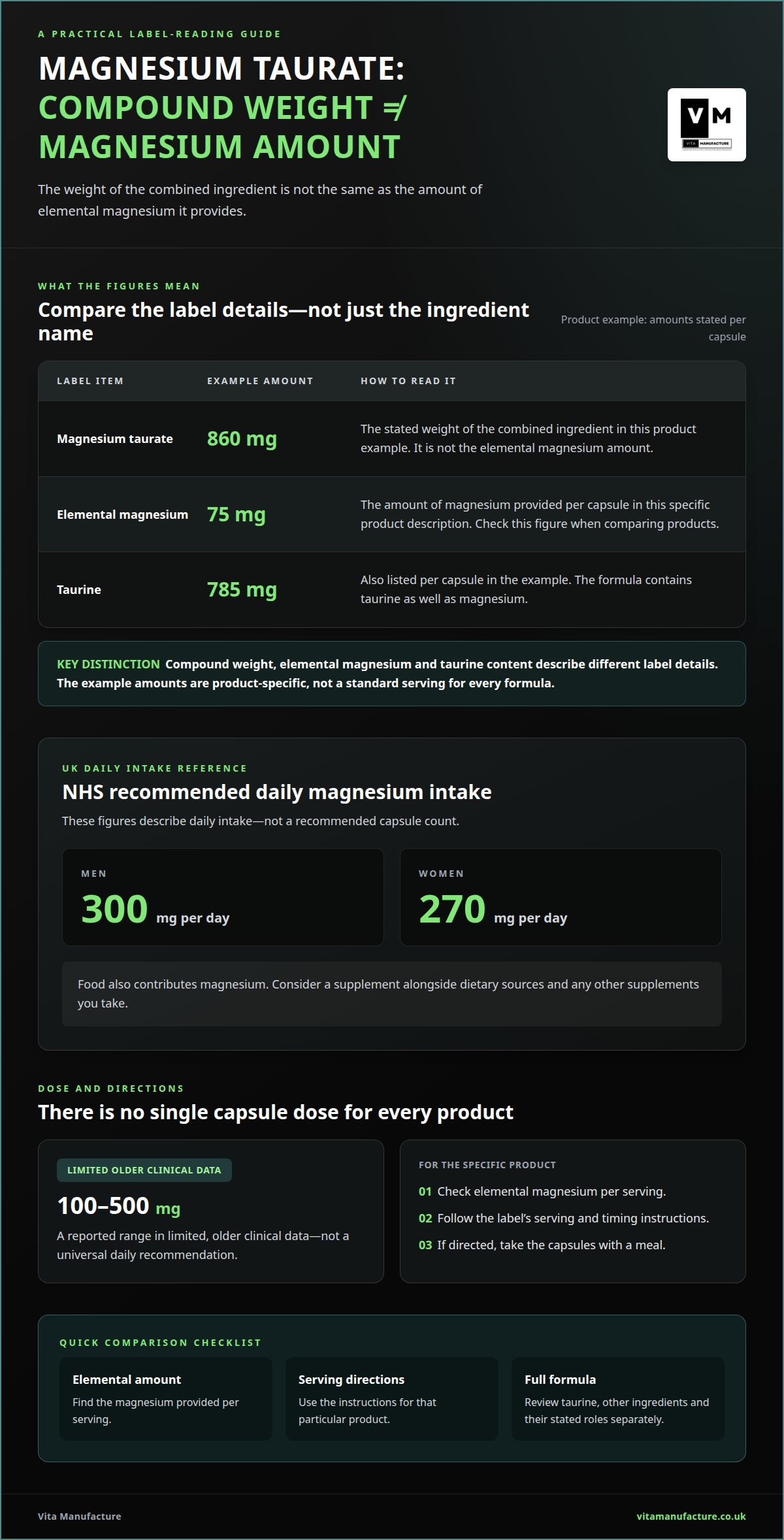
For adults in the UK, the NHS recommends a daily magnesium intake of 300mg for men and 270mg for women. These figures describe daily intake, not a recommended capsule count. Food also contributes magnesium, so consider the supplement alongside dietary sources. Magnesium’s role in muscle and nerve function is relevant to nutrition, but it doesn’t show that a taurate product will address an individual concern.
Read the elemental magnesium amount separately from the total magnesium taurate weight. The compound also contains taurine, so its full weight isn’t all magnesium. For example, one product description gives 75mg of elemental magnesium and 785mg of taurine per capsule, alongside 860mg of magnesium taurate. These are product-specific amounts, not a standard serving for every formula.
There’s no single capsule dose that applies across all magnesium taurate products. Very limited, older clinical data suggest doses range from 100 to 500 milligrams, but this isn’t a universal daily recommendation. The capsule strength, elemental magnesium amount and product directions all matter. Follow the label for the particular product rather than adapting another formula’s serving instructions.
Follow the timing instructions on the label. If it says to take the capsules with a meal, do so. Taking more capsules does not necessarily increase benefits. Consider the elemental magnesium per serving together with magnesium from any other supplements you take. Keep products away from children and follow the age and storage warnings on the packaging.
When assessing magnesium with taurate, distinguish the proposed benefit from the practical label details: elemental magnesium per serving, taurine content, and clear directions. A product may also list capsule materials, such as hydroxypropyl compounds, separately from its active ingredients. Check each item’s stated role rather than assuming that a higher compound weight means a greater benefit.
Choosing magnesium with taurate means assessing the complete formula, not just its name. Check the product’s intended use, serving instructions, and elemental magnesium amount. These details clarify what the supplement provides and how it fits alongside food and other products. They also make comparisons more meaningful, without treating ingredient weight as evidence of a particular health outcome.
Magnesium’s role in muscle and nerve function
Magnesium supports processes involved in muscle contraction and nerve communication. Understanding these roles helps distinguish normal nutrition from claims about a particular supplement form.
Muscle Function
Muscle movement involves coordinated contraction and relaxation. Calcium helps trigger contraction, while magnesium contributes to processes that regulate it. Normal muscle function depends on balanced mineral availability, not just the name of a supplement ingredient. When assessing a nutrition product, focus on its stated elemental magnesium per serving and intended use. The form of magnesium describes the compound, not a guaranteed result.
Nerve Function
Nerve cells communicate through electrical signals and chemical messengers. Magnesium contributes to regulating ion movement across cell membranes, which is part of this signalling process. This role helps explain why magnesium is discussed in relation to nerve function. It does not establish that magnesium taurate treats a particular symptom or that taurine makes the formula more effective than another form.
These functions are connected: nerve signals prompt muscles to respond, and muscle cells rely on regulated mineral movement for contraction and relaxation. To assess a supplement, separate three questions: what the nutrient does in the body, how much elemental magnesium a serving provides, and what benefit the product claims. The answers are not interchangeable.
For example, when comparing two capsule labels, do not judge strength by the total weight of the magnesium compound. The relevant magnesium contribution is the elemental amount declared per serving. The rest of the formula, including taurine and other ingredients, describes its composition, not proof of a specific muscle or nerve outcome. Compare products using their stated serving sizes.
Magnesium from food and supplements contributes to overall intake. A capsule is one possible part of a wider nutrition pattern, not a replacement for dietary sources. Consider whether the product’s declared amount and directions suit its intended use. For children, follow the product’s age guidance and keep supplements out of reach.
For a brand developing a magnesium formula, clear wording matters as much as ingredient selection. Label design can distinguish elemental magnesium from the full compound weight and present serving directions clearly. This helps readers understand how the formula is intended to be used.
Use with medicines or other supplements
Magnesium and taurine can affect how some medicines work. Review your full supplement and medication routine before adding a formula.
Medication Interactions
Magnesium can interfere with the absorption of certain medicines. Taking it at the same time as doxycycline can make the antibiotic less effective. Magnesium can also reduce the effectiveness of alendronate when both are taken together. Timing matters, so consult a pharmacist or prescriber about how to space them.
Other interactions involve a medicine’s effects on the body. Magnesium may lower blood pressure, increasing the risk of hypotension when taken alongside blood pressure medicines. Furosemide and other diuretics may make magnesium less effective. Some proton pump inhibitors can dangerously lower magnesium levels, and magnesium may be less effective when taken with them.
Interactions with Other Substances
Taurine can lower blood sugar, which may cause hypoglycaemia in people using insulin. That makes the taurine amount relevant, not just the elemental magnesium figure. Anyone using insulin should discuss the supplement with a healthcare professional before starting it, particularly if their routine includes other products containing taurine.
Large amounts of taurine may increase caffeine-related side effects, such as a rapid heart rate. Consider caffeine from drinks and other products alongside the supplement, rather than assessing each in isolation. A supplement is not a substitute for prescribed treatment or a healthy lifestyle. Combining products can also make total ingredient intake harder to track.
Safety Considerations
Kidney disease increases the likelihood of magnesium toxicity because the kidneys help regulate magnesium levels. People with kidney disease should consult a healthcare professional before using a magnesium supplement. Do not assume a product is suitable simply because it is sold as a supplement or contains a familiar mineral.
Possible side effects of magnesium supplements include abdominal pain or cramps, diarrhoea, nausea, and vomiting. Some people taking taurine in multivitamin or mineral supplements have reported nausea, vomiting, and increased urination. If symptoms arise after starting a product, stop using it and seek appropriate medical advice, especially if you also take prescription medicines.
Make an interaction review practical: list each medicine, supplement and regular source of caffeine, then discuss the combination with a pharmacist or prescriber. Include the product’s serving directions and amounts of magnesium and taurine. Keep supplements out of reach of children, and don’t change prescribed medicine doses to accommodate a supplement. These steps help clarify risks before use and support safer decisions about combining products.
Dosage and how to take it
Use the serving directions on the specific product label. Magnesium taurate products differ in capsule strength and elemental magnesium content, so capsule count alone doesn’t show the dose. Very limited, older clinical data suggest magnesium taurate doses range from 100 to 500 milligrams. This range describes doses in limited data, not a universal daily recommendation.
Read the declared elemental magnesium amount alongside the weight of magnesium taurate. The compound includes taurine, an amino acid, so its total weight is not the same as its magnesium contribution. A product’s serving information may report both values separately. Use the elemental amount when adding the supplement to your dietary magnesium intake.
Serving instructions vary between products. One product’s directions recommend taking four capsules daily, preferably with a meal. Another product page sets a minimum of one capsule daily and a maximum of three. These are product-specific examples, not instructions to combine or average. Follow the directions for the product you have.
Taking capsules with food may be part of the label’s directions. If the instructions say “preferably with a meal,” take the serving alongside food. Do not increase the number of capsules in pursuit of faster effects. Follow the stated serving and account for magnesium from other supplements. A multivitamin, for example, may also contribute magnesium.
More isn’t automatically better. Magnesium toxicity is rare, but may occur when someone takes more than 5,000 milligrams of magnesium at one time. That figure describes a level associated with possible toxicity, not a dose to approach. Keep the serving within the product directions and consider total intake from all supplement products.
Pay attention to side effects while using a supplement. Magnesium products can cause digestive effects, including abdominal discomfort or diarrhoea. If these occur after starting a product, do not take extra capsules to make up for missed servings. Review the label and seek advice from a healthcare professional if symptoms persist or concern you.
Check the full ingredient list as well as the serving panel. If methylcellulose appears, note it as a separately listed ingredient, not as magnesium. The label should make the intended serving and ingredient amounts clear. Store the container as directed, keep it out of reach of children, and follow its safety instructions.
A practical routine is simple: read the serving directions, note the elemental magnesium per serving, then include other magnesium supplements in your daily total. This keeps your intake tied to the product’s actual instructions, not an unrelated capsule example or the weight of the complete compound.
Magnesium taurate supplement ingredients
A magnesium taurate formula has two active ingredients: magnesium and taurine. The ingredient list shows what the product contains, while the nutrition panel explains its magnesium contribution. Keep these roles distinct. Total compound weight, for example, includes taurine and does not by itself tell you the elemental magnesium amount.
For a clear formulation, present the amounts in a way readers can understand. One product example provides 1,570mg of taurine in two capsules. That figure describes taurine, not elemental magnesium. A reader comparing products needs to see which amount refers to each ingredient, and whether the stated amount applies per capsule or per serving.
Other ingredients may support the capsule or tablet format. Read each component separately from magnesium and taurine, rather than assuming every ingredient contributes to the active nutrient amount. If a formulation includes a material such as methylcellulose, identify it clearly in the ingredient information. Transparent labelling helps readers understand the formula without confusing capsule components with its main active ingredients.
Is magnesium taurate approved or regulated as a supplement in the UK? The ingredient name alone does not establish blanket UK approval for every finished product. A product’s status and presentation depend on its full composition, intended use, and claims, so the ingredient itself should not be described as proof of approval.
That distinction matters for claims about energy, tiredness, fatigue, and muscle function. An ingredient’s presence does not, by itself, establish that a finished product delivers a particular effect. Keep descriptions aligned with the formula and the evidence supporting its intended use. Readers should be able to distinguish ingredient facts from statements about potential outcomes.
When assessing a formula, work through the label in a consistent order:
Identify magnesium and taurine as the active ingredients.
Separate elemental magnesium from total compound weight.
Check whether each amount applies per capsule or serving.
Review other ingredients and the product’s intended directions.
This approach also helps when considering product format and fit with daily routines. A capsule, for instance, needs clear ingredient information and serving instructions. Do not assume a different form of magnesium has the same composition, or that a greater ingredient weight automatically means a stronger product.
For a brand planning a magnesium taurate product, ingredient sourcing and label clarity should develop together. Vita Manufacture can support the next step through private-label supplement development. Develop a private-label supplement concept with a formula and ingredient presentation shaped around its intended use.
Vita Manufacture
Vita Manufacture helps founders and established brands turn supplement concepts into products through New Product Development, contract manufacturing, and private- or white-label supplements. If you are exploring a magnesium taurate formula, this support can connect ingredient choices, serving format, and product direction within one development pathway.
New Product Development suits brands shaping a distinct concept, while private- and white-label options offer different routes to market. Contract manufacturing supports production of a brand’s product. The right approach depends on how well defined your formula is and how much development support you need.
With the formulation questions in this guide in mind, contact Vita Manufacture to discuss your supplement concept and next steps.
Turn your formulation concept into a product plan
A promising supplement concept needs more than an ingredient choice. Its direction should connect the intended audience, formula, product format, and positioning. For a product combining magnesium with taurate, these decisions can shape how clearly the finished supplement communicates its purpose and fits your brand.
Vita Manufacture supports brands at different stages through New Product Development, Contract Manufacturing, and Private Label Supplements. Whether you are refining an early concept or planning production for an established brand, start by defining what you want the product to deliver and how it should fit your portfolio. Clear priorities give the development conversation a practical starting point.
Share your concept, formulation questions and commercial goals with Vita Manufacture to explore a suitable route forward. Contact Vita Manufacture about your formula and take the next step towards shaping a product that reflects your brand’s ambitions.
Frequently Asked Questions
Are There Side Effects To Watch For?
Yes. Magnesium supplements can cause abdominal cramps, diarrhoea, nausea, or vomiting. Taurine-containing supplements have also been associated with digestive effects and increased urination. Note the product’s ingredients and when symptoms begin, especially if you use more than one supplement. Large amounts of taurine may also increase caffeine-related effects, such as a rapid heart rate.
Can You Take Too Much?
Yes, excessive magnesium intake can cause toxicity, and kidney disease increases the risk. Consider the combined magnesium from every supplement you take, rather than viewing one capsule in isolation. A multivitamin, for example, may contribute additional magnesium. Follow the product’s stated serving, and do not take extra capsules to make up for a missed dose. If you have kidney disease, ask a healthcare professional about your total intake.
How many tablets should I take per day?
There is no tablet count that applies to every product. Directions vary: one product may recommend four capsules daily, while another sets a maximum of three. These examples are not interchangeable instructions. Check the exact product label for its serving size, whether it refers to capsules or tablets, and how often to take them. If you use other magnesium supplements, account for those too rather than adding servings without reviewing the amounts.
What's the Recommended Dosage?
No universal magnesium taurate dose is established by the information covered here. Very limited, older clinical data suggest doses ranging from 100 to 500 milligrams, but that range isn’t a standard recommendation for daily use. Follow the specific product’s directions and distinguish its magnesium amount from the full compound weight. If a medicine or health condition affects your supplement choices, discuss the planned dose with a pharmacist or healthcare professional.
Which Supplements Are Similar?
Other magnesium supplements are the closest comparison, including products that pair magnesium with a different compound or provide it in another formulation. “Similar” does not mean equivalent: ingredient composition, elemental magnesium per serving, and directions can differ. Compare those label details rather than relying on the front-of-pack description. When choosing between formulations, also consider whether other active ingredients could affect your existing supplement routine.
What is magnesium taurate and how much elemental magnesium does it contain?
Magnesium taurate is a compound containing magnesium and taurine, so its total weight isn’t the same as its elemental magnesium content. The amount depends on the product. For example, one capsule in a listed product provides 75mg of elemental magnesium alongside 860mg of magnesium taurate. Use the product’s nutrition or supplement panel for its specific serving, rather than applying that example to every capsule.
What are the potential benefits of magnesium taurate, and what evidence supports them?
Magnesium taurate may appeal to people interested in magnesium’s roles in the body, but those roles do not prove a specific benefit from this compound. Evidence for magnesium taurate’s outcomes is limited, and older clinical dosing information does not establish effectiveness. Treat claims about heart health, muscle function, or other results cautiously: an ingredient’s presence alone is not evidence that a finished supplement will deliver them.
What is the recommended magnesium intake for adults in the UK?
According to the NHS, the recommended daily magnesium intake is 300mg for men and 270mg for women in the UK. These are intake recommendations, not capsule doses. Magnesium from food contributes to the daily total, so the amount in a supplement should be considered alongside dietary sources. Check the elemental magnesium figure on the product panel when working out how much a serving adds.