Calculating Supplement Profit Margins: A Guide
Updated: Oct 23
A supplement’s headline margin can look healthy until you account for the sales channel. Calculating profit margins for a supplement product means looking beyond the selling price and manufacturing costs: packaging, fulfilment, platform fees, promotions and marketing can all affect what remains. Gross margin, markup and net profit describe different things, so one percentage on its own can hide the commercial realities behind each sale.
This guide explains how to calculate product-level gross margin, distinguish it from markup and net profit, and compare sales channels using consistent assumptions. You’ll learn which costs to include, how discounts and fulfilment affect the result, and how to test whether a product’s economics fit your plans. Product-development and manufacturing choices matter too: a useful commercial model starts before launch, not after the first sales arrive.
Table of Contents
What does calculating profit margins for a supplement product actually tell you?
How to calculate a supplement product’s profit margin step by step
How do supplement profit margins differ across sales channels?
How to test and improve a supplement product margin without guessing
How Vita Manufacture can support commercially considered supplement development
What does calculating profit margins for a supplement product actually tell you?
Revenue is the amount generated from sales; profit is what remains after costs; margin expresses that profit as a proportion of revenue. It shows how much of each pound of sales remains at a particular stage of the calculation. It is not the cash earned or the money currently available in your account.
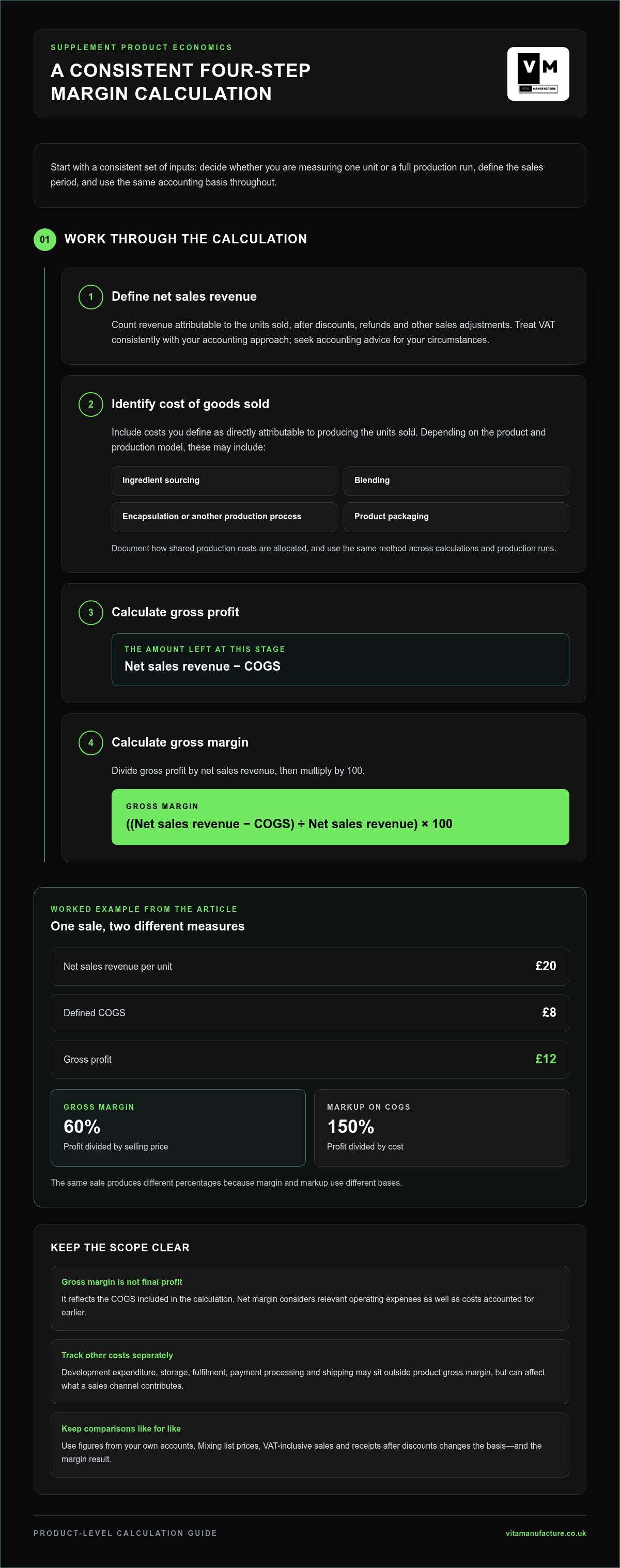
Product gross margin is the share of net sales revenue left after cost of goods sold, expressed as a percentage. Divide gross profit by net sales revenue, then multiply by 100. For an overview of the wider concept and its variations, see Profit margin.
For example, if a product has net sales revenue of £20 per unit and defined COGS of £8, gross profit is £12 and gross margin is 60%. That percentage describes the relationship between those two figures. It does not mean the brand has £12 in final profit: operating expenses and other costs still need to be accounted for.
Gross margin, net margin and markup: what is the difference?
Gross margin shows the share of sales remaining after the COGS included in your calculation. Define those costs clearly so you can compare like with like. Net margin is a broader business measure: it considers profit after relevant operating expenses as well as the costs accounted for earlier.
Margin and markup use different bases. Margin divides profit by selling price; markup divides profit by cost. In the £20 selling price and £8 COGS example, the £12 gross profit represents a 60% gross margin, but a 150% markup on COGS. It is the same sale, expressed in two different ways. Confusing the measures can lead to pricing decisions based on the wrong percentage.
Why a supplement product needs its own margin calculation
A product-level margin answers a focused question: how much remains from sales after the costs assigned to that product? It does not show whether the whole business is profitable, whether overheads are covered, or whether cash flow is healthy. A brand can report positive gross margin while still facing operating expenses, stock commitments or a delay between paying suppliers and receiving customer payments.
Separate calculations also show how product and commercial choices affect the result. Formulation, pack format, production volume and sales channel can all change the cost or revenue assumptions. For instance, single-ingredient powder ranges from businesses like Sunshine Valley face very different packaging, raw material and shipping cost dynamics compared to multi-ingredient capsules. A model for one format or order size should not automatically be applied to another.
This clarity matters as you develop private label supplements and build a distinctive brand. Treat each product and channel scenario as a separate case, and keep its assumptions visible. As formulation, packaging and manufacturing plans evolve, update the model rather than relying on a single headline margin. For wellness brands that also explore health technologies alongside consumable supplements—such as the molecular hydrogen devices developed by Pureffect—evaluating individual product economics remains just as crucial. The steps below provide a consistent way to do that.
How to calculate a supplement product’s profit margin step by step
A reliable calculation starts with a consistent set of inputs. Decide whether you’re measuring one unit or a full production run, define the sales period, and use the same accounting basis throughout. When calculating profit margins for a supplement product, work through these steps in order:
Define net sales revenue. Start with revenue attributable to the units sold, after discounts, refunds and other sales adjustments. Treat VAT consistently with your accounting approach, and seek accounting advice on the appropriate treatment for your circumstances.
Identify cost of goods sold (COGS). Include the costs you’ve defined as directly attributable to producing the units sold. Apply the same definition across calculations and production runs.
Calculate gross profit. Subtract COGS from net sales revenue.
Calculate gross margin. Divide gross profit by net sales revenue, then multiply by 100.
Gross margin = ((net sales revenue − cost of goods sold) ÷ net sales revenue) × 100.
For a symbolic example, let N represent net sales revenue and C represent COGS. Gross profit is N − C, and gross margin is ((N − C) ÷ N) × 100. Use figures from your own accounts rather than mixing list prices, VAT-inclusive sales and post-discount receipts. Changing the denominator changes the margin result. A calculation based on gross sales will differ from one based on net sales after discounts and refunds.
Which costs belong in a supplement product’s cost of goods sold?
Build COGS from costs directly associated with making the product sold. Depending on the product and production model, this may include ingredient sourcing, blending, encapsulation or another production process, product packaging and other directly attributable production costs. Don’t assume every business expense belongs here. Define your categories and record the basis for each allocation.
If a production cost applies across multiple units or runs, document how you allocate it. Apply the same method consistently so changes in reported margin reflect real changes in costs or sales, rather than a change in calculation.
How to treat development, fulfilment and overhead costs
Separate one-off formulation or development expenditure from recurring per-unit production costs. Keep development spending visible in your wider commercial model, but don’t include it in COGS for one run and omit it from the next without documenting the reason. Clear records of supplement formulation services and other development inputs help explain how the product cost model was built.
Storage, fulfilment, payment processing and shipping may sit outside product gross margin, but they still affect what a channel contributes. Track them separately in a channel-level view, alongside relevant overheads, and check that you haven’t counted them twice. Vita Manufacture’s product development and manufacturing support brings development decisions and manufacturing into the same planning conversation.
How do supplement profit margins differ across sales channels?
A product doesn’t have one fixed commercial result across every route to market. Direct sales, wholesale and subscriptions can produce different net sales revenue and involve different costs, responsibilities and cash-flow patterns. Compare them on a consistent basis: use revenue after discounts and refunds, apply the same COGS definition, and show channel costs separately. Channel comparisons are meaningful only when cost definitions match.
The table below sets out what to include in each scenario. Use it as a modelling framework, not as a prediction that one channel will always deliver a higher margin.
Direct-to-consumer, wholesale and subscription: what changes?
For a like-for-like comparison, begin with the same product and COGS basis, then add the costs tied to each route. Direct-to-consumer can involve costs beyond production, including customer acquisition and sending individual orders. Wholesale may involve a lower selling price per unit, while trade terms and the allocation of fulfilment responsibilities also affect the result. Subscriptions need a defined time horizon because repeat orders depend on retention assumptions, not just a single transaction.
Compare both gross margin and channel contribution. A channel with higher gross margin may leave less contribution once acquisition, fulfilment or other variable costs are included. It may also involve different exposure to returns, stock commitments or payment timing. A percentage alone cannot show those differences or establish which route carries less risk.
Margin versus markup when setting a supplement’s selling price
Use the same cost base, C, to see why the measures differ. If the selling price is P, margin is (P − C) ÷ P; markup is (P − C) ÷ C. To set a price for a target margin, solve for price: P = C ÷ (1 − target margin). Simply adding the target percentage to cost calculates markup, not the selling price required for that margin.
As you compare channels, document assumptions about sourcing, production, order handling and distribution. Clear supplement supply chain management can make those inputs easier to track as your commercial model develops.
How to test and improve a supplement product margin without guessing
A margin model doesn’t predict the future. It shows which assumptions drive the result, helping you make decisions and review them against actual sales and costs. When calculating profit margins for a supplement product, establish a verified baseline, change assumptions one at a time, then compare the outcomes.
Create a simple margin model for a supplement product
Use one worksheet row for each product format, pack size and sales channel. Record the revenue and cost assumptions for that specific scenario, alongside each input’s source, date and status: estimated or confirmed. Label gross margin, channel contribution and net margin separately, so a change in one measure doesn’t obscure what the others show.
Use this repeatable checklist:
Verify inputs: reconcile sales, discounts, refunds, COGS and channel costs against available records or documented estimates.
Calculate the baseline: apply the same definitions and time period throughout, then save the result as your comparison point.
Test scenarios: first change one assumption at a time, such as packaging or a promotional discount. Then model combined changes to see how decisions interact.
Review outcomes: compare modelled results with actual performance, update assumptions and note what changed and why.
Which decisions should you test first?
Prioritise assumptions that affect costs, revenue or your ability to deliver the product. Test ingredient sourcing, packaging choices, production volume, channel fees and promotional plans. For each scenario, record the margin result alongside the operational and commercial trade-offs.
Production volume: compare order-size assumptions, including the effect on unit costs and cash tied up in stock. A larger run may change the per-unit calculation, but it won’t automatically improve total profitability if demand, sell-through or storage requirements differ.
Pricing and promotions: model the expected selling price after discounts, then assess it against customer demand and brand positioning. If promotions are part of the plan, don’t treat the undiscounted price as the revenue you’ll actually receive.
Channel mix and fulfilment: test how different sales routes affect fees, delivery responsibilities and recurring service costs. Keep channel-specific assumptions visible.
Sourcing and formulation: assess potential cost changes alongside product quality, formulation objectives and production requirements. A lower input cost isn’t automatically a better decision if it affects the product you intend to make.
Separate decisions you can influence, such as pack format or promotional strategy, from external variables, such as shifts in demand or supplier conditions. Assign a realistic range to uncertain inputs rather than treating one forecast as certain. No scenario guarantees a particular margin improvement. The value lies in understanding the trade-offs before committing.
Vita Manufacture’s product-development support connects early development decisions with a more considered commercial model.
How Vita Manufacture can support commercially considered supplement development
A credible product cost model starts before production. Formulation, pack format and manufacturing decisions shape the assumptions behind unit costs, while regulatory considerations and the route to market affect the wider plan. Bringing these questions into development early helps you weigh commercial objectives alongside the product you want to create, rather than treating cost as a calculation to complete after key choices are fixed.
Bring commercial assumptions into product development
Start with the fundamentals: who is the target customer, what format and pack size will serve them, which sales channels are in scope, and what commercial objectives will guide the project? These decisions give the product model a practical frame. For example, a pack designed for one channel may involve different packaging and fulfilment assumptions from a pack intended for another route to market.
Vita Manufacture supports new product development, formulation and contract manufacturing, alongside regulatory guidance. Considering these areas together as the product takes shape helps connect cost assumptions with development choices and relevant quality and regulatory considerations. Founders choosing a UK supplement manufacturer can assess how product design, manufacturing requirements and commercial plans fit together, rather than treating production as a standalone step.
Keep the model grounded. Record which inputs are confirmed and which are estimates, then revisit them as the formulation, packaging and production plan develops. This gives you a clearer basis for weighing trade-offs without assuming that the lowest-cost option is automatically right for product quality, positioning or customer expectations.
Plan for a product that can evolve with your brand
A product plan should account for more than the first manufacturing decision. Logistics and distribution connect production with stock management and the route to market. Considering these requirements alongside the product model can help identify assumptions that may need to change as your brand, sales mix or operational needs evolve.
Vita Manufacture supports brands through formulation, manufacturing, regulatory guidance, logistics and distribution. Its facility is ISO 22000:2018-certified, and its transparent customer portal supports the end-to-end service. These provide useful quality and visibility considerations when coordinating development and operational planning.
For founders calculating profit margins for a supplement product, development and manufacturing inputs are part of building a more realistic commercial view. A considered plan links the product you want to make with the costs and channel assumptions you need to assess, while leaving room to review them as requirements evolve.
Make your next product decision with greater clarity
A margin model is most valuable when it informs what you do next. Use it to guide decisions about product format, production plans and routes to market, then revisit its assumptions as your requirements develop. That makes calculating profit margins for a supplement product an ongoing planning tool, not just a launch-stage exercise.
Commercial planning also depends on connecting development decisions with quality and delivery. Vita Manufacture brings product development, manufacturing, regulatory guidance and logistics together, supported by an ISO 22000:2018-certified facility and a transparent customer portal. This helps you consider product economics alongside operational requirements as your brand evolves.
You don’t need every decision settled before taking the next step. A clear view of your goals and current assumptions is a strong place to begin. Discuss your supplement product-development goals with Vita Manufacture and explore a considered plan for your next stage of growth.
Frequently Asked Questions
How do you calculate gross profit margin for a supplement product?
Gross profit margin is gross profit divided by net sales revenue, multiplied by 100. Gross profit is net sales revenue less the cost of goods sold included in your calculation. When calculating profit margins for a supplement product, treat discounts and returns consistently across periods, and confirm VAT treatment with your accountant. This product-level measure doesn’t account for wider business expenses used when assessing net profit.
What is the difference between profit margin and markup on a supplement?
Margin measures profit as a proportion of the selling price, while markup measures it as a proportion of cost. Both describe the same sale but produce different percentages because they use different bases. Label figures clearly in pricing models and reports. Use margin to assess the share of sales retained as profit at the chosen calculation stage; use markup to express the amount added to cost.
What costs should be included when calculating a supplement product’s margin?
The product cost base may include directly attributable ingredients, production and packaging costs. Development expenditure, storage, fulfilment, marketing and overheads may need separate treatment, depending on whether you’re assessing gross margin, channel contribution or net profit. Define the measure first, document how shared costs are allocated, and use the same method across products or production runs. Check that costs haven’t been counted in both product and channel analyses.
Is there a good profit margin for a supplement product?
There’s no single margin percentage that suits every supplement brand. Product format, sales channel, operating model, customer acquisition costs and growth stage all influence commercial viability. Rather than relying on a generic benchmark, compare your own consistently calculated results over time and test whether each product’s contribution supports the business’s operating needs. A margin that looks strong in isolation may not be enough once other business costs are considered.
How do wholesale and direct-to-consumer sales affect supplement margins?
Each channel has different selling prices, fees, fulfilment responsibilities and customer-acquisition assumptions. Direct sales may involve individual-order fulfilment and payment costs, while wholesale terms can reduce revenue per unit or shift delivery responsibilities. Build a separate calculation for each channel using the same product-cost definitions. Then compare the contribution after relevant channel costs, rather than choosing a route based only on headline gross margin.
Should VAT be included when calculating a supplement product’s profit margin?
VAT treatment affects the revenue figure used, and the appropriate approach depends on your business circumstances and applicable tax rules. Keep the treatment consistent in your calculations, clearly record whether revenue figures include or exclude VAT, and ask your accountant to confirm the correct accounting treatment. This helps make margin figures more reliable for pricing decisions and business reporting.
How often should a supplement brand review product margins?
Review margins when ingredient, production, packaging, fulfilment or channel costs change, and at regular management intervals. Promotions and shifts in channel mix can also alter realised results, even if the product itself hasn’t changed. Record the date of each calculation and the source of its inputs. This creates a clear audit trail and helps distinguish genuine commercial changes from updates to estimates or calculation methods.