Beta Alanine Guide: Sports Formulation & Sourcing
Beta-alanine is a non-essential amino acid that the body stores in muscle as carnosine. Supplementation may help delay fatigue during high-intensity exercise, particularly efforts lasting 0.5-10 minutes. The International Society of Sports Nutrition suggests 4 to 6 grams per day to optimise muscle carnosine levels.
If you’re weighing up beta-alanine, you’ll want more than a dosage figure. Understanding its role, how it is produced and what the evidence suggests can help you assess it. This guide explains how regular use may affect anaerobic capacity and strength, and why dividing servings can matter.
You’ll also find a practical look at combining beta-alanine with creatine, including how the ingredients support different aspects of training. Whether you’re considering personal use or developing a sports nutrition product, understanding the evidence and formulation choices can give you a clearer basis for your next decision.
Table of Contents
What is beta-alanine?
Beta-alanine is an amino acid the body uses to make carnosine in muscle. This connection helps explain its role in exercise nutrition and supplement formulation.
Beta-alanine, carnosine and anserine
Beta-alanine joins with histidine to form carnosine, a dipeptide found in skeletal muscle. Anserine is a related compound, also formed from beta-alanine and histidine, and occurs in animal tissue.
Muscle carnosine is the main link for athletes: beta-alanine supplies one of its building blocks. Supplementation can increase muscle carnosine stores by 20% to 30% after at least 2 weeks, and by 40% to 60% after 4 weeks. These figures describe changes in stores, not a guaranteed performance result. The ingredient is called beta-alanine in English.
Carnosine as a muscle buffer
Carnosine helps buffer hydrogen ions that build up as muscles work intensely. This matters during demanding exercise, when acidity can contribute to fatigue and make it harder to sustain effort.
Carnosine contributes 10-20% of total buffering capacity in type I and II muscle fibres. Supplementation aims to support this system by increasing the availability of a carnosine building block. Paraesthesia, a tingling sensation, can occur in a dose-dependent manner. Tingling is a potential side effect, not evidence that the ingredient is improving performance.
Food sources of beta-alanine and carnosine
Carnosine occurs in animal muscle foods such as beef, poultry and fish. These foods provide carnosine, rather than a concentrated serving of beta-alanine as a standalone ingredient.
Food choices affect exposure to carnosine and related compounds, while supplements provide beta-alanine directly. UK retail prices vary by product and pack, so compare the stated ingredient amount, serving information and product quality details. On English-language product information, the ingredient is called beta-alanine.
UK food supplements are regulated as foods, but quality testing can vary between products. Review the label and product information for ingredient details and any disclosed quality checks.
Dosing to increase muscle carnosine
The International Society of Sports Nutrition suggests 4 to 6 grams per day to optimise muscle carnosine levels. Regular intake supports the aim of building muscle stores over time, rather than relying on a single serving before exercise.
Dividing the daily total into smaller servings can help manage tingling, which is dose-dependent. Anyone with a health condition or taking medicines should seek medical advice before use. The same applies to people who are pregnant or breastfeeding. Check serving directions carefully: the amount per serving and the full daily total are different measurements.
Regular beta-alanine intake increases carnosine concentration in muscles and helps delay fatigue at higher exercise intensities. Carnosine occurs in human muscle at 17-25 mmol/kg of dry muscle; its imidazolium group has a pKa of 6.83.
Biosynthesis and industrial production
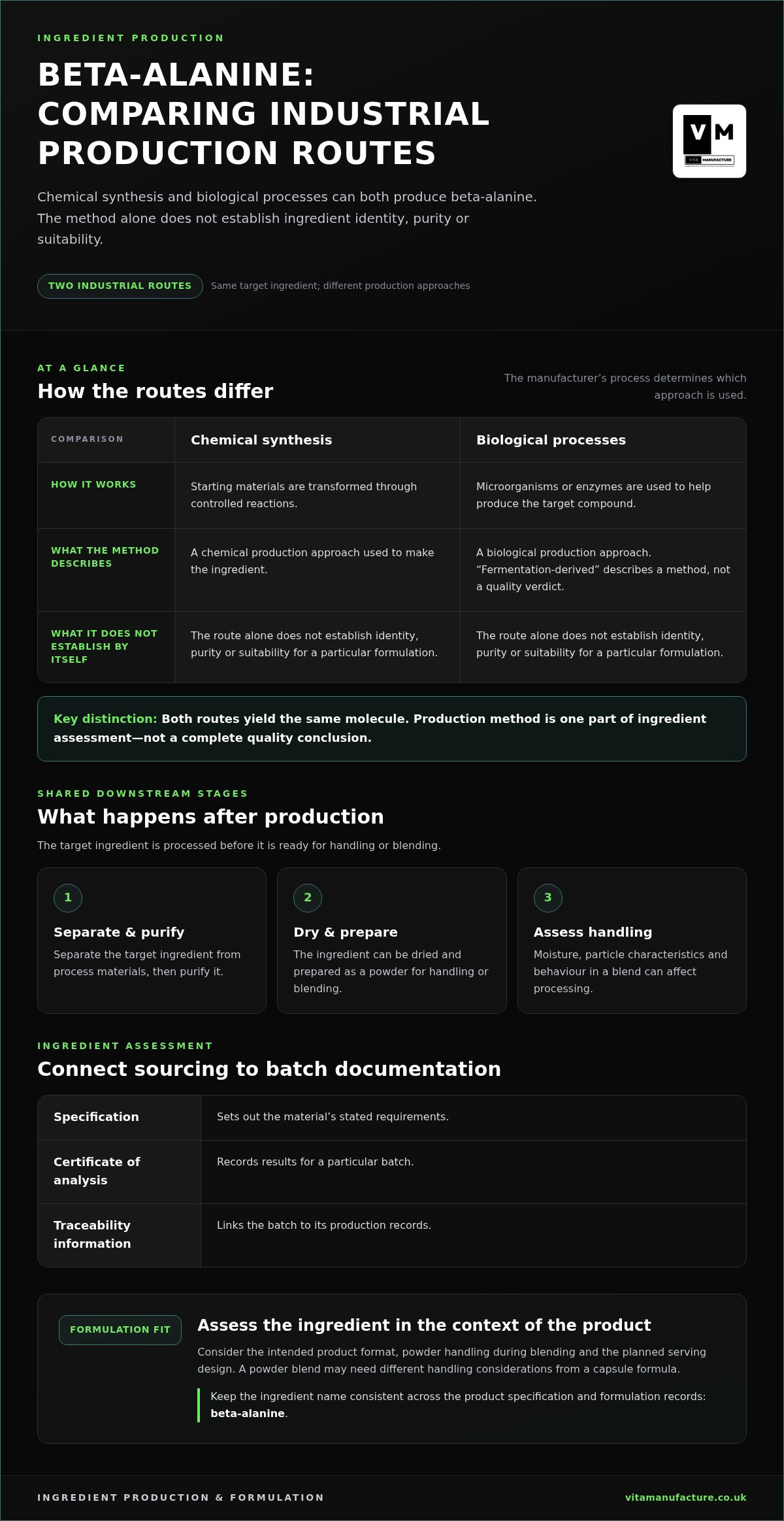
Beta-alanine can form naturally through metabolism or be produced as an ingredient for supplement formulations. Both routes yield the same molecule, but production and purification determine what reaches the finished ingredient. For product developers, origin describes how an ingredient was made, not its identity or quality on its own.
In the body, beta-alanine forms through metabolic processes involving the breakdown of other compounds. Cells then use it as a building block to make carnosine. This biological route helps explain its role in muscle, but it is not the same as producing a concentrated supplement ingredient. Manufacturing must yield material that can be collected and assessed.
Industrial production may use chemical synthesis or biological processes. Chemical routes transform starting materials through controlled reactions; biological routes use microorganisms or enzymes to help produce a target compound. The approach depends on the manufacturer’s process. A description such as “fermentation-derived” tells you about the method, but does not by itself establish the ingredient’s identity, purity or suitability for a particular formulation.
After production, the target ingredient is separated from process materials and purified. It can then be dried and prepared as a powder for handling or blending. These stages matter to formulators because residual moisture, particle characteristics and behaviour in a blend can affect processing. Use the standard English name beta-alanine in product specifications to identify the ingredient clearly.
When sourcing an ingredient, connect its description to batch-specific documentation. A specification sets out the material’s stated requirements, while a certificate of analysis records results for a particular batch. Traceability information links the batch to its production records.
Production method is one part of ingredient assessment, not a complete quality conclusion. A development team can consider the intended product format, how the powder handles during blending and whether it suits the planned serving design. For example, a powder blend may need different handling considerations from a capsule formula. Keep the ingredient name consistent across the product specification and formulation records.
These practical questions help connect sourcing decisions with a workable product concept. Ingredient identity, batch documentation and handling characteristics each inform formulation planning. Supplement formulation development can help bring ingredient choices and product design into the same conversation.
Long-term effects on anaerobic capacity and strength
Beta-alanine’s effects build through increased muscle carnosine, rather than an immediate stimulant-like response. Muscle carnosine stores rise with repeated intake, so changes develop over time. Reported increases are 20% to 30% after at least 2 weeks, and 40% to 60% after 4 weeks. These are changes in carnosine, not direct measures of strength or sporting performance.
How long does it take to work, and how long do its effects last? Muscle carnosine can increase after at least 2 weeks of supplementation, with larger increases reported after 4 weeks. After intake stops, stores decline over time; the duration depends on how much has accumulated and the body’s turnover, rather than a single fixed timeframe.
The performance case is most relevant to intense efforts lasting 0.5-10 minutes. Examples include repeated hard intervals, demanding circuits, or sustained high-intensity bouts. These efforts can create acidity in working muscle, and carnosine contributes to the muscle’s buffering capacity. That mechanism helps explain why beta-alanine is associated with anaerobic exercise, rather than every type of training.
Strength outcomes need to be interpreted in context. A heavier single lift or brief maximal effort is not the same test as repeated work under fatigue. In sessions with repeated sets or sustained high-intensity intervals, maintaining output across efforts may matter more than a one-off peak. Beta-alanine supports carnosine accumulation; it does not replace progressive resistance training or adequate recovery.
Assess effects against the exercise demand, not a broad promise of “more strength”. For example, a coach might compare the number of high-quality repetitions completed in a repeated-effort session. A runner could track whether pace is maintained across hard intervals. In either case, keep the exercise, workload and rest periods consistent so the comparison reflects performance, not a changed training session.
Timing also shapes expectations. A single serving before training does not instantly create higher muscle carnosine. The relevant process is regular intake over weeks, followed by training that challenges anaerobic capacity. A person training mainly at low intensity may have less reason to prioritise this ingredient than an athlete whose sessions repeatedly involve hard efforts within the 0.5-10-minute range.
Strength and anaerobic capacity are related, but they are not interchangeable outcomes. Carnosine’s buffering role provides a plausible basis for supporting repeated intense effort; it does not show that every user will gain maximal strength. Track a specific training measure over a consistent programme, and interpret results alongside the exercise type and duration.
Suggested daily dosage
Dosage guidance varies because studies have tested different daily amounts and schedules. The International Society of Sports Nutrition suggests 4 to 6 grams per day to optimise muscle carnosine levels. That provides a useful reference range, while the amount used in a study does not automatically suit every supplement format or training plan.
Across studies, beta-alanine doses have ranged from 1 to 7 grams per day. Amounts used for exercise performance commonly fall between 3.2 and 6.4 grams per day. These ranges describe study protocols, not a reason to start at the highest amount. The purpose is to support gradual carnosine accumulation through consistent intake.
Dividing the daily total into servings of 2 grams or less can help manage the dose. Paraesthesia, the temporary tingling sensation associated with supplementation, is dose-dependent. Smaller servings reduce the amount taken at once, while keeping track of each serving helps prevent accidental double dosing.
For example, a 6-gram daily total can be divided into four equal servings of 1.5 grams. Each serving stays below the 2-gram guide, and the four servings add up to the intended daily amount. This is a practical illustration of splitting a total, not a requirement to use 6 grams.
Plan around the daily total, not the workout clock. The aim is consistent intake of the chosen amount, because muscle carnosine rises over time rather than immediately after one serving. Taking a dose only before training is not the same approach as following a repeated daily schedule.
A simple tracking routine can make the schedule clearer:
Choose a daily total within the relevant guidance range.
Divide that total into servings of 2 grams or less.
Record each serving so the daily sum remains clear.
Keep the schedule consistent while assessing use over time.
These steps also help distinguish the amount per serving from the full daily intake. For instance, four 1.5-gram servings total 6 grams; one 1.5-gram serving does not. Check the product’s serving information carefully, since the labelled serving and the amount of ingredient per serving determine the calculation.
For personal use, consider your training demands and the product directions when interpreting dosage ranges. A high-intensity training schedule and a single serving are different contexts. Decisions about intake should reflect the intended daily total, not a rushed attempt to increase it.
ESN says beta-alanine can cause a harmless tingling sensation on the skin and that splitting intake into two servings can help reduce it. This offers a practical way to manage the sensation while keeping intake organised. Dividing the intake does not mean overlooking the total daily amount. Keep the planned daily total in view and check the product directions to see how much beta-alanine each serving provides. This helps distinguish the amount in one portion from the full amount taken across the day.
Combining beta-alanine with creatine
Beta-alanine and creatine can be included in the same sports formulation, but they serve different roles. Beta-alanine supports muscle carnosine accumulation, while creatine is associated with the phosphocreatine energy system. Their different mechanisms provide a rationale for combining them, but do not prove that the blend has a greater effect than either ingredient alone.
Beta-alanine is most relevant to repeated, high-intensity exercise, particularly efforts lasting 0.5-10 minutes. Its contribution relates to carnosine and muscle buffering. Creatine’s role is distinct, so a combined product should be positioned around complementary ingredient functions, not as one ingredient amplifying the other automatically.
How does beta-alanine compare with creatine and caffeine for sports performance? Beta-alanine is used to raise muscle carnosine over time, while creatine relates to phosphocreatine and caffeine is commonly used for acute stimulation. They are not interchangeable; each suits a different formulation rationale.
Consider a training programme with repeated hard intervals followed by resistance work. A formulation containing beta-alanine and creatine may be designed to address different demands within that programme. The product concept should explain each ingredient’s intended role clearly, rather than imply that every user will experience identical benefits.
Combining ingredients also involves practical formulation decisions. A product developer needs to consider the intended serving, flavour profile, format and how the ingredients behave together in the finished product. If intake is divided across the day, the label should clearly distinguish the daily total from the amount per serving. Clear instructions help avoid confusion between one serving and a full day’s intake.
A powder blend and a capsule product, for example, present different constraints. A powder allows ingredients to be combined in one mix, while a capsule formula needs to fit the selected capsule format. The right option depends on the target serving, user experience and product positioning, not just the ingredient names.
A credible product claim should match the evidence for each ingredient and avoid suggesting proven synergy without supporting evidence. Explain beta-alanine’s rationale separately from creatine’s role, and state how the combination is intended to fit the training context. This gives athletes a more useful basis for comparing a combined product with single-ingredient options.
For a combined formula, packaging is part of the user experience: serving directions and ingredient amounts need to read clearly. Plan your supplement label design around the product’s intended format and usage instructions.
Vita Manufacture: New Product Development
Vita Manufacture’s New Product Development can help turn a sports nutrition concept into a defined supplement project. If you’re considering a beta-alanine formula, this is a practical next step after weighing the ingredient’s role, dosage approach and potential pairing with creatine.
Bring your product goals and preferred format to the development discussion. Vita Manufacture also offers Contract Manufacturing and Private Label Supplements, giving founders different routes from concept towards production. The right route depends on how much of the product concept you have established and what support your project needs.
For a new formulation or private-label project, contact Vita Manufacture to discuss your plans, or visit vitamanufacture.co.uk.
Turn your formulation idea into a clear next step
The next decision is how your product should serve its intended audience. A beta-alanine formulation needs a clear purpose, a considered format and straightforward usage information. These choices help shape a coherent concept that is practical to develop.
If you’re moving from research towards a commercial product, Vita Manufacture can support the development journey. Its New Product Development, Contract Manufacturing and Private Label Supplements services provide routes for different stages of a supplement project. The right starting point depends on whether you’re shaping a new concept or building around an established product direction.
Bring your formulation goals into a conversation about the next steps, from product concept to production planning. Contact Vita Manufacture about beta-alanine and take the next step towards developing your sports nutrition idea.
Frequently Asked Questions
What is beta-alanine and how does it work?
Beta-alanine is a non-essential amino acid that the body uses to make carnosine in muscle. Carnosine helps buffer acidity during intense exercise, which is why supplementation is associated with efforts that place high demands on working muscles. When assessing a supplement, distinguish the ingredient’s role in building carnosine from an immediate pre-workout effect. The intended benefit develops through regular intake.
What are the evidence-based benefits of beta-alanine for exercise performance?
Evidence points to a potential benefit during intense exercise lasting 0.5-10 minutes, rather than a universal boost across every activity. The likely relevance depends on the effort being repeated or sustained at high intensity, such as hard intervals. This makes the exercise context central to evaluating a product: a benefit linked to demanding anaerobic work shouldn’t be treated as proof of improved performance in unrelated activities.
What is the recommended beta-alanine dose and how should it be taken?
The International Society of Sports Nutrition suggests 4 to 6 grams per day to optimise muscle carnosine levels. Split the total into smaller servings, and use the product label to distinguish the amount in each serving from the full daily amount. For example, if a label’s serving size differs from your planned daily total, calculate the total from the stated ingredient amount, not the scoop or capsule count alone.
Does beta-alanine work better when combined with creatine or other supplements?
Combining beta-alanine with creatine brings together ingredients with different roles, but does not establish that the combination works better than either alone. Beta-alanine relates to muscle carnosine, while creatine has a distinct role in sports formulations. Caffeine differs again, so compare ingredients by their purpose and training context. A combined formula should explain each ingredient’s contribution clearly, rather than imply proven synergy.
How much does beta-alanine cost in the UK, and what should buyers look for?
UK prices vary by product and pack. Compare the stated ingredient amount, serving information and product quality details, including any disclosed quality checks.