Best Pre Workout Supplement for Bodybuilding Guide
The best pre-workout supplement for bodybuilding isn’t necessarily the one with the longest ingredient list. Choose one with clearly disclosed doses of ingredients that match your training needs and caffeine tolerance; pre-workout is designed to support readiness for a session, and is commonly taken 20-30 minutes beforehand. The European Food Safety Authority gives 400mg as the recommended daily caffeine content, so include caffeine from other sources when considering your total.
It’s understandable to look for an extra edge as you work towards strength and muscle-building goals. But pre-workout labels can be hard to assess: caffeine, creatine and beta-alanine have different roles, and the amount per serving matters. This guide explains what pre-workout may do, which ingredients may support bodybuilding, how to compare servings and how to use caffeine cautiously. You’ll learn how to choose a formula around your training priorities, rather than relying on bold claims or a crowded label.
Table of Contents
1. Caffeine-related side effects and serving guidance
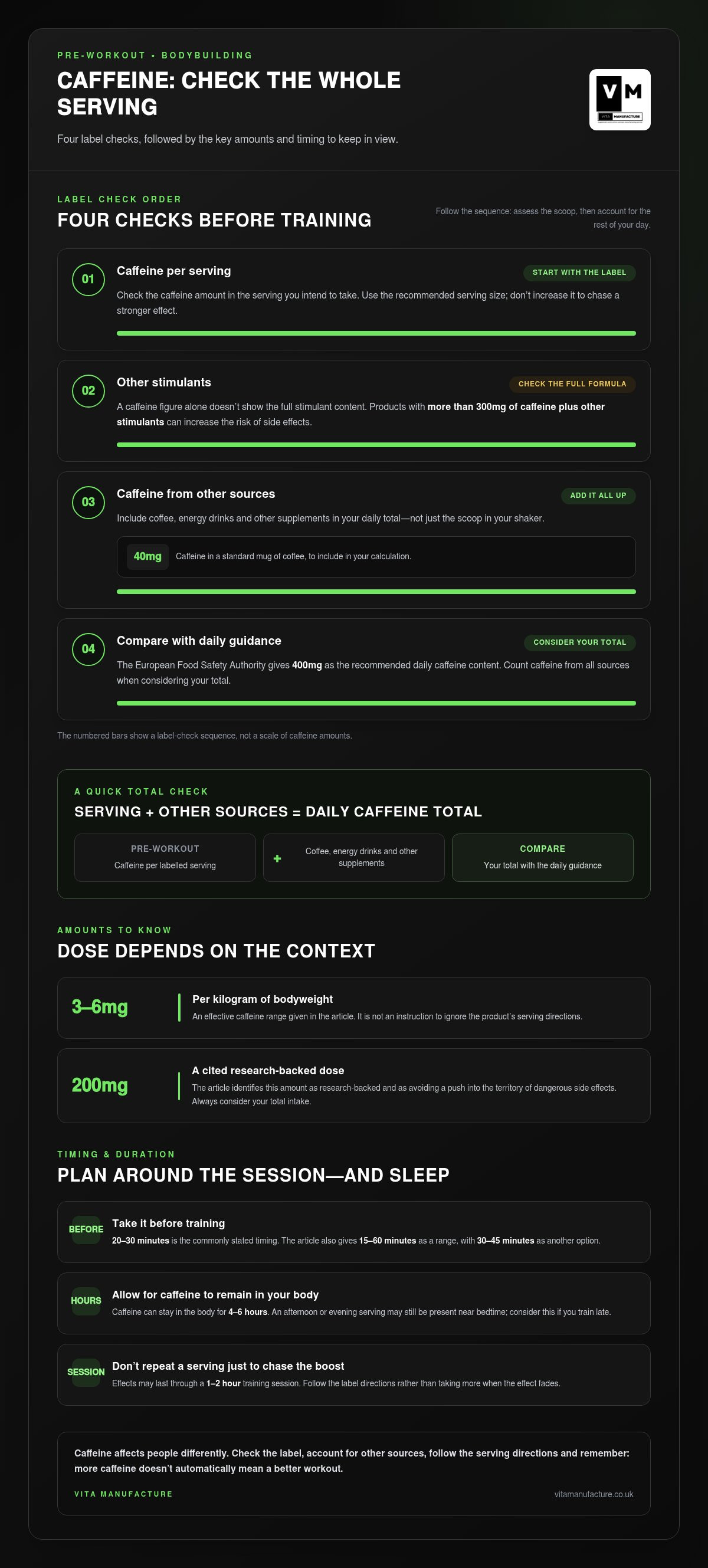
Take pre-workout 20-30 minutes before training; suggested timing also ranges from 15-60 minutes, with 30 to 45 minutes another option. Use the product’s recommended serving size, rather than increasing it to chase stronger effects. The right amount depends on the caffeine per serving and what else you consume that day.
The European Food Safety Authority cites 400mg as the recommended daily caffeine content. Count caffeine across drinks and supplements, not just the scoop in your shaker. A standard mug of coffee contains 40mg, so coffee alongside a pre-workout serving contributes to your daily total. Check the label before combining products.
Compare the labelled serving with the amount you intend to take. A pre-workout serving may contain other stimulants as well as caffeine, so the caffeine figure alone doesn’t show the full stimulant content. Products with more than 300 milligrams of caffeine plus other stimulants can increase the risk of side effects. Don’t double-scoop to compensate for low energy.
A caffeine dose of 3-6 mg per kilogram of bodyweight is given as an effective range. This is a bodyweight-based measure, not an instruction to ignore the product’s serving directions. A 200mg dose is identified as research-backed and as avoiding a push into the territory of dangerous side effects. Read the label and consider your total intake.
Caffeine affects people differently, so pay attention to how a serving influences your energy and training. If you’re new to a caffeinated formula, follow the label’s serving directions rather than taking extra. Before combining it with coffee or another stimulant product, add up the caffeine from each source. More caffeine doesn’t automatically mean a better workout.
Consider timing as well as your session start. Caffeine can stay in the body for four to six hours, so an afternoon or evening serving may still be present near bedtime. If you train late, consider whether caffeine could interfere with sleep, then choose a lower-caffeine option or avoid a stimulant-based pre-workout.
Pre-workout effects may last through a training session of 1-2 hours, but that doesn’t make repeated servings during the session appropriate. Follow the label’s directions and don’t treat a fading boost as a reason to take more. Keep track of servings alongside coffee and other caffeinated drinks to make your daily total easier to assess.
Use a simple routine: check caffeine per serving, note any other stimulants, add your usual coffee or energy drinks, then compare the total with the daily guidance. For example, include a 40mg mug of coffee in your calculation. This approach helps you assess amounts consistently and use caffeine cautiously, without assuming every formula delivers the same effects.
2. Ingredients including creatine, beta-alanine and caffeine
Ingredient names tell only part of the story. For bodybuilding, compare what each ingredient is intended to support, how much each serving provides and whether that amount suits your routine. Creatine, beta-alanine and caffeine have different roles, so a formula containing all three won’t automatically suit every training session.
Creatine supports a different goal from a stimulant. The suggested amount is 3 to 5 grams when creatine isn’t already included in your shake. Check the pre-workout label first, then add only what you need to reach your intended intake. This avoids overlooking creatine already present in another product or taking multiple servings simply to obtain one ingredient.
Some formulas use a different creatine form. One suggested formula lists 2g of CON-CRET® Creatine HCL, so compare its form and stated amount with the other ingredients on the label. Don’t assume that two products provide equivalent amounts just because both list creatine. Record the ingredient and dose, then assess the full serving rather than judging by the headline claim.
Beta-alanine is associated with muscular endurance. Check the product label for beta-alanine serving guidance and follow its directions. Check whether the label provides that amount per serving or whether you would need more than one serving. Keep the daily total in mind if you use another supplement containing beta-alanine, and follow the product’s serving directions.
Beta-alanine can cause a tingling sensation after a serving, but that sensation doesn’t measure workout effectiveness or prove the formula is working better. If it feels uncomfortable, review the amount per serving and don’t take extra. Also, don’t confuse beta-alanine with alanine, which is a different ingredient.
Caffeine is included for its stimulant effect and may contribute to alertness and energy. Check the amount per serving alongside ingredients such as creatine and beta-alanine, then include coffee, energy drinks and other caffeinated products in your daily total. This is especially useful when comparing formulas with similar ingredient lists but different stimulant levels.
Use a simple label check before buying: identify each ingredient, note its amount per serving and consider whether that amount suits its intended use. Separate ingredients intended to support training from stimulants, and check whether you already take them elsewhere. Clear amounts make comparison easier than a label that lists ingredients without their individual quantities.
For brands developing a formula around specific ingredient choices, ingredients and bulk sourcing can support a more deliberate approach to supplement development.
3. Choosing products with transparent, adequately dosed ingredients
Compare pre-workouts by ingredient amounts, not label length. UK formulas can differ in stimulant content, supporting ingredients and serving directions, even when they appear designed for similar sessions. There’s no single formula for every lifter. The best fit depends on whether the disclosed ingredients and amounts align with your goals, routine and tolerance.
Start with the full ingredient panel. Check that individual amounts are stated, then compare them with the serving size you would take. If a blend lists ingredients without their quantities, it’s difficult to judge how much of each one a serving provides. Also check whether the label gives amounts per serving or for a daily intake.
For example, the suggested L-tyrosine range is 1 to 2 grams, with 1.5 grams described as a suitable target dose. Taurine is given at 1 to 2 grams daily, with 1 gram described as an ideal dose for most applications. These examples show why comparing ingredient names alone can mislead: the amounts and stated use matter too.
Betaine anhydrous offers another useful label comparison. Clinical studies consistently use 2.5 grams per day, usually split into two 1.25-gram servings. A pre-workout containing 1,250 mg is described as a solid starting dose. Check whether the panel states the amount in one serving or across the day before comparing it with another formula.
For a practical comparison, record the following details for each product:
Amount of each named ingredient per serving.
Serving size and directions for use.
Caffeine and other stimulant ingredients.
Whether a proprietary blend obscures individual amounts.
Then match those details to your own sessions. If you already consume caffeine or take a separate supplement, include those sources in your assessment. Don’t assume a larger serving or more ingredients will produce stronger effects. A transparent label shows what one serving provides and where ingredients may overlap.
Are pre-workout supplements regulated in the UK, and how can you check quality or banned substances? Regulation and banned-substance assurance are separate considerations: a product’s label or availability for sale doesn’t verify its quality or prove it’s free from prohibited substances. Review the full ingredient declaration and look for clear, product-specific quality information, especially if prohibited-substance risk matters to you.
For a brand developing a formula, clear ingredient choices start during product development. A considered formulation can define ingredient amounts and serving directions before label design, making the finished product easier to assess and compare.
UK pre-workouts vary in stimulant content, supporting ingredients and serving directions. Compare the disclosed amount of each ingredient per serving instead of relying on ingredient lists alone. The right fit depends on whether those amounts suit your goals, routine and tolerance, including any caffeine or supplements you already use.
Choose a pre-workout with a transparent ingredient panel, amounts per serving and clear directions. Check that its serving size and stimulant content suit your goals, routine and tolerance. No single formula is the best fit for every lifter.
4. Citrulline malate for blood flow and endurance
Citrulline malate is included in some pre-workouts for its potential role in blood flow and muscular endurance. The stated dose range matters: studies showing benefits generally use 6 to 8 grams, while 6 grams is described as the widely accepted minimum effective dose. Use those figures to assess a label, not as a promise of stronger training performance.
Start by finding citrulline malate on the ingredient panel and checking the amount per serving. If a product provides less than 6 grams, compare that serving with the stated range before deciding whether it fits your needs. Don’t assume that a prominent mention on the front label means the formula contains an adequately sized amount.
Check the ingredient name carefully. L-citrulline and citrulline malate are related but distinct label terms, so don’t treat their listed gram amounts as automatically interchangeable. The dose guidance here refers to citrulline malate. A transparent panel should identify the form in the formula and state how much each serving provides.
For a practical comparison, write down the citrulline malate amount for each product you’re considering. Compare like with like, then note whether one serving reaches the 6-gram minimum or falls within the 6 to 8 grams range. This simple step helps distinguish a formula built around a meaningful amount from one where citrulline appears only as a minor addition.
Consider the demands of your session, too. A bodybuilding workout may involve repeated sets, short rests or longer endurance-focused work. Citrulline malate may suit a formula aimed at blood flow and endurance, while creatine and caffeine serve different purposes. Match the ingredient to your training priority instead of expecting one compound to support every aspect of strength training.
Keep your comparison specific. Record the serving size, citrulline malate amount and other active ingredients. If the label lists a blend without individual quantities, it’s harder to tell how much citrulline malate one serving provides. A clear amount makes consistent comparisons easier and helps you look beyond marketing language.
Track your sessions when assessing a formula. Note the serving, workout type and how the session felt, then compare similar training days rather than unrelated workouts. This won’t prove that citrulline caused a change, but it gives you a structured way to judge whether the formula fits your routine and endurance goals.
Finally, treat 6 to 8 grams as a comparison point, not an instruction to exceed the label’s serving directions. Check the complete formula before adding separate citrulline malate, since it may already be included. Clear amounts and ingredient forms make it easier to choose deliberately, whether your priority is endurance, blood flow or a balanced pre-workout formula.
5. Pre-workout supplements for bodybuilding and muscle building
Pre-workout may support a training session, but it doesn’t build muscle by itself. Muscle growth depends on consistent resistance training, recovery and nutrition. For those looking to optimise their routine, adopting personalized wellness programs can help tailor nutrition and supplementation to individual training demands. The best pre workout supplement for bodybuilding is one that supports a specific need without displacing those foundations.
What are the best pre-workout supplements available in the UK? Choose by transparent ingredient amounts, stimulant content and serving directions, not rankings or claims alone. The best pre workout supplement for bodybuilding depends on your training priorities and tolerance, not simply the number of ingredients in the formula.
Timing should fit your session. Pre-workout is commonly taken 20-30 minutes before training; another suggested window is 30 to 45 minutes beforehand. Follow the labelled serving, and don’t add extra scoops during an intense workout. Effects may last through a session of 1-2 hours, so factor in when you finish.
How much do popular pre-workout supplements cost in the UK per serving? Compare the pack price with the number of servings, then consider whether the serving sizes and ingredient profiles are comparable.
Are stimulant-free pre-workout supplements effective for bodybuilding? They can provide ingredients such as citrulline malate or beta-alanine without caffeine’s stimulating effect. Whether that suits you depends on what you want from a formula and whether you prefer to avoid stimulants.
Keep your comparison practical: match each ingredient to a training purpose, check amounts per serving and account for caffeine from drinks or other supplements. Consistent training and recovery remain central to muscle-building progress. Track how a formula fits your routine across similar sessions rather than judging it from one workout.
Vita Manufacture: New Product Development
Vita Manufacture’s New Product Development can help turn a considered pre-workout concept into a supplement project. It’s a natural next step if you’re developing a formula around defined ingredients, serving amounts and training priorities, rather than simply comparing finished products.
For a route to market using an established product format, explore Private Label Supplements or White Label Supplements. If you have a distinct formulation brief, New Product Development is the relevant starting point, while Contract Manufacturing supports production. The right route depends on whether you’re shaping a new formula or building a brand around a supplement product.
Bring your product concept and priorities to Vita Manufacture to discuss an approach aligned with your brand. Visit vitamanufacture.co.uk to discuss your supplement project.
Turn your product idea into a clear next step
The search for the best pre workout supplement for bodybuilding can also help shape a focused product brief. Identify the audience, training needs and formulation priorities your concept is designed to serve. This gives development and production decisions a stronger foundation.
For a new formula, Vita Manufacture offers New Product Development. Contract Manufacturing and Private Label Supplements are other routes, depending on whether you’re developing a distinct concept or building a brand around a supplement product. Consider which approach best fits your plans and the product experience you want to create.
A well-defined brief can bring your ingredient choices, intended use and brand direction into alignment. If you’re ready to explore the next step, contact Vita Manufacture. A clear concept is a strong starting point for building something purposeful.
Frequently Asked Questions
What does pre-workout do?
Pre-workout is intended to support preparation for a training session, often through ingredients such as caffeine or beta-alanine. Its effect depends on the formula and your response, so use it to complement, not replace, a structured bodybuilding programme. For example, a stimulant-based product may suit a session when you want caffeine, while a stimulant-free option avoids it. Neither replaces consistent training, nutrition and recovery.
Can you stack it with creatine?
Yes, you can combine pre-workout with creatine, but first check whether the formula already contains it. If it doesn’t, the suggested amount is 3 to 5 grams added to a shake. For example, if your pre-workout lists creatine, include that serving in your overall intake rather than automatically adding another full dose. Keep the product directions in view and avoid doubling servings just to increase one ingredient.
Should you cycle off?
Some guidance recommends taking a break from pre-workout every 6 to 8 weeks, with at least 7-10 days off. This can be a practical point to review whether you still want a stimulant-based product or prefer training without it. Keep a simple record of use and sessions, then follow the label when restarting. Cycling is not a reason to increase servings before or after the break.
Should you take pre-workout with or without food?
Follow the product label’s directions, as formulas can differ. If you train after a meal, consider how the timing fits your session and usual routine; if you train before eating, prepare the serving as directed. For example, avoid changing both your meal timing and supplement serving on the same training day, so you can assess what suits your routine.
Will I get a tingling sensation after taking pre-workout?
Beta-alanine can cause a tingling sensation for some users, but that feeling doesn’t show whether a workout is more effective. Check the amount per serving and compare it with your other supplements containing beta-alanine. The suggested daily amount for pre-workout use is 3.2 grams. Follow the label rather than taking extra to trigger a sensation, and choose a different formula if you prefer to avoid beta-alanine.
What ingredients are effective in pre-workout supplements for bodybuilding?
Useful ingredients depend on your training priorities and the amounts provided. Examples include creatine, beta-alanine, caffeine and citrulline malate, which are included for different purposes. Suggested reference amounts include 3 to 5 grams of creatine when it isn’t already included, 3.2 grams of beta-alanine daily and 6 to 8 grams of citrulline malate. Compare the label’s individual amounts, not just its ingredient list.
How much caffeine is in leading pre-workout supplements, and what is a safe daily limit?
Caffeine amounts vary by formula; the ingredient guidance gives 150-250 milligrams as a pre-workout range. The European Food Safety Authority cites 400mg as the recommended daily caffeine content. Include coffee, energy drinks and other supplements when assessing your total. For example, a standard mug of coffee contains 40mg. Check each label before combining products, as formulas can also contain other stimulants.
Are pre-workout supplements safe, and what side effects should users know about?
Use pre-workout according to its label and pay particular attention to stimulant amounts. Products with more than 300 milligrams of caffeine plus other stimulants can increase the risk of side effects. Caffeine can remain in the body for four to six hours, which may matter if you train later in the day. Don’t combine servings casually, and stop using a product if you experience effects that concern you.