Private Label Supplements: The Comprehensive Guide to Strategic Brand Building
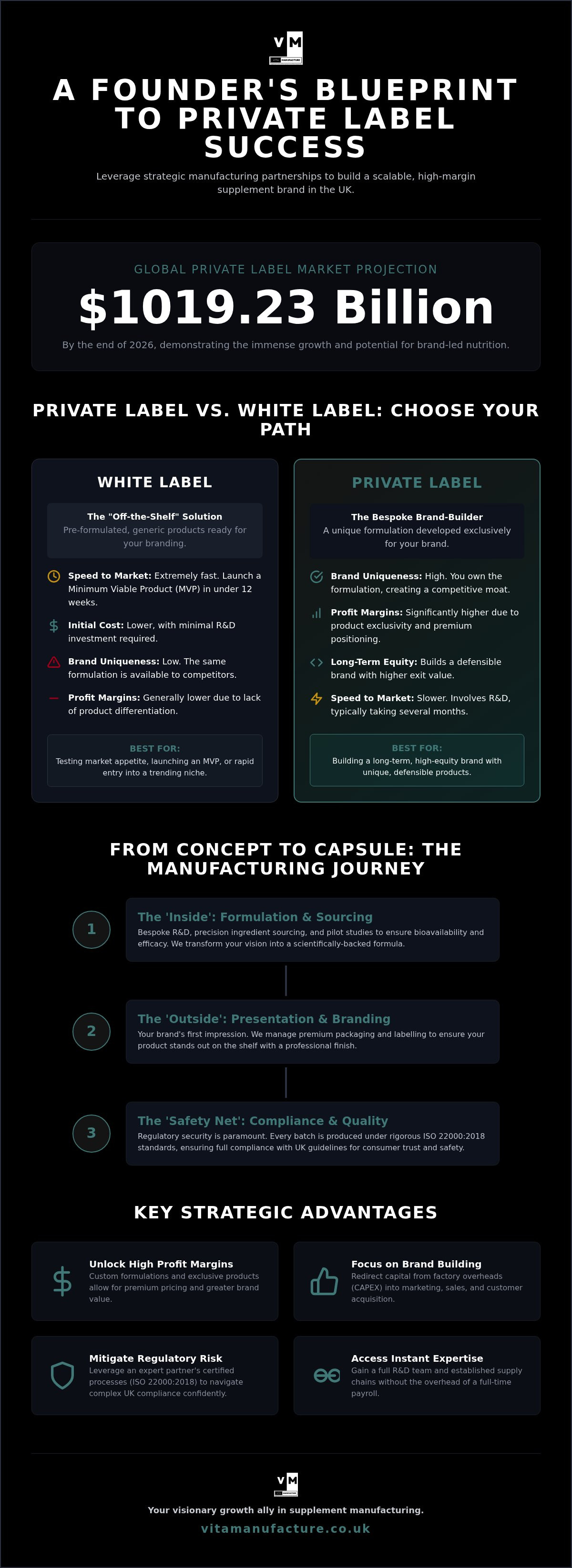
By the end of 2026, the global private label market is projected to reach a staggering $1019.23 billion, proving that private label supplements have become a primary vehicle for rapid market dominance. You likely recognise the immense potential within the wellness sector, yet does the prospect of navigating complex UK regulatory frameworks feel like an insurmountable wall? It's a common frustration for founders who prioritise quality and bioavailability but lack the physical infrastructure to produce at scale.
This guide provides the clarity you need to leverage manufacturing partnerships as a strategic asset for building a high-margin brand with long-term equity. You'll discover how to transition from a conceptual vision to a commercially viable product line without the complexities of managing a factory floor. We'll examine the critical distinctions between stock and custom formulations, the nuances of maintaining ISO 22000:2018 standards, and the roadmap for finding a UK partner that functions as a true visionary growth ally. Whether you're targeting the $18.2 billion personalised nutrition market or established sports health segments, this is your blueprint for a sophisticated, scalable venture.
Table of Contents
What are Private Label Supplements? Defining the Landscape
Your brand identity shouldn't be restricted by your manufacturing capacity. At its core, the model for private label supplements involves a strategic partnership where a professional manufacturer produces high-quality formulations that you market and sell under your own unique brand name. It's the invisible backbone of the modern wellness industry; a system that allows visionary founders to focus on market positioning whilst an expert partner handles the scientific and operational heavy lifting.
The UK market has undergone a significant transformation. We've moved away from generic, off-the-shelf products towards sophisticated, brand-led nutrition. Consumers now demand transparency and efficacy, leading entrepreneurs to seek out a private label model that offers more than just a standard product. It provides a platform for innovation where you own the brand equity, but a specialist contract manufacturer manages the production complexities. With the global private label market projected to reach $1019.23 billion by the end of 2026, this model has become the gold standard for scalable growth.
The Core Components of a Private Label Partnership
A successful partnership isn't just about placing a logo on a bottle. It's a three-tiered ecosystem designed for commercial viability:
The 'Inside' (Formulation): This involves precision ingredient sourcing and bespoke formulation development to ensure your product actually delivers on its promises.
The 'Outside' (Presentation): Your packaging and labelling are the first touchpoints for your customers, requiring a professional finish that reflects a premium brand.
The 'Safety Net' (Compliance): Regulatory security is non-negotiable. A reliable partner ensures every batch meets ISO 22000:2018 standards and adheres to current UK guidelines.
Why Private Labelling is the Engine of Modern Wellness Brands
Why are so many entrepreneurs moving away from in-house manufacturing? The answer lies in scalability and risk mitigation. Building a factory requires enormous capital expenditure (CAPEX) that can stifle a young company's growth. By choosing private label manufacturing, you redirect those funds into marketing and customer acquisition.
Speed to market is another critical factor. When a trend emerges, whether it's high-absorption magnesium or specialised nootropics, you need to move fast. A contract partner provides instant access to professional R&D and established supply chains, allowing you to launch new products in months rather than years. You gain the benefit of a full scientific team without the overhead of a full-time payroll. Don't you want your business to be agile enough to capture these shifts as they happen?
Private Label vs. White Label: Choosing Your Strategic Path
Deciding between white label and private label models is the most critical commercial choice you'll make. Whilst both allow you to enter the wellness sector without owning a factory, they serve vastly different strategic objectives. Recent data highlighting private label market growth suggests that brands are increasingly prioritising customisation to stand out in a crowded marketplace. Are you looking for a rapid entry point or a long-term competitive moat?
White label products are pre-formulated "stock" items. They're ready for your logo and immediate distribution. Conversely, private label supplements are bespoke or modified formulations unique to your brand identity. This distinction dictates your profit margins, your brand's defensibility, and your overall exit value. Many successful founders adopt a hybrid approach; they validate a niche with white label products before investing in custom R&D to solidify their market position.
When to Opt for White Label Supplements
Speed is the primary advantage here. If you've identified a trending ingredient and want to launch a Minimum Viable Product (MVP) in under 12 weeks, white label is your best route. It allows you to test market appetite with minimal financial risk. You can focus your energy entirely on marketing and community building whilst relying on the manufacturer's existing, proven recipes. It's an efficient way to "fail fast" or "win quick" without heavy upfront development costs.
The Power of Bespoke Private Label Formulations
Custom formulations are where true brand equity is built. By developing a proprietary blend, you create a Unique Selling Proposition (USP) that competitors cannot simply replicate by calling the same supplier. This is your "moat." You can optimise dosages for specific consumer needs or enhance bioavailability through advanced delivery systems. In the UK, ensuring these custom products meet ISO 22000:2018 standards is vital for consumer trust and safety.
Building private label supplements from the ground up gives you total control over the "Inside" of your product. It ensures that your scientific claims are backed by your specific recipe, not a generic one shared by dozens of other brands. If you're ready to move beyond stock options, exploring bespoke contract manufacturing can transform your product from a commodity into a strategic asset. Does your current roadmap prioritise this level of brand defensibility?
Strategic Advantages: Why Private Label is the Engine of Brand Equity
Choosing to manufacture private label supplements isn't merely a tactical shift; it's a strategic move to build long-term brand equity. How do you plan to scale when your current production capacity hits its ceiling? A professional contract manufacturing partnership allows you to move from small pilot batches to mass production without the friction of capital-intensive upgrades. This seamless scalability ensures that your growth is never throttled by operational bottlenecks, allowing you to meet surging demand with total confidence.
Beyond volume, a strategic ally provides supply chain resilience that solo entrepreneurs simply cannot match. Professional sourcing of high-quality raw materials protects your brand from market volatility and sudden ingredient shortages. By leveraging a partner's established network and bulk-buying power, you ensure that your capsules contain exactly what the label promises, batch after batch. This consistency isn't just about safety; it's the foundation of consumer loyalty and a bulletproof brand reputation. You aren't just buying a product; you're securing a reliable future for your business.
Leveraging UK Manufacturing Standards for Consumer Trust
The "Made in Britain" label carries a powerful halo effect that resonates with both domestic and international customers. It signals a commitment to rigorous safety protocols and ethical production. Adhering to ISO 22000:2018 standards is the gold standard for food safety and traceability, providing a level of transparency that modern consumers demand. Whilst navigating Food Standards Agency (FSA) requirements can be daunting, your manufacturing partner acts as your regulatory guide, ensuring every batch is compliant. If you intend to expand into international markets, understanding the nuances of FDA compliance for private labelers is equally vital for global commercial success.
Commercial Viability and Profit Margins
Are you overpaying for inefficiency? Analysing the cost-per-unit benefits of contract manufacturing often reveals significant savings compared to small-scale in-house efforts. Professional bottling and packaging lines operate with surgical precision, drastically reducing product waste and the likelihood of costly returns. These operational efficiencies directly impact your bottom line, turning potential losses into profit. Additionally, professional logistics and distribution ensure that your products reach the customer in pristine condition, which is a key driver of customer lifetime value (LTV). When your operations are lean and your quality is high, your profit margins naturally expand, allowing you to reinvest in new product development. Is your current production model actually serving your financial goals?
From Concept to Capsule: Navigating the Manufacturing Journey
The transition from a conceptual vision to a physical product is a journey of precision. It begins with identifying a market gap. Why does this specific product need to exist? Once the "Why" is established, you move into the technical R&D phase. For founders transitioning from stock options to bespoke private label supplements, this is the moment where you define your brand's scientific authority. It's a methodical progression that ensures every capsule delivers on its commercial promise.
Full-scale production only begins once the formula is perfected. This involves rigorous quality testing and bottling within a facility that adheres to ISO 22000:2018 standards. The journey doesn't end at the factory gates; it extends to storage, logistics, and global distribution. A strategic partner provides the end-to-end infrastructure required to manage these moving parts, allowing you to focus on high-level brand growth whilst the operational details are handled with surgical accuracy.
The Critical Role of R&D and Pilot Studies
Don't skip the prototype. Pilot studies are the filter that separates a good idea from a commercially viable product. During this phase, we test for stability and shelf-life to ensure that active ingredients remain potent until the final expiry date. We also evaluate organoleptic properties. Does the powder dissolve without clumping? Does the capsule have a neutral scent? Refining these details before full-scale production protects your brand reputation and reduces the risk of expensive batch failures. If you're ready to begin this process, our new product development services offer the scientific rigour needed to launch with confidence.
Packaging and Labelling: Compliance Meets Creativity
Packaging is where regulatory compliance meets creative brand identity. In the UK, labels must strictly adhere to health claim regulations set by the Food Standards Agency (FSA). You cannot simply claim a product "cures" a condition; your partner must guide you through what is legally permissible whilst maintaining a premium aesthetic. By 2026, sustainable packaging has moved from a "nice-to-have" to a consumer requirement. Whether you choose recycled glass or compostable pouches, your format should reflect your target demographic's values. Consider these factors early:
Compliance: Accuracy in ingredient lists and authorised health claims.
Format: Choosing between capsules, powders, or liquids based on consumer convenience.
Sustainability: Reducing the environmental footprint to appeal to the conscious 2026 consumer.
Selecting Your Partner: Why Vita Manufacture is the Strategic Choice
Choosing a partner for your private label supplements is a decision that extends far beyond the production line. You aren't just looking for a vendor; you're seeking a strategic ally who understands the high stakes of market entry. Does your current choice offer the scientific depth required to sustain long-term growth? At Vita Manufacture, we position ourselves as visionary partners who think like business owners, prioritising your commercial outcomes as much as the technicalities of production. Whilst many manufacturers focus solely on the physical product, we prioritise the long-term viability of your brand.
Our competitive edge lies in a fusion of scientific rigour and operational transparency. We hold ISO 22000:2018 certification, which serves as the definitive benchmark for food safety and quality management in the UK. Unlike generic providers, we offer a transparent customer portal that provides real-time visibility into your supply chain. This level of insight allows you to manage your inventory and launch timelines with precision. We facilitate international growth from our UK base, ensuring your brand carries the prestige of British manufacturing standards wherever you choose to sell.
Comprehensive End-to-End Support
We provide a seamless transition from initial concept to global distribution. By offering a single point of contact for R&D, contract manufacturing, and logistics, we eliminate the friction of managing multiple vendors. Our team provides the regulatory guidance necessary to keep your brand compliant with shifting UK laws, ensuring your labels and formulations are secure. This end-to-end support is designed to be scalable, supporting both ambitious startups and established market leaders looking to refine their product portfolios with bespoke solutions.
Your Next Steps to Launch
Before you begin production, it's vital to have a clear brand vision. What specific problem does your supplement solve? How will it stand out amongst the projected $18.2 billion personalised nutrition market? Preparing for your first consultation involves gathering your market research and defining your target demographic's needs. When you have this foundation, we can help you build the "Inside" and "Outside" of your product with surgical accuracy. Are you ready to scale? Consult with our strategic manufacturing team today to turn your vision into a commercially viable reality.
Ready to Build Your Wellness Legacy?
Building a high-margin brand requires more than just a vision; it demands a foundation of scientific rigour and operational excellence. Bespoke formulations for private label supplements offer a superior path to brand equity by providing a unique selling proposition that generic stock options simply can't match. By prioritising ISO 22000:2018 certification and leveraging end-to-end R&D and logistics support, you ensure your products meet the highest UK safety standards whilst maintaining total commercial agility.
Success in the wellness industry isn't just about the first batch; it's about the ability to scale with a partner who provides total transparency through a dedicated customer supply chain portal. Are you prepared to transition from a conceptual idea to a market-leading product line? The roadmap to growth is clear, and the infrastructure for your success is already in place. Now is the time to secure your position in this expanding market.
Partner with Vita Manufacture for your next supplement launch and turn your strategic vision into a tangible commercial asset.
Frequently Asked Questions
What is the difference between private label and white label supplements?
White label involves selling pre-formulated stock products under your brand, whereas private label supplements are bespoke formulations unique to your business. White label is often the fastest route for market entry, but private label builds significant brand equity and defensibility. Choosing a private label model allows you to control the exact ingredients, dosages, and bioavailability, ensuring your product stands out in a competitive market rather than being a generic copy of others.
How much does it cost to start a private label supplement brand in the UK?
Start-up costs vary significantly based on the complexity of your formulation and the scale of your initial production run. You should budget for research and development, initial manufacturing batches, and professional packaging design. Whilst we don't provide fixed pricing without a consultation, remember that choosing a contract manufacturer reduces capital expenditure by removing the need for factory infrastructure. Your investment is redirected towards creating a high-margin, scalable asset with long-term commercial viability.
Do I need a license to sell private label supplements?
You don't typically need a specific supplement license to sell in the UK, but you must register as a Food Business Operator (FBO) with your local authority. It's your responsibility to ensure that all products comply with Food Standards Agency (FSA) regulations and the UK Nutrition and Health Claims Register. Working with an ISO 22000:2018 certified partner provides the regulatory security and peace of mind you need to operate safely and professionally within the law.
What are the minimum order quantities (MOQs) for custom formulations?
Minimum order quantities for bespoke private label supplements are determined by the specific ingredients and the complexity of the production process. Custom formulations generally require higher MOQs than stock white label options because of the unique setup required for your proprietary blend. These quantities ensure that the production run remains commercially viable whilst maintaining the high standards of scientific rigour and quality assurance our facility provides for every visionary partner we support.
How long does the private label manufacturing process take from start to finish?
The timeline from initial concept to a finished product typically spans several months, depending on the depth of R&D required. This journey includes formulation development, stability testing, and pilot studies to ensure commercial viability. Once the prototype is approved, full-scale production and quality testing follow. A methodical approach ensures that your brand enters the market with a stable, safe, and effective product that meets all UK regulatory requirements and exceeds consumer expectations.
Can I provide my own ingredients for the manufacturing process?
We prefer to manage ingredient sourcing directly to maintain the integrity of our ISO 22000:2018 certification and ensure total supply chain traceability. Our professional sourcing network provides access to high-quality, verified raw materials that meet strict safety standards. If you have a specific proprietary ingredient, we can evaluate its documentation and safety profile during the R&D phase to determine if it can be safely integrated into your unique custom formulation whilst maintaining quality.
Is private label supplement manufacturing better than making them myself?
Manufacturing supplements in-house requires immense capital investment in cleanrooms, specialised machinery, and scientific staff. Outsourcing to a professional contract manufacturer allows you to leverage existing certifications and technical expertise without the operational burden. This model is significantly more scalable; it enables you to focus on strategic brand building and market growth whilst your partner handles the complexities of production, quality control, and global logistics. It's the most efficient way to build a premium brand.
How do I ensure my private label supplements are compliant with UK regulations?
Compliance is achieved through a combination of rigorous formulation review and accurate labelling. Your products must adhere to FSA guidelines regarding ingredient safety and the UK Register of Nutrition and Health Claims. A strategic manufacturing partner provides the necessary regulatory guidance to navigate these complex frameworks. This includes ensuring your labels are legally compliant and that your manufacturing process meets international standards for food safety and traceability, which is essential for building long-term consumer trust.